Flooding of the City of Rushing Water
MulanThe flooding of the City of Rushing Water is both a public crisis and the leverage for a staged sacrifice. The city’s dark, turbulent river and its fearful residents make the threat feel immediate, but the Hag and the Magistrate use that fear to present Mulan as the River King’s destined bride. The crisis thus turns on a distinction between danger and explanation: the waters are alarming, while the supposed divine demand is a claim used to direct the city’s desperation against a young traveler.
The City and Its Flooding
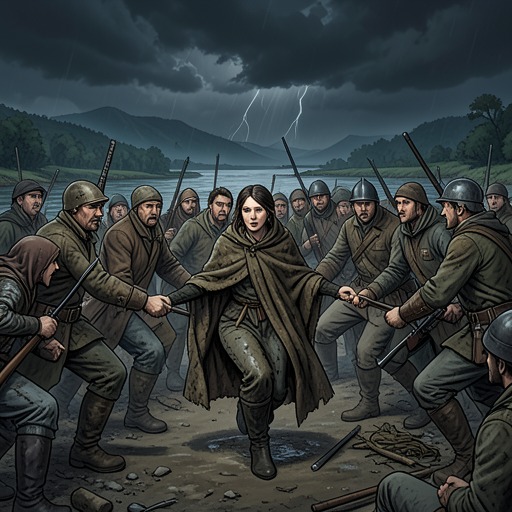
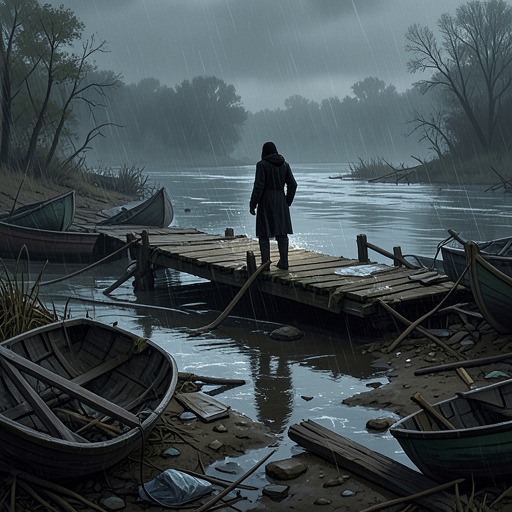
When Mulan is marched through the city, the streets are unkempt and the buildings ramshackle, with tattered paper windows and rotting wooden beams. The procession leads toward the river, where a larger crowd has gathered. At the landing, dark, turbid water strikes an ancient dock; its waves seem almost punitive, while the crumbling platform and the hunched, twisted form of The Odd-Shaped Rock give the gathering a stark, exposed setting. The flooding is not merely distant news: it is the crisis around which the crowd’s fear and the proposed sacrifice have been organized.
The Hag makes the danger concrete by invoking continuing floods, hungry children, homes collapsing during sleep, and a futureless city. Her appeal binds the river’s behavior to the residents’ daily security. The crowd responds with an angry, repeated refusal to accept those conditions, and its discontent grows into a surge toward Mulan. The scene shows how collective hardship can be redirected: rather than question the proposed remedy, the townspeople are urged to make one young stranger pay for relief.
The Bride Claim and the City’s Officials
The Hag identifies Mulan as the River King’s bride and insists that she must join him beneath the river. The Magistrate lends official authority to the claim. He explains that the River King lost his mate, has remained unhappy, and wants a new wife; because the Hag says the destined bride would arrive on a black horse, Mulan’s arrival on Black Wind is treated as proof. The reasoning turns coincidence into a sentence: a detail of Mulan’s journey is made to stand in for evidence that she has been chosen.
The Magistrate’s polished public manner contrasts with the city’s distressed surroundings and the Hag’s menacing appearance. He describes the sacrifice as an honor, although Mulan rejects the premise and points out that she is no one’s bride. The crowd’s presence makes that official performance consequential: the Magistrate speaks before people whose fear has already been stirred, while Mulan has been brought there without explanation and is given little chance to defend herself.
Lu Ting-Pin exposes the interests and contradictions beneath the story. He asks whether the Hag actually spoke with the River King, and she claims that the king told her he would keep flooding the river unless he received a wife. Lu Ting-Pin then accuses the Magistrate of taking bribes from fearful parents and suggests that, once he could extract no more money, the Hag supplied a supposed bride of destiny. The Magistrate’s startled, guilty reaction lends force to the accusation, while grumbling begins among the spectators. The account of the crisis is therefore challenged not by denying the crowd’s fear, but by questioning who has profited from it and who has defined its cause.
Mulan at the Riverbank
Mulan’s arrival converts the alleged prophecy into immediate peril. She is escorted through the streets by silent people and a stone-faced soldier, past residents who watch her without intervening. One voice recognizes that she is only a young girl; another warns the speaker not to invite the authorities to take their own daughter instead. The exchange reveals a population that can see the injustice of the choice yet fears becoming its next target.
At the landing, Mulan is confronted by the Hag and the Magistrate before a crowd, with the river directly behind them. She pleads that throwing her into it would kill her. The Hag answers by returning attention to the city’s suffering, and the crowd’s resentment turns into a physical rush toward Mulan. Just before she can scream, the Jade Rabbit rubs his head against her shoulder. The moment interrupts the scene at its point of greatest danger; the account establishes the mob’s movement and Mulan’s exposure, rather than describing the flooding’s eventual end.
What the Crisis Reveals
The episode makes the flood a test of how authority operates under pressure. The Magistrate supplies an official-sounding account, the Hag presents herself as the interpreter of the River King’s wishes, and the crowd is encouraged to accept a human offering as the price of safety. Lu Ting-Pin’s questions expose that this explanation is vulnerable: the Hag’s claimed conversation with the River King and the black-horse prediction are assertions, not independently demonstrated facts, while the accusation of bribery gives the Magistrate a material interest in keeping fear alive.
The riverbank also sharpens a recurring concern in Mulan’s journey: vulnerable people can be made to carry the cost of other people’s fear and decisions. Here that cost is framed as marriage and death, imposed on a girl who has only just arrived in the city. The crisis’s force lies in the gap between the real danger of flooding and the unverified sacrifice offered as its solution. By placing Mulan before the river, the officials, and the crowd at once, the episode turns an environmental emergency into a public contest over evidence, responsibility, and whose life the city is willing to spend.