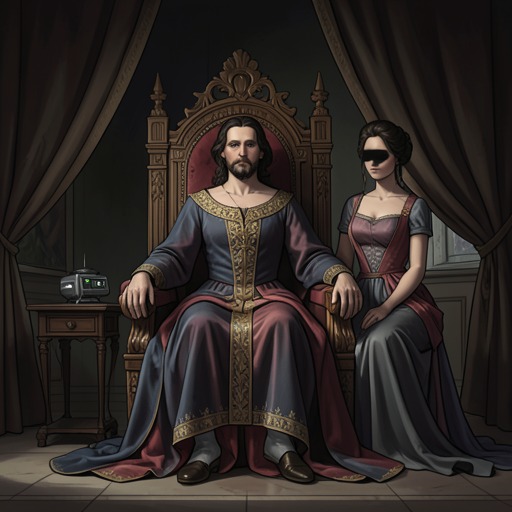
Tyranny of the Zhou Dynasty under Daji’s Influence
MulanTyranny under Daji is presented as a political catastrophe made possible by Emperor Zhou’s devotion to her: the ruler grants her wishes without restraint, and the costs fall on the kingdom and its people. Her extravagant demands weaken the realm, while her pursuit of increasingly cruel entertainments turns imperial power toward pointless suffering. The resulting revolt ends Emperor Zhou’s reign, but not Daji’s escape; the White Fox survives to remain a force beyond the fallen court.
Daji and the Emperor’s Favor
The account identifies Daji as the White Fox in one of her favored forms: a beautiful woman whose charm has grown more effective over centuries. Emperor Zhou, the last emperor of the previous dynasty, is described as unable to resist her. On seeing her, he makes her his royal companion and lavishes gifts on her, sparing no expense to satisfy her wishes. The arrangement gives Daji extraordinary influence over the court without making her the formal ruler. The emperor’s willingness to indulge her is the channel through which her private whims become public burdens.
The details of that favor establish a pattern of waste. The fastest horses are driven to exhaustion every week to bring fresh fruit from the southern part of the kingdom. Charcoal for the heaters is broken up and mixed with costly honey to alter its smell for Daji. Because she likes the sound of silk tearing, rooms are filled with fine, handwrought silk for her to rip. These demands are not presented as necessary provisions of court life: they convert labor, transport, and valuable goods into disposable comforts, arranged solely around her preferences.
Extravagance at Public Expense
The scale expands from courtly excess to the forced labor of the wider population. Peasants from four hundred villages are enslaved to build Daji a palace adorned with jewels and jade, together with a lavish garden and a lake dug to hold wine. Roasted meat is hung from branches along the lake so she can take it while passing by on a three-story boat made of gold and marble. Each image enlarges the distance between the pleasures of the palace and the people made to supply them.
Even the fall of a leaf becomes an imperial expense. When one lands in front of Daji, she insists that it, and any other fallen leaves, be replaced with leaves made of silk. The episode makes her demands seem both arbitrary and inexhaustible: the natural world itself must be remade to fit her taste. The kingdom is quickly bankrupted. The narrative thus links personal indulgence to material consequences, showing how the emperor’s unbounded compliance turns extravagance into a crisis of governance.
Cruelty and War as Entertainment
The account distinguishes Daji’s cruelty from her excess, presenting both as causes of the regime’s downfall. Once the pleasures of boating on wine and eating delicacies bore her, she sought new diversions. Believing that a true sage would have seven holes in his heart, she ordered the kingdom’s wisest men killed so she could examine their hearts. After seeing an ant accidentally cooked in a frying pan, she had Emperor Zhou devise a comparable execution for his enemies and took pleasure in their torture. The episodes show imperial authority answering curiosity and amusement with lethal violence.
Her desire to watch a real war brings that violence to its largest scale. Daji asks for a battle involving hundreds of thousands of soldiers, and Emperor Zhou declares war on a neighboring kingdom to satisfy her. When she arrives after the fighting has begun, he stops the combat and orders a road built to a cliff ledge so she can watch from a comfortable vantage point. Only after she is seated in a rosewood chair, fanned by a handmaid and supplied with fruit, does he allow the fighting to resume. Daji watches the carnage with delight; when it ceases to interest her, she wants to return home. Though his troops are winning, Emperor Zhou halts them in mid-battle and retreats.
The pause and retreat reveal the regime’s inversion of political purpose. The army’s actions serve neither victory nor protection of the kingdom, but the changing attention of a spectator. The deaths of so many soldiers are described as meaningless, and their waste becomes a public grievance. A few days later, when Daji demands another battle, larger and bloodier, the accumulated outrage turns into open revolt.
Revolt, Downfall, and Escape
A new emperor is declared, and troops from across the regions rally to attack their own capital rather than march to another war. Commoners who have suffered under the regime gather at the city gates to join them. As the palace is stormed, the Imperial Guard turns to fight beside the rebels and discovers there is no opposition. The uprising is therefore more than a change among rulers: soldiers and commoners converge against a reign they regard as defined by bloodshed and extravagance.
Trapped and without supporters, Emperor Zhou is easily killed by the new emperor’s son. Daji appears to hang herself with the help of her handmaid, but the account immediately overturns that apparent ending. When her body is retrieved the next day for burial, it is a stalk of bamboo. The White Fox has escaped, leaving behind, as before, a trail of blood and destruction. The regime falls, but the source of its corruption is not captured or brought to account.
Meaning and Aftermath
Mulan recognizes Emperor Zhou as the ruler whose reign her father helped end, but learns from the Jade Rabbit that the White Fox had driven his wickedness. The Jade Rabbit complicates that explanation: Emperor Zhou was more foolish than wicked, though not especially good, and his worshipful devotion to Daji helps explain why she now seeks revenge. The tyranny is consequently neither reduced to a single ruler’s character nor detached from his choices. Daji exploits his devotion, but he repeatedly chooses to make the kingdom, its soldiers, and its people answer her desires.
The contrast between the court’s waste and the suffering it produces gives the episode its political force. Fresh fruit, silk, wine, and a golden boat are not merely signs of wealth; they are privileges maintained through exhausted horses, coerced labor, depleted resources, and the deaths of soldiers. The rebellion exposes the limit of an emperor’s power when his rule has alienated both the army and the common people. Yet the bamboo in place of Daji’s body leaves the conclusion unsettled: the court has been overthrown, while the White Fox’s capacity to evade the consequences remains intact.