Lu Ting-Pin's penance
MulanLu Ting-Pin’s penance is a ten-thousand-demon sentence imposed by the Eight Immortals after his forbidden marriage to Yellow Peony and his attempt to conceal her from the world. It strips him of powers and imposes a moral boundary against interfering in Yellow Peony’s life; its completion ultimately depends on what his transformed sword accomplishes, not on Lu Ting-Pin personally delivering every blow.
Sentence and Its Terms
The penance requires Lu Ting-Pin to destroy ten thousand demons. When he explains its terms to Mulan, he has already killed nine thousand nine hundred ninety-nine, leaving one remaining. The number makes the punishment measurable, but its final condition concerns the sword: when it has destroyed ten thousand demons, the penance is complete. Lu Ting-Pin initially expects to finish the count himself, and identifies the White Fox as the demon he wants for the final one.
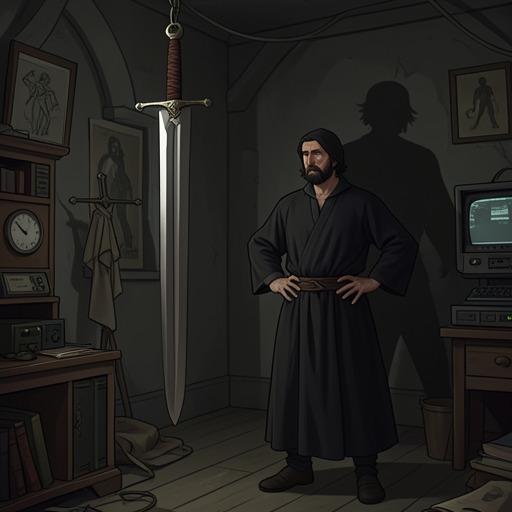
The sentence also changes what Lu Ting-Pin can do. The Eight Immortals take away his fly whisk, limiting his ability to travel great distances by flight, and transform his two-edged sword into a weapon made of peach wood. The restrictions are practical as well as punitive: during the crossing at Kunlun, he explains that he cannot fly while carrying mortal weight. Mulan has to act without waiting for him to solve the danger through flight. His punishment therefore remains present in the adventure as a limit on the help he can offer, rather than merely a past judgment recounted in conversation.
Lu Ting-Pin’s punishment reaches into ordinary moments, too. While sharing tea from Lu Ting-Pin’s Gourd with Mulan and the Jade Rabbit, he explains that his gourds are not yet allowed to make wine because of the sentence. The detail sets a light exchange against the more serious restrictions on his powers and conduct. Even a familiar possession is subject to the consequences of his judgment.
The Marriage That Prompted It
Lu Ting-Pin traces the sentence to his love for Yellow Peony, a mortal woman. He describes being captivated by her, then admits that he knew their relationship violated the Eight Immortals’ moral code. They married in secret, and he used his powers to hide their relationship. As the lies he told to explain his absences became less credible, the other Immortals grew suspicious.
The lake Lu Ting-Pin created around the home he shared with Yellow Peony exposed his attempt to keep their life hidden. Its jade-green water and orange fish were not simply decoration: he had made the lake to prevent others from reaching the house, imagining that he could keep Yellow Peony apart from the rest of the world. The unusual body of water drew the attention of the other Immortals. When they investigated during one of his absences, his deception was revealed.
The Eight Immortals’ judgment is both a loss of power and a prohibition on further interference. They use their talismans to hold Lu Ting-Pin helplessly in the air and extract many of his powers before naming the penance. He is forbidden to see Yellow Peony or intervene in her life again. Lu Ting-Pin later recognizes the reason for that boundary: he had treated her as though she were a possession to hide, rather than a person with thoughts and a destiny of her own. His account presents the sentence as punishment for the harm caused by his selfish conduct, not only as a penalty for breaking an immortal rule.
The Cost to Yellow Peony’s Family
The consequences of the marriage continue after the Immortals dissolve it. Yellow Peony has a daughter with Lu Ting-Pin, and the scandal brings disgrace. The Immortals arrange for Yellow Peony to move to another town and establish a different identity; after the marriage is ended, she remarries and begins another family. Lu Ting-Pin learns only gradually what happened, because the ban prevents him from returning to her life.
Yellow Peony cannot bear the sight of her eldest daughter, who reminds her of the relationship, its shame, and the dishonor it brought. The daughter bears the anger and resentment that Lu Ting-Pin says should have been directed at him. This account complicates his desire to rescue his daughter from the White Fox: the present danger gives him a purpose for completing the sentence, but his own history shows how attempts to control another person’s life can injure the very people they are meant to protect. His regret is tied not only to the loss of Yellow Peony, but also to the consequences borne by their child.
Peach Wood, the White Fox, and Completion
The peach-wood sword makes the terms of the sentence visible. When Mulan notices that the sword is wood rather than metal, Lu Ting-Pin specifies that it is peach wood, which can kill noxious beasts and demons. Its material is not an incidental alteration: the Eight Immortals changed his weapon so that killing demons would form part of his penance. The sword’s purpose thus joins the punishment’s two central features—its fixed tally and the restriction placed on Lu Ting-Pin’s former powers.
Lu Ting-Pin wants the White Fox to be the final demon because he believes her death will free his daughter, whom the White Fox controls as a servant. Mulan raises the claim that no man can kill the White Fox. Lu Ting-Pin rejects the claim as an assumption based on what has not yet happened, not a proven impossibility. His proposed final act therefore carries two linked stakes: completing his penance and ending his daughter’s servitude. The pursuit of that end is also shaped by the sentence’s earlier command that he not interfere in the daughter’s mortal life, a restriction he has to reconcile with his wish to free her.
The sentence ends in an unexpected way. After the Jade Rabbit recovers his strength, Lu Ting-Pin’s appearance brightens and his sword, which he has been cleaning, gleams as metal rather than wood. The Jade Rabbit asks whether the required count has been fulfilled. Lu Ting-Pin answers that the wording required the sword to kill ten thousand demons but did not specify that he had to wield it. The completion therefore releases him despite his not personally making the sword’s final tally. The reversal preserves the sentence’s stated condition while overturning Lu Ting-Pin’s assumption about how it must be fulfilled.
Significance
The penance links a supernatural rule to the consequences of intimate choices. Lu Ting-Pin’s secret marriage leads not only to the removal of powers and the altered sword, but also to a lasting separation from Yellow Peony and a daughter who suffers from the shame of their relationship. His later account acknowledges that the prohibition against interference was meant to prevent him from repeating his possessive treatment of Yellow Peony. The punishment consequently measures more than a count of demons: its history exposes the human cost behind the offense.
Its conclusion also changes the meaning of atonement. Lu Ting-Pin expects completion to depend on his own last act, but the condition is fulfilled through the sword’s tally rather than his direct agency. The distinction leaves the sentence intact while allowing its end to arrive through an unforeseen interpretation of its terms. What began as a restriction on Lu Ting-Pin’s power concludes with his release from the punishment, without erasing the harm that first made the penance necessary.