Mulan Is Captured After Reaching the City of Rushing Water
MulanMulan’s arrival at the City of Rushing Water turns a journey toward a hoped-for meeting with Lu Ting-Pin into a sudden, unexplained arrest. The city’s battered entrance and the hostile crowd gathered there transform the threshold from a welcome into a trap: Mulan rides through the gate, but loses control of her horse, her movement, and the purpose of her visit almost at once.
A City in Ruin
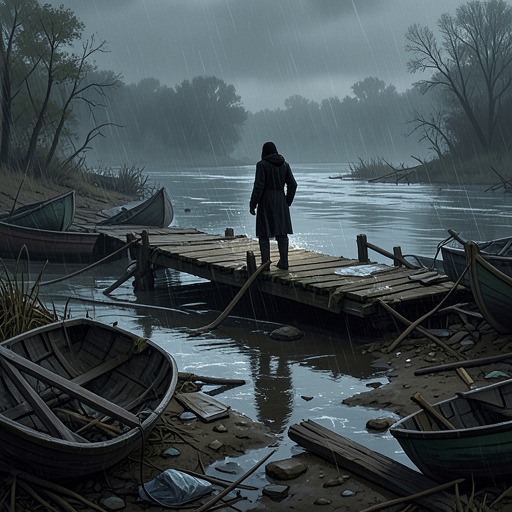
The approach has already unsettled Mulan’s expectations. She had pictured the City of Rushing Water as a grand place of tiled roofs and carved wooden windows, fitting for a city where she expected to meet Lu Ting-Pin, once one of the Eight Immortals. Instead, the Rabbit has told her that floods ruined most of the homes, that those able to leave did so, and that the remaining area is poor and offers few prospects. The contrast between the imagined city and its diminished circumstances shapes the arrival before Mulan even sees the crowd.
What comes into view is first the wall: long, grey, and stained by age and weather. Worn pillars flank the way, and the road is paved with broken bricks that recall the city’s former prosperity. The gate still rises above the wall, with two curved, upward-reaching roofs and a large arch echoed by a smaller opening above it, apparently a sentry lookout. But the lookout is empty. The architecture retains the form of a defended, once-grand entrance while offering no visible sign of ordinary civic welcome or protection.
The Crowd at the Gate
Black Wind carries Mulan along the broken road, his hooves sounding unevenly against the bricks. Through the archway she sees a huge crowd assembled inside the entrance, watching her approach. She slows the horse and whispers to the Rabbit that they seem to be waiting for them. He agrees, but cannot explain what is happening. Instead, he warns that Mulan will not be helped if she is seen talking to him, then ducks back into her pouch.
Mulan calls to him again, but he does not answer. As Black Wind continues toward the gate, the silence leaves her to face the crowd alone. Hundreds of eyes follow her; nobody waves, beckons, smiles, or nods. Their grim stillness makes the passage into the city feel less like arrival than exposure. Mulan’s heartbeat seems to keep time with Black Wind’s steps as the distance to the gate closes, an inward measure of mounting apprehension set against the crowd’s unmoving watch.
Seizure and Separation
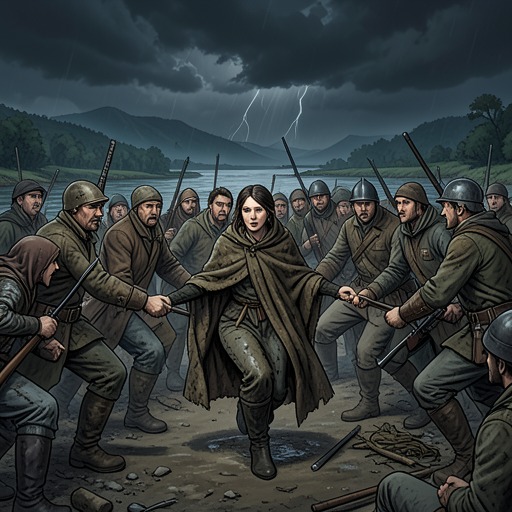
Near the entrance, Mulan tries to meet the watchers with a friendly greeting. Once she passes through the gate, however, they surround her, their low grumbling undercutting the welcome she attempted to offer. Bamboo spearpoints are aimed at her, and she tries to keep clear of their sharp ends. A man in leather armor, who appears to be a soldier or official, grips her arm and tells her she is coming with him.
Mulan protests but agrees to go when the spears wave around her and the man tightens his grip. She slides off Black Wind and is swept up by the crowd. In the confusion, the people wrench the reins from her hands. She calls out for her horse and reaches back toward him, but the crowd ignores her and pushes her onward. The forced separation from Black Wind makes the capture tangible: she is not merely being questioned at the gate but physically removed from the familiar companion who brought her there.
As she is carried forward helplessly, Mulan catches fragments of the crowd’s muttering: they identify her and say that events are unfolding as a woman had said they would. The words indicate that her arrival was anticipated, but the speaker’s identity and the reason for the expectation remain undisclosed in this scene. When Mulan asks what the people want and where they are taking her, the immediate outcome is still unresolved.
The Turning Point
The capture reverses the apparent purpose of Mulan’s arrival. She has come to the city in expectation of meeting Lu Ting-Pin, but the crowd’s response prevents her from approaching that meeting on her own terms. The Rabbit’s decision to hide is understandable as a precaution against being seen, yet it also leaves Mulan without his visible presence or help at the moment the threat becomes immediate. Her attempt at a light, civil greeting meets armed coercion instead.
The scene’s threat comes from coordinated attention rather than an individual challenge: the crowd is already gathered, watches without greeting her, surrounds her as soon as she passes the gate, and participates in separating her from Black Wind. The remark that someone predicted this arrival adds a further uncertainty without identifying who arranged or anticipated it. The episode therefore ends not with an explanation of the crowd’s purpose, but with Mulan in its hands and asking where she is being taken.