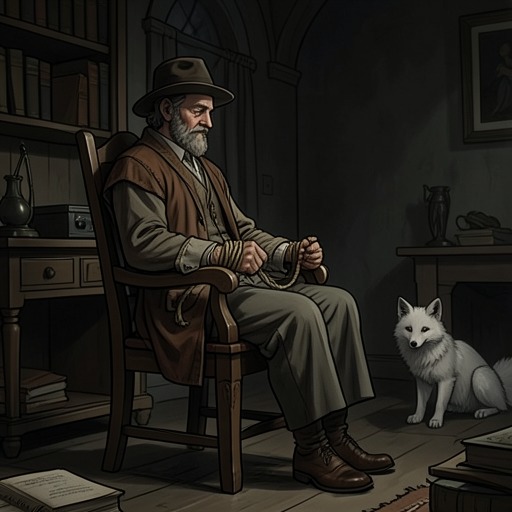
The White Fox Tricks the Scholar and Turns Him to Stone
MulanThe White Fox’s deception of the Scholar turns an attempted seduction into a years-long imprisonment of memory and labor, ending when he identifies her disguise and is petrified for resisting her. Told as part of the Jade Rabbit’s account to Mulan, the episode makes the Fox’s menace intimate: she does not simply overpower her target, but reshapes the familiar bonds of marriage and home until the victim can no longer tell enchantment from ordinary life.
The Scholar and the Oracle Bone
The episode begins on a verdant island, where the White Fox appears as a richly dressed noblewoman and the Red Fox serves as her maid. The White Fox singles out a young man disembarking from a ship. His plain robes mark him as a poor scholar, but she presents him as the one person with the learning needed for her task. She asks him to transcribe and translate an ancient bone, then has the Red Fox open a small gold casket covered with jewels. Inside lies a blackened oracle bone, an arresting contrast between the precious container and the crumbling object it protects.
The Scholar recognizes the bone’s importance and peers at it, but does not accept the offer. His ship has gone astray and is stopping only to resupply; he has already been away longer than intended, and he promised to return to his wife. He bows and leaves. The White Fox lets him go with apparent composure, remarking that another approach will be more entertaining. The scene establishes the central imbalance: the Scholar thinks he is declining a noblewoman’s request, while the Fox treats his refusal as a change in tactics rather than an end to her pursuit.
An Enchantment Made Familiar
At a teahouse overlooking the island’s green hills and the sea, the Scholar thinks about his wife while waiting for the ship. When a woman refilling his teapot seems to be Suhling, he is so startled that he knocks over the tea tray; the porcelain breaks, but he scarcely notices. He follows her out of the teahouse, along the path and toward the rocky coastline. Her white-robed figure remains visible until she disappears behind a crag. He finds an opening in the rock and peers into the darkness, then feels a sharp pain and loses consciousness.
The scene shifts to the Scholar at home, where Suhling tells him that he has returned. She says his memory has been disappearing ever since he came back from his trip, and he cannot remember coming home. The gap between the apparent reunion and this uncertainty is part of the Fox’s hold over him: he has reached the place he longed for, but cannot retain a clear account of how he got there. Suhling offers him a treat, and he remembers refusing the rich woman’s proposal because he needed to return to his wife. She tells him that the woman gave him the bone to translate at home. The jeweled casket now sits on his desk in their humble house, and the Scholar feels drawn to open it and resume the work.
The deception therefore depends on more than an imitation of Suhling’s appearance. The Fox makes the Scholar’s desire to return home the setting for continued labor, persuading him that the bone belongs in his domestic life and that his wife herself expects him to translate it. His intermittent memory loss leaves him unable to test that version of events against a stable recollection of his journey.
The Discovery and Petrification
As he works, the Scholar translates an incomplete prophecy. It begins with a bud in the Family of Flower and points toward a child who, in the tenth month of the Year of the Rabbit, will cease to be a child and save the Emperor. The wife’s interest sharpens as he explains it. Looking at his own wrinkled fingers and white-streaked beard, the Scholar realizes that he has grown old, cannot remember the year or season, and recalls nothing beyond the desk and the room. Suhling, by contrast, remains young and unchanged.
That contrast breaks the disguise’s hold. The Scholar calls the bone cursed and says it has brought evil spirits into the house; when the woman tries to stop him, he asks why she cares so much about the bone, why she has urged him only to keep working, and why he has aged while she has not. As she falls, a white fox’s tail appears from beneath her robe. The Scholar recognizes that the woman is a fox spirit, rejects her and the bone, then crushes the fragile object in his hand and throws its dust at her.
His act of defiance does not free him. The White Fox snarls, and as the Scholar steps through the doorway, his feet become stone. The hardness rises through his legs and body; his lips turn cold before he can call for help. His last awareness is of the island’s green-blue sea and his longing to see his real wife. The transformation fixes him in the landscape of the island he had believed he left, making his separation from Suhling permanent within the story.
Consequences and Narrative Significance
The Jade Rabbit explains that the Scholar’s long exposure to the White Fox’s poison enabled her to punish him with this power after he discovered and thwarted her. The event thus links the Fox’s patient deception to the severity of her retaliation: she has kept him working for years, and when he finally acts against her, the accumulated poison gives her a means to silence him as stone. The Rabbit adds that she has not used this punishment again because she has been occupied pursuing Mulan’s sister.
The Scholar’s fate also gives the bone a double role. It is the object that attracts the Scholar’s learning and binds him to the Fox’s scheme, but it also becomes the focus of his suspicion and the thing he destroys when he finally names the evil in his house. His decision exposes the disguise without undoing its consequences. In the Rabbit’s larger account, the episode is one of several stories of the White Fox’s transformations and cruelty; for Mulan, it is also a grim parallel to the danger of a journey undertaken to save a sibling. The Scholar reaches for the truth too late to recover his former life, and the tale leaves him fixed in stone, still yearning for the wife whose image the Fox had turned against him.