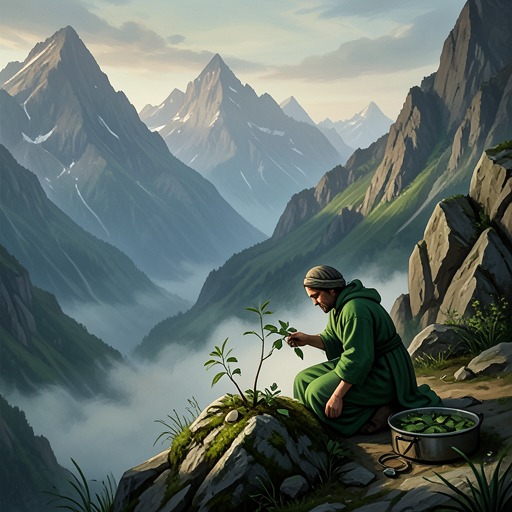
The Old Immortal Dragon’s Departure and the Origin of Dragon Beard Grass
MulanThe Old Dragon’s departure is remembered as both a community’s loss and the origin of Dragon Beard Grass, the growth that gave Green Island its name. In the tale the Jade Rabbit tells Mulan, an Immortal healer leaves an island where he had long served its people; the villagers’ grief and their attempt to keep him there produce the last gift by which his counsel and the island’s peaceful character are preserved.
The Healer the Island Revered
Centuries before the tale is told, the Old Dragon lives on an island, spending his time in the hills gathering herbs and plants and making medicines. The islanders come to him for remedies, help, and advice. Someone from the village visits every day, and his usefulness extends across the ordinary scale of need: the story says that no problem, great or small, seemed beyond his ability to solve.
The people’s name for him grows from this reputation. Though bent with age, he appears wise and powerful to those who seek his aid, and many come to believe that he is a dragon spirit in human form. Even islanders who do not share that belief call him the Old Dragon. The name thus belongs to a whole community’s understanding of him: it reflects the reverence he inspires without making the villagers’ belief an established fact about his identity.
The Announcement and Farewell
One spring day, the Old Dragon tells his visitors that he will leave the island. The news spreads quickly, drawing the islanders together around him. Their questions become pleas: they ask whether he is truly going and beg him not to leave, with many in tears. The change is sharp. The man whose daily presence had made every problem seem answerable now announces that he will no longer be there to help.
He explains that he is needed elsewhere, but gives no further account of where he is going. Instead, he waves his hand, and a shimmering cloud appears at his feet. He steps onto it as the villagers watch in amazement. Before rising, he says that he has enjoyed his time among them and asks them to cherish the island’s spirit of peace. His departure is therefore not only a separation: it includes a final charge to the people who remain, directing their attention from their dependence on him toward something they can continue to protect themselves.
The Beard and the Island’s Grass
As the cloud carries the Old Dragon upward, he leans down to bid the villagers farewell. Their awe gives way to renewed grief, and the most desperate reach toward him in an attempt to keep him from leaving. They can reach only his beard, which hangs over the cloud’s edge. When they pull, its hairs come away easily. The villagers find themselves holding clumps of beard with traces of blood, and release them in alarm.
The detail makes the attempted restraint consequential without reversing the departure: the Old Dragon continues upward and disappears, while the hairs the villagers have pulled loose remain behind. The story then follows those remnants across the island. Carried by the wind, they settle in its rich soil, which the tale connects to the peaceful heart of the island, and take root. Their growth spreads until Dragon Beard Grass carpets the island. What began as the villagers’ desperate effort to prevent a parting becomes the means by which a remnant of the departing Immortal takes lasting form in the place he leaves.
The Rabbit’s Tale and Its Legacy
The Old Dragon’s counsel survives through the grass’s origin. The islanders, though grief-stricken, vow to heed his words and honor the peaceful spirit of their home. The story links that promise to a visible change in the landscape: the beard hairs become the grass, and the island is called Green Island. The name records not simply what grows there but the connection the tale draws between the Immortal’s departure, the people’s response, and their commitment to peace.
The account is itself presented as inherited knowledge. At Lu Ting-Pin’s suggestion, the Jade Rabbit agrees that telling the story will do no harm, and Mulan listens with fascination. She draws out the connection between the grass and the Old Dragon’s beard, and between its red roots and the blood on the hairs; the Jade Rabbit confirms her understanding. Lu Ting-Pin then praises the Jade Rabbit for possessing stories, including ones he does not know he has. The scene frames the tale as knowledge carried and retold, while its ending gives the islanders’ loss a lasting consequence: the Immortal is gone, but the grass and the obligation to cherish the island’s peace remain.