River King's Bride Sacrifice Is Thwarted
MulanThe River King’s bride sacrifice is thwarted when Hua Mulan is selected as the supposed offering to end the flooding of the City of Rushing Water. What begins as a demand backed by a frightened crowd becomes a public unmasking: Lu Ting-Pin challenges the ceremony’s authorities, the townspeople revolt, and the Hag’s flight reveals that she is the White Fox in disguise.
The city’s demand
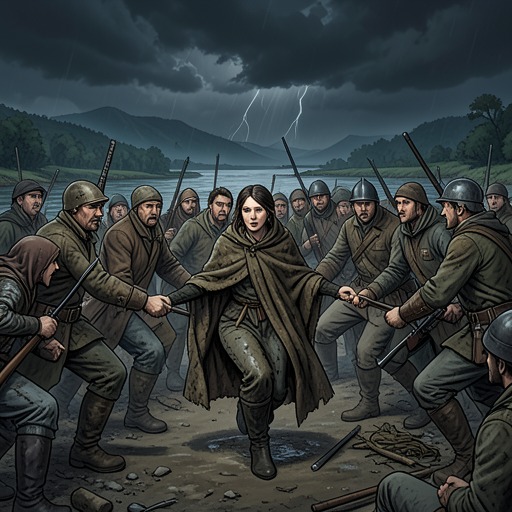
When Mulan is brought before the Magistrate and the Hag, the Magistrate accepts her arrival as confirmation that the River King has found his bride. The Hag makes the alleged terms explicit: unless Mulan joins the River King at the bottom of the river, he will continue flooding the city and angering its waters. Mulan rejects the claim that she belongs to anyone, but the ceremony leaves little room for individual refusal. The proposed marriage is not a union freely chosen; it is a sacrifice imposed on a young stranger in the name of public safety.
The threat gains force from the crowd’s desperation. When the Hag insists that the city must provide a bride, the people surge forward, their fury threatening to overwhelm Mulan. She agrees to go, then immediately makes her agreement conditional: the crowd must promise not to hurt the Jade Rabbit, hidden in the pouch she pulls toward her chest. The gesture sharpens the scene’s stakes. Faced with the prospect of her own death, Mulan still uses her bargaining power to protect her companion.
Lu Ting-Pin challenges the ceremony
The crisis breaks when a man arrives leading Black Wind and identifies himself as Lu Ting-Pin. His presence commands the crowd’s attention, but his first intervention is a question about what is happening. The Magistrate describes the gathering as a ceremony meant to placate and honor the River King; Lu rejects that description, recognizing the assembly instead as an angry mob. His challenge changes the scene from an apparently settled ritual into a claim that can be examined and contested.
Lu asks whether the Hag actually spoke with the River King. She says that he told her the flooding would not stop without a new wife, and that she reported his demand to the Magistrate. Lu then suggests that the Magistrate has taken bribes from fearful parents and that the Hag was allowed to identify a bride only after the Magistrate could no longer extract more money. The Magistrate’s startled, guilty reaction strengthens the accusation, although the crowd’s growing suspicion—not a formal confession—drives the confrontation onward.
The Hag asserts that the River King specified a woman who would ride into town on a black horse, pointing to Mulan as proof. Lu answers the supposed sign with a practical objection: Mulan is too young to marry. The Hag insists that the timing of the marriage does not matter because the River King wants his betrothed below. Rather than accept either the prophecy or the Hag’s authority, Lu proposes that she go down to the river herself and ask the River King precisely what he wants. The suggestion turns her demand back upon its maker and exposes the risk she has assigned exclusively to someone else.
The crowd reverses course
Lu’s intervention gives voice to doubts already gathering among the townspeople. Someone accuses the Hag of inventing the bride demand to obtain more money; another says that if anyone must go into the river, it should be her. Their accumulated resentment breaks into a rush toward the Hag. She steps back with a cry of anger and jumps into the river, while the Magistrate stares at the place she occupied before fleeing. The mob pursues him, shifting its force away from Mulan and toward the officials who had presented the sacrifice as necessary.
Lu places one arm around Mulan’s shoulders and the other around Black Wind as the crowd streams past them. The tumult carries on around the three without drawing them into its pursuit. Mulan, however, watches the Hag rather than the fleeing Magistrate: she sees a white fox tail protrude from the waves and then transform into a fish’s. No one else witnesses this change. The ceremony is broken, but the transformation supplies a private revelation beyond the public exposure of corruption: the woman who demanded a bride was the White Fox, using the Hag’s appearance and authority to manipulate the city.
Reversal and narrative significance
The episode overturns the roles established at its start. Mulan enters as an outsider whom the Magistrate treats as the answer to the city’s crisis; Lu’s questions make the supposed divine instruction look like a scheme, and the crowd turns from enforcers of the sacrifice into pursuers of its alleged architects. Yet the escape into the river means that the White Fox’s identity is witnessed only by Mulan, leaving the public uproar and the supernatural reveal on different levels of knowledge.
The scene also places Mulan’s willingness to face danger beside her protectiveness toward the Jade Rabbit. Her offer to go is not simple submission: she tries to secure his safety, while Lu’s arrival gives her a way out of the imposed choice. The proposed sacrifice is thus defeated through a combination of Mulan’s concern for her companion, Lu’s scrutiny of the authorities’ story, and the townspeople’s anger at apparent exploitation. The episode exposes the fragility of a ritual founded on fear, without establishing that the flooding itself has ended or that the River King has ceased to pose a threat.