Führer’s special train
MunichThe Führer’s special train is Adolf Hitler’s heavily guarded mobile headquarters and the confined setting of Paul von Hartmann’s journey from Berlin toward Munich. For Hartmann, boarding it is an act of concealment that becomes an immediate danger: he is admitted under an apparently authorised name, only for Sturmbannführer Sauer to discover him aboard as the train begins to leave. Its movement then places the resistance plot inside the very apparatus of command it opposes.
Entry and Departure
Frau Winter tells Hartmann that his name will be on the list at Anhalter Bahnhof and that the train is scheduled to depart at 8:50 that evening. Showing identification at the gate will be sufficient. The arrangement offers him access to a train whose doors and locomotive are guarded by Nazi SS sentries, but it does not make his presence secure: once Hartmann has reached the platform, the train’s scale and ceremonial appearance make clear how closely controlled its passage is.
The train stands about twenty metres down the track, seven spotless dark-green carriages bearing a gold Nazi eagle with outspread wings. Each carriage door has a guard; the black locomotive at the front is guarded too. Hartmann walks toward the rear carriage beneath the station’s floodlit roof spars, then climbs aboard. The detailed approach delays the moment of entry: before he reaches the sleeper compartment, the reader has seen a vehicle presented not as ordinary transport but as a protected extension of the regime.
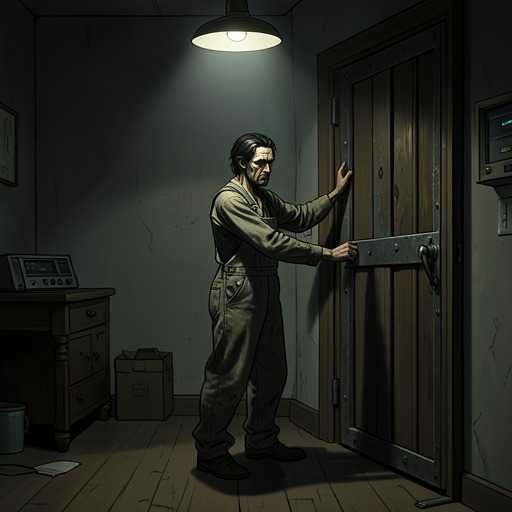
An adjutant directs Hartmann to the final compartment and explains that refreshments will be served in the dining car after the train has left Berlin, when passengers will also be informed about its operations. Hartmann’s berth has two bunks, dim yellowish light, polished wood, dusty upholstery, and stale air. He puts his suitcase on the lower mattress and sits beside it. The compartment feels to him like a cell; with his nerves too strained to devise a fallback plan, he wonders whether Colonel Hans Oster has managed to contact the British.
Adolf Hitler passes within three metres of Hartmann, wearing a belted brown overcoat and surrounded by men in black. Hartmann sees him through the compartment window, then turns to find Sauer at the open door with the adjutant. Sauer questions why Hartmann is there and who authorised his name to be added to the list. Before that challenge can be resolved, the train lurches forward and stops abruptly. It then gathers speed past luggage trolleys, the station sign, and saluting officials, moving out into the marshalling yard. The departure converts Hartmann’s precarious access into a predicament: he is already aboard, and the train is leaving Berlin.
The Journey and Its Interior
The train is unusually heavy and made entirely of welded steel. Through the night it travels south at an average of 55 kilometres per hour, without stopping or even slowing, passing Leipzig, smaller towns and villages, and long stretches of darkness broken by the occasional light of an isolated farmhouse. Hartmann lies sleepless in his underclothes on the upper bunk, looking through a gap in the blind. The uninterrupted passage gives the journey the scale of a crossing: he imagines himself moving across an immeasurable ocean and measures the German landscape against the more bounded English world he had known with Hugh Legat at Oxford.
The sleeper compartment is only one part of the train’s working interior. When Paul Schmidt asks Hartmann to prepare a two-page summary of the overnight English-language press, Hartmann follows him past General Wilhelm Keitel’s table and into another carriage. Desks, typewriters, filing cabinets, and short-wave radio equipment fill the space; German Wehrmacht signals officers sit facing one another with headphones, while the windows are blacked out. Hartmann recognizes that this is not simply a conveyance but a mobile command post. He also infers that the original plan must have been for Adolf Hitler to travel in it to the Czech frontier.
The assignment gives Hartmann practical work amid the tension of the journey. Schmidt leaves him handwritten English transcripts and instructs him to concentrate on headlines and editorial opinion. Hartmann sorts the material according to the influence of the publications and begins writing. The train’s command functions are thus visible not only in its communications equipment but in the work carried out aboard it: information is gathered, condensed, and prepared for the Führer.
Route, Reversal, and Command
After more than twelve hours of relentless movement, the train begins to slow in hilly country about an hour south of Munich. The woodland thins; a river and a picturesque old town appear, with brightly painted houses below a medieval castle and the Alps in the distance. The train passes through the scene at walking pace before stopping at Kufstein. The contrast between the holiday-poster landscape Hartmann remembers from a 1932 journey with Hugh Legat and the train’s ponderous military purpose makes the route carry both present danger and remembered intimacy.
Later, the train’s order is reversed. Adolf Hitler’s saloon car is now at the rear, the sleeper carriages for his entourage at the front, and the communications wagon and dining compartment in the centre. As the train rolls north toward Munich, Hartmann sits with Schmidt, who repeatedly tends a large pipe and watches for instructions from the Führer’s adjutants. Adolf Hitler and Benito Mussolini appear able to understand one another without Schmidt’s interpreting, leaving him anxious and apparently put out. Nearby, Heinrich Himmler presides over a table of Nazi SS officers; Sauer is among them, smiling with the group but repeatedly turning his gaze back toward Hartmann.
Narrative Function
The train gathers together the elements that make Hartmann’s position dangerous: Adolf Hitler’s physical proximity, Sauer’s persistent attention, the guards at every entrance, and the communications staff and equipment that turn the carriages into an operational centre. Its compartments offer temporary privacy, but not freedom from surveillance; its formal procedures admit Hartmann, yet cannot prevent Sauer from questioning his presence. The departure’s sudden lurch is therefore more than a change of location: it closes off the station as a space of possible intervention and carries the uncertainty forward into the journey.
Its movement also structures the passage between different kinds of pressure. At night, Hartmann watches an immense landscape slide past and reflects on national identity; inside, the train’s desks and radios expose the practical organization of power. The later stop at Kufstein briefly frames the journey through familiar scenery, but the changed arrangement of the cars and Sauer’s watchful attention restore the threat. The Führer’s special train is at once transport, command post, and enclosure: it brings Hartmann closer to the people and machinery he is trying to outmaneuver while making escape or concealment increasingly precarious.