Walther pistol
MunichThe Walther pistol is the weapon Paul von Hartmann keeps with him on the journey to Munich and while trying to get a document into British hands. It is never fired in the scenes presented; instead, the pistol’s significance lies in the effort required to conceal and retain it. Hidden in clothing and behind a train toilet’s plumbing, it becomes a recurring physical risk that accompanies Hartmann through searches, surveillance, and the tense wait for an opportunity to act.
Possession and Refusal to Surrender
At the door after an informal inter-departmental meeting, Colonel Hans Oster draws Hartmann aside and asks quietly whether he has a weapon, adding that it should be returned to the Abwehr armoury. Hartmann meets his gaze and refuses. The exchange establishes the pistol as more than an incidental possession: even an ally who knows about it expects it to be surrendered, but Hartmann chooses to keep it. The weapon remains his responsibility as he leaves with Erich Kordt and crosses Wilhelmstrasse towards the German Foreign Ministry.
The refusal is brief, and the evidence gives no explanation of Hartmann’s precise intention in keeping the pistol. Its subsequent handling nevertheless makes the choice consequential. On the train, Hartmann treats the weapon as something that must remain out of sight: while dressing before dawn, he folds his trousers around it and carries it towards the toilet. The pistol is not displayed as a threat or used to force a way forward. Its presence instead complicates an already secret journey, demanding careful concealment while Hartmann also protects the document he is carrying.
Concealment on the Train
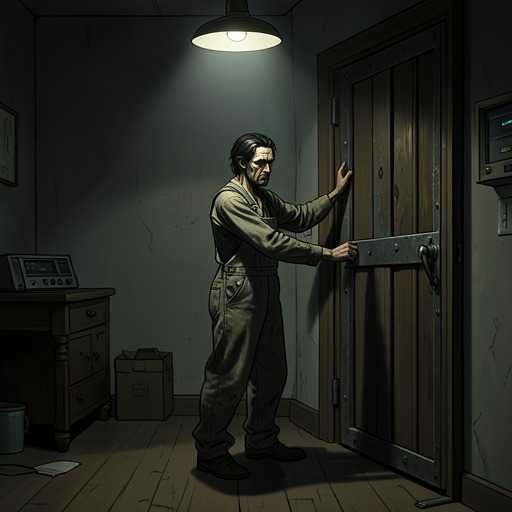
In the train toilet, Hartmann finds a hiding place behind the wooden panel beneath the basin. After shaving, he feels around the panel, pulls it away to expose the plumbing, and wedges the pistol behind the waste pipe before replacing the covering. This improvised hiding place places the weapon among ordinary fittings rather than in a locked case or a secure compartment. The concealment depends on Hartmann’s ability to locate the gap and restore the panel without attracting attention.
That secrecy is tested when Sturmbannführer Sauer searches Hartmann’s compartment. Sauer has emptied the suitcase and apparently checked the jacket, but Hartmann discovers him rummaging through the belongings rather than confronting him with the pistol. The search makes the distinction between possession and control tangible: the weapon may be Hartmann’s, yet he cannot safely keep it in an obvious place while Sauer is watching him. The pistol’s absence from the searched luggage does not end the danger; it leaves Hartmann dependent on the concealed hiding place.
The risk returns as the train approaches Munich. After leaving the dining car amid laughter that he suspects is directed at him, Hartmann goes into another toilet and again reaches beneath the basin. The cubicle is filthy, and someone rattles the locked door while he searches the pipework. He panics before finding the pistol. He then slips the Walther into his inside pocket and flushes the toilet again to cover the sound of replacing the panel. The sequence turns concealment into a narrow, physical task: find the weapon, hide it on his person, and leave without revealing what he has done.
The Weapon During the Munich Mission
Once in Munich, Hartmann continues to carry the pistol while he waits for Hugh Legat and considers how to deliver the envelope to the British delegation. As time passes, he reaches inside his jacket to touch the gun’s metal, warmed by his body, then feels the outline of the envelope beneath his shirt. The two objects are held close but serve different roles in his immediate problem: the envelope must reach British hands before a deal is agreed, while the pistol remains concealed against his body. Hartmann knows he must find a way to make contact without being seen by Sturmbannführer Sauer, whom he suspects of watching him and alerting other SS men.
This recurrence gives the pistol a place in the scene even when Hartmann is not using it. His hand returns to its metal while he weighs the difficulty of approaching the British room in full view of the assembly. The object marks the bodily and practical stakes of his position: he is carrying a weapon, a document, and the knowledge that he is being observed, but the pistol itself does not solve the problem of how to pass the message. His immediate challenge remains one of access and timing, not armed confrontation.
Narrative Function
The pistol’s appearances are organized around concealment and recovery. First Hartmann refuses to surrender it; then he hides it behind the train toilet’s plumbing, faces Sauer’s search, retrieves it under pressure, and later touches it while waiting in Munich. Each recurrence renews the risk of discovery without producing a discharge or an armed encounter. The weapon therefore remains a latent danger rather than an instrument put into action in these scenes.
Its material details sharpen that tension: it is wrapped in trousers, wedged behind a waste pipe, felt for amid plumbing, slipped into an inside pocket, and touched as warmed metal beneath Hartmann’s jacket. These are practical acts of concealment, not public displays of power. The Walther accompanies Hartmann’s mission, but the evidence leaves its ultimate use unresolved. Within the events described, its decisive function is to make the danger of carrying a weapon through searches and guarded political spaces concrete.