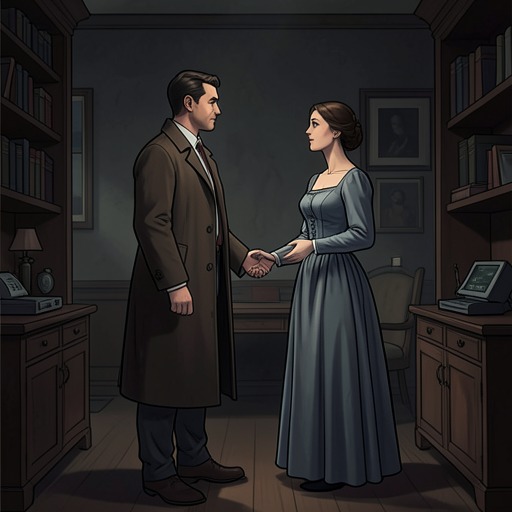
Anny’s “Perfect Moments” Rule
NauseaAnny’s “Perfect Moments” Rule is her attempt to transform an ordinary present into a moment of heightened, deliberate significance by arranging its light, setting, appearance, gestures, and words. Remembered by Antoine Roquentin as part of their former relationship, the rule makes intimacy into a joint performance: Anny composes and directs, while Roquentin is expected to recognize the moment’s potential and help realize it. Its beauty and its burden are inseparable. The scene may promise perfection, but its success depends on a set of demands Roquentin cannot reliably understand or meet.
Definition and Practice
Anny’s pursuit of perfect moments is not simply a wish for pleasant occasions. She expects a moment to be made: its circumstances must be right, and the people within it must act in ways that bring its latent significance into focus. Roquentin recalls that when the time was not convenient, she lost interest in everything. Her eyes became lifeless, and she dragged herself along; at other times, she picked a quarrel with him. The rule therefore sets a high threshold for engagement. Without the right conditions, the ordinary present is not merely disappointing but unusable.
When the conditions seem promising, Anny works to shape them. She watches her surroundings, adjusts her bearing, and tells Roquentin what she wants him to do. Her practice joins atmosphere to action: the colour of the light, the dress she wears, and the position of her face matter alongside where he sits and whether he speaks. A perfect moment is thus neither an accidental burst of feeling nor a private experience she can produce alone. It requires a scene, and it requires participation.
Anny as Director
Roquentin’s recollection gives the rule a distinctive rhythm. He is told it is better not to answer Anny when she is dissatisfied, but to wait. Then, at a signal he can no longer identify, she shudders; her fine, languishing features harden, and she begins what he calls her ant’s work. Humming between her teeth, looking around, and straightening herself with a smile, she seems to give orders to the objects around her before explaining, in a low, rapid voice, what she expects from him. The shift from languor to purposeful activity turns her from a disengaged presence into the organizer of the scene.
In one remembered attempt, Anny points to the sky and the sun’s colour on the carpet, draws attention to her green dress and unmade-up, pale face, and instructs Roquentin to return and sit in the shadow. She insists that he understand what he has to do and urges him to speak. Her directions are concrete, but they also carry an interpretation: she sees how beautiful the moment could be and needs Roquentin to see it too. The arrangement of light, clothing, posture, and speech is her means of making that possible.
The scene shows Anny exercising an imperious, charming authority over both Roquentin and the surrounding objects. She does not merely propose a mood; she assigns actions and tries to bring the setting under its design. Her instructions make the moment feel like a performance with a role for each participant. The rule’s creative force lies in this power to turn a carpet, a patch of shadow, and a change of posture into parts of a composition; its interpersonal force lies in Anny’s expectation that Roquentin will follow her direction.
Roquentin’s Part and the Cost of Failure
Roquentin experiences the enterprise not as a shared improvisation but as a responsibility whose success rests on him. He feels that the moment has an obscure meaning that must be trimmed and perfected, and that certain movements must be made and certain words spoken. Under the weight of this task, he stares without seeing and struggles amid rites that Anny invents on the spot. His failure is not a refusal to take part so much as an inability to grasp and execute the moment’s requirements while it is being made.
The contrast between Anny’s purposeful direction and Roquentin’s bewilderment gives the rule its tension. She can identify a possible beauty and issue instructions, yet the meaning she wants the two of them to realize remains obscure to him. As he struggles, he tears her improvised rites to shreds with his strong arms. The image makes his part in the failure physical as well as interpretive: what Anny constructs through arrangement and instruction, Roquentin disrupts without being able to replace it with a successful performance.
Anny hates him at such times. The reversal is sharp: the rule promises a moment of shared intensity, but the attempt to produce it exposes a division between the director and the person expected to respond. Her anger follows the collapse of the scene, while Roquentin’s account emphasizes the burden and confusion he felt during the effort. The rule is therefore also a measure of incompatibility. Anny’s standards require an attunement that Roquentin does not possess, and his presence can become the obstacle to the very perfection she is trying to create.
The Rule in Their Relationship
The perfect-moment practice belongs to a relationship that had already ended by mutual agreement six years before Roquentin recalls these scenes. The intervening exchange about forms of address makes the distance explicit. When he left for Tokyo, he began his letter with “My Dear Anny.” Anny objected that she had never been, and was not, his dear Anny, just as he was not her dear Antoine; if he did not know what to call her, she said, it was better to call her nothing. The affectionate formula could not restore a shared identity that the relationship had relinquished.
The old scenes nevertheless remain important to Roquentin. He says that he still respects and loves Anny with all his heart, and hopes someone else has had better luck and skill in the game of perfect moments. His description of it as a game preserves both its artistry and its demands: it calls for skill, yet its rules are not presented as reliably learnable or mutually negotiated. The hope that another person might succeed acknowledges that he could not give Anny what the practice required, without claiming that the task itself has become easier.
The remembered instruction that Roquentin’s red hair spoils everything adds a smaller, pointed instance of the same pressure. Anny’s judgment reaches even to a feature he cannot change, making the desired composition depend on more than his willingness to follow directions. Together with her demands for particular words and motions, the remark shows how exacting the imagined scene can become: success is vulnerable not only to action but also to bodily circumstance.
Memory and Significance
Roquentin’s account presents the perfect moments through memory rather than as a rule set out in the abstract. Their meaning emerges in fragments: Anny’s abrupt shudder, her humming and movements, the sun on the carpet, the green dress, the shadow, and the commands that ask him to speak. These details make the practice tangible while also preserving its central uncertainty. Roquentin can recall what Anny directed, yet he admits that the moment’s meaning escaped him and that he no longer remembers the signal that began her work.
The rule’s significance is finally measured against the limits of recollection and attachment. In the same letter episode, Roquentin recalls that Anny’s smile had been the last part of her image he retained; he had lost even that memory three years earlier. Taking her letter from the landlady’s hands briefly brings the smile back to mind, and he tries to recover the tenderness he associates with Anny. But the smile does not return, and he remains dry and empty. The perfect moment was meant to rescue significance from the ordinary instant by giving it form. In the present, Roquentin can still describe its methods and the failure of their shared performance, but he cannot recover the presence that once gave the effort its emotional charge.