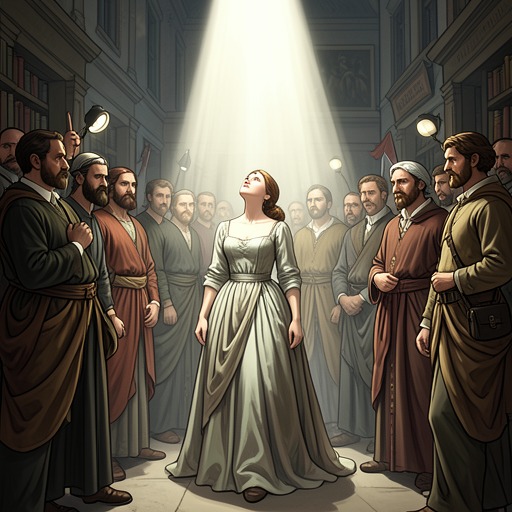
Anny’s doctrine of perfect moments
NauseaAnny’s doctrine of perfect moments is an ethic of turning exceptional situations into episodes shaped by deliberate, appropriate action. It gives a methodical form to her youthful search for grandeur: first a situation seems set apart from ordinary life, then its participants must make it into a perfect moment. Her memories also reveal the cost of that ideal. The dramatic scene, the prescribed role, and even physical discomfort could be subordinated to a moment’s intended meaning; later, however, she no longer believes that love, hate, or death arrive with the transformative force she once assigned them.
Origins in privileged situations
As a child, Anny carried illustrated volumes of Michelet’s histories to the attic and learned their pictures by heart. The illustrations were rare, occupying a page of their own, and their scenes could be separated from the relevant text by many pages. Their scarcity made them seem selected: although other episodes might have greater visual or historical interest, a few events appeared to possess a quality that set them apart.
Her examples include three images for the entire sixteenth century: the death of Henri II, the assassination of the Duke of Guise, and Henri IV’s entry into Paris. The pictures’ awkward drawing did not lessen their grandeur. In the scene of the Duke of Guise’s assassination, spectators’ gestures formed something like a chorus, while small incidental details—pages falling, dogs fleeing, jesters seated on the throne’s steps—belonged to the same strikingly unified composition. For Anny, these pictures suggested that certain events were privileged: rare, precious situations marked by style.
That childhood interpretation extended beyond historical images. Being a king seemed privileged to her at eight, and so did dying. Pictures of people at the point of death, together with accounts of their sublime last words, led her to imagine that death lifted a person above the ordinary self. She believed that even being present in a dying person’s room could communicate some of its grandeur to those nearby.
From situation to perfect moment
Anny’s account distinguishes the privileged situation from the perfect moment made from it. Signs announce what is coming; then the exceptional situation enters people’s lives gradually and majestically. Only afterward comes the choice of whether to turn it into a perfect moment. The situation is material to be worked upon, rather than a finished meaning that simply descends on its participants.
That transformation requires conduct suited to the occasion. Some actions, attitudes, and words are called for; others are prohibited. The people involved must feel as though they are putting the exceptional situation in order. If the conditions are fulfilled, the moment becomes perfect. Although Antoine Roquentin compares this process to making a work of art, Anny insists that it was not primarily an aesthetic exercise for her: it was a duty, and a moral question.
Her childhood memory of her father’s death shows how the belief worked before it became a fully articulated rule. Taken upstairs to see him for the last time, she felt unhappy on the stairs but also experienced religious ecstasy at entering what she considered a privileged situation. She tried to make the proper gestures. Her mother and aunt, kneeling beside the bed and crying, disrupted the scene she had imagined. Anny recalls their grief with anger, as though it spoiled the form she believed the occasion required. The memory demonstrates the doctrine’s severity: spontaneous mourning could appear as a failure to sustain the moment’s prescribed grandeur.
Rules of feeling and performance
Anny illustrates the code through a story remembered from school. A captured king, having lost a battle, sees his son and daughter pass in chains without weeping or speaking. When a servant is led past in chains as well, he groans and tears his hair. The story gives Anny an example of feeling governed by context: the king’s response to his children and his response to a servant are not interchangeable. In some situations, she says, crying would make a person unclean; in an ordinary mishap, such as dropping a log on one’s foot, groaning or crying is perfectly acceptable. Stoicism without regard to circumstance would be as mistaken as a failure to observe the role a particular moment demands.
Her account of the first kiss with Roquentin turns the same principle toward their relationship. He remembers the kiss taking place at Kew Gardens beside the Thames. Anny adds what he did not know: she was sitting on nettles, and their stings continued whenever she moved. She had little desire for his lips; the kiss mattered to her as an engagement, a pact. For that reason, she regarded her discomfort as irrelevant to the occasion. It was not enough to conceal pain: she believed she had to cease attending to it altogether. She says she maintained that composure for more than twenty minutes, while Roquentin pressed for the kiss she had already decided to give according to form, and felt the discomfort only after they stood up.
The episode makes the doctrine’s demand more exact than mere self-control. Anny does not present herself as simply enduring discomfort while privately suffering; she describes removing it from awareness because it had no place in the scene she was constructing. The kiss carried a meaning for her that its physical circumstances did not supply on their own. Its significance lay in the pact she intended it to enact, and in the disciplined performance by which she made the act answer to that intention.
Disillusionment and shared change
When Roquentin asks whether there are no longer any privileged situations, Anny identifies that loss as the change at the heart of her account. She once imagined hate, love, or death arriving like tongues of fire on Good Friday, raising people above themselves. She had thought that hate itself existed as a force that could come over someone. Now she describes the experience differently: it is the person who hates or loves, while the supposed categories stretch into a continuous sameness, like a piece of dough growing longer. The names people invent seem unable to make real distinctions within that flow.
The doctrine’s decline is not a simple rejection of its former self. Anny and Roquentin recognize that they have changed in parallel, though they reached their understanding in different words. He is glad not to remain merely a point from which she has moved farther away; he sees them meeting at the same arrival. Their exchange recasts her old ideal of a privileged encounter. The moment between former lovers is no longer presented as an exceptional scene that can restore their earlier roles, but as a recognition that both have travelled toward a similar disillusionment.
Anny’s doctrine therefore holds together two contrasting accounts of meaning. In its earlier form, significance is made through disciplined attention to the demands of a particular situation: one must know what to do, what to say, and even what feelings to exclude. In her later account, no enduring force called Love, Hate, or Death descends to elevate a person beyond ordinary existence. The memories remain exact and consequential, but the belief that once organized them no longer governs her understanding.