Bouville library’s red-cross book restrictions
NauseaBouville library’s red-cross book restrictions make access to certain books a matter of supervised permission rather than ordinary borrowing. The Corsican librarian marks works by Gide, Diderot, and Baudelaire, along with medical texts, and personally interrogates students who seek them; his appeals to age, homework, and teachers turn the library’s reading room into a site of paternal oversight.
Marked Books and Supervision
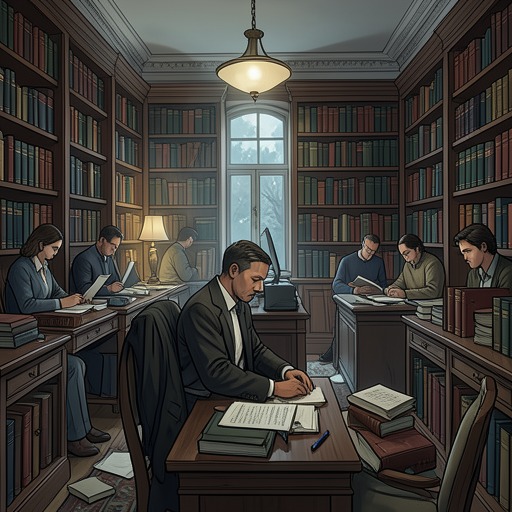
Certain volumes in the library bear a red cross, which the narrator calls a mark of Hell. The designated books include works by Gide, Diderot, and Baudelaire, as well as medical texts. The restriction is therefore presented not as a neutral cataloguing system but as a conspicuous boundary around reading considered unsuitable for students.
The Corsican librarian enforces that boundary directly. When a student wants one of the marked books, he signals the student over, draws him to a corner, and questions him. His intervention interrupts the ordinary act of choosing a book and makes access conditional on submitting to his scrutiny.
The Librarian’s Method
The librarian’s interrogation expands into a public reprimand. He redirects the student toward books he considers more interesting and instructive for someone of that age, then asks whether the student has finished his homework, what grade he is in, and whether he has anything to do after four o’clock. He ends by invoking the student’s teacher, threatening to report the reading request.
The sequence joins several forms of authority: age-based judgment, schoolwork, and the possibility of informing a teacher. The restriction operates through personal surveillance and anticipated discipline, not merely through the red mark on a book. The librarian controls the boundary by questioning the reader and presenting approved reading as both more appropriate and more instructive.
Narrative Significance
The episode places the restrictions within a broader portrait of the library as an institution where apparent order can conceal coercion. Students are not simply denied a book; they are made answerable for wanting it, while the librarian’s paternal manner supplies the social justification for that control. The red cross thus distinguishes prohibited reading and makes the act of seeking it visible to authority.