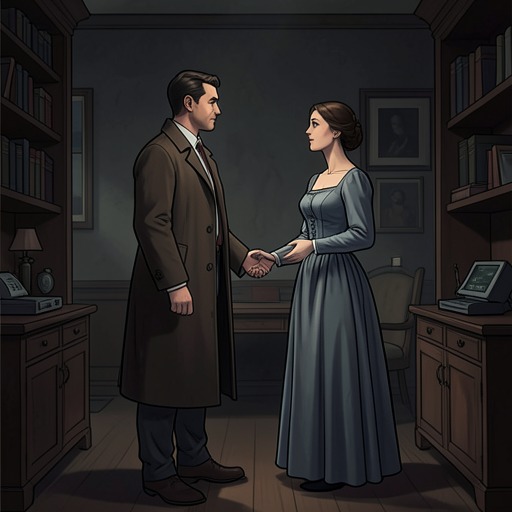
Antoine Roquentin and Anny’s Romantic Relationship
NauseaAntoine Roquentin and Anny’s Romantic Relationship is a former love organized around Anny’s demand that life be shaped into “perfect moments” and Roquentin’s failure to help her make those moments succeed. Their separation does not simply end their attachment: for a time, shared memories remain intensely alive, but they eventually recede into an inaccessible past. When a letter from Anny brings their history back into view, Roquentin still loves and respects her, yet discovers that tenderness cannot be summoned at will. The relationship’s decisive pattern is therefore both intimate and irreparable: they once carried every instant together, but can no longer return to the person each was in that shared life.
Identity and Background
Six years before the present scene, after the relationship had ended by mutual agreement, Roquentin decided to leave for Tokyo and wrote to Anny. The exchange they recalled made their changed intimacy plain. Unable to call her “my dear love,” he began his letter “My Dear Anny”; Anny replied that she had never been and was not his dear Anny, just as he was not her dear Antoine. If he did not know what to call her, she said, it would be better to call her nothing. Their words turn forms of address into a measure of separation: even affectionate names had become claims neither could honestly make.
The relationship had once lasted three years, a span Roquentin remembers not as a sequence of ordinary recollections but as an encompassing emotional burden. While they loved one another, neither allowed even their meanest instant, smallest grief, or unspoken thought to be detached and forgotten. Sounds, smells, and changes in light remained bound up with their shared experience, retaining the power to give joy or pain. Their difficulty was not a lack of feeling: Roquentin says they parted because they did not have enough strength to bear the weight of a love that left no shadow, escape, or shelter.
Anny’s Perfect Moments
Anny wanted particular moments to achieve a perfected form. When the time did not suit her, she lost interest, her eyes went lifeless, and she dragged along lazily; at other times she picked quarrels with Roquentin over small breaches of the mood she wanted. Her criticism of the solemn way he blew his nose and the care with which he coughed into his handkerchief shows how readily ordinary conduct could become part of the moment’s success or failure.
The effort to create a perfect moment was active and demanding, not merely a wish for romance. Anny might suddenly shudder, her languishing features harden, and she begin what Roquentin calls her “ant’s work.” She would look around, straighten up smiling, and appear to give orders to the objects around her before explaining, in a low, rapid voice, what she expected him to do. She directed his attention to the sky, the sun’s color on the carpet, her green dress, and her unmade-up, pale face, then instructed him to sit in the shadow and speak to her. Each ordinary feature was recruited into a scene whose beauty had to be made and recognized.
Roquentin experienced that process as a responsibility he could not meet. He felt that the enterprise’s success rested in his hands, while the moment carried an obscure meaning that had to be trimmed and perfected through particular movements and words. Instead of mastering its rites, he stared without seeing and struggled against them. The gestures Anny had improvised were torn apart by his resistance; at such times, she hated him. The contrast between her insistence on composition and his inability to participate turns their shared desire for closeness into a recurring conflict over how a moment should be lived.
Separation and the Past
The relationship’s end changed the status of their memories. For as long as they remained together, Roquentin says, they carried away the details of their life rather than leaving them behind. When Anny left him, however, the three years crumbled into the past all at once. He did not even suffer in the way he might have expected; he felt emptied out. Time began to flow again, and that emptiness grew larger.
The later departure from Saigon marked another erasure. When Roquentin decided to return to France, what remained of the past—strange faces, places, and quays beside long rivers—was wiped away. By the time he considers Anny’s letter, the past has become an enormous vacuum. Roquentin contrasts that absence with the immediate present: a waitress dreaming near the counter, a man in the room, and a tram passing the Hotel Printania at evening. Even the distant places he had seen, including Benares, the terrace of the Leper King, and Java’s broken temple steps, remain only as brief reflections rather than a recovered life. The history he shared with Anny is no longer an inhabitable world.
The Letter and Recognition
When Roquentin is alone in a dark room with Anny’s letter in his dispatch case, shame keeps him from reading it again. He tries instead to remember its phrases, briefly imagining an endearment that he knows she did not write. The letter contains a direct request to see him, signed by Anny, but offers no further indication of what she feels. Roquentin recognizes the absence of an affectionate formula as characteristic of her exacting nature; he does not mistake the request to meet for a restoration of their former closeness.
The letter brings back a smile he thought he had lost. Roquentin remembers first losing Anny’s eyes, then the memory of her long body, and finally the memory of her smile three years earlier. Taking the letter from the landlady’s hands brusquely, he thought he saw Anny smiling again. He tries to revive the tenderness she inspires, believing it is near and ready to be born, but the smile does not return. He remains dry and empty. The memory’s momentary reappearance is therefore not a reunion with the past: it makes the distance between the remembered woman and his present inability to feel her more definite.
Continuing Attachment and Its Limit
Roquentin says he will go to see Anny and that he still respects and loves her with all his heart. He also hopes someone else has had better luck and skill in the game of perfect moments. This hope acknowledges both the attachment that remains and the failure that marked their life together: he can wish Anny success without claiming that he can now supply what she once demanded of him.
Their relationship is recalled through both intimate particulars and the failure of recollection itself. Anny’s exacting attention to a dress, a carpet, the light, and a gesture once made shared experience feel charged with meaning; afterward, even the smile attached to that life cannot be restored. The three years had once fused their instants into a continuous burden, but separation broke that continuity, leaving Roquentin with love and respect that persist without recovering the former intimacy. His willingness to meet her thus coexists with a limit he cannot overcome: the past remains consequential, but it is no longer available to be lived again.