Club de l'Ordre
NauseaClub de l'Ordre is an aristocratic association founded by Olivier Blevigne after the Paris Commune and described as a meeting place for Bouville’s principal businessmen and shipowners. Its history links commercial influence to a doctrine of elite rule: Blevigne argued that those supposedly best equipped to govern had a duty to exercise power, while his portrait transformed that political identity into a lasting civic image.
Foundation and Membership
Blevigne’s biographical entry says that, after returning to Bouville from Versailles, where he had taken refuge during the Commune insurrection, he founded Club de l'Ordre. For many years its members met each evening. The entry characterizes the circle as aristocratic and more restricted than the Jockey Club, presenting exclusivity as part of its identity rather than an incidental feature.
The association united leading businessmen and shipowners, and the account credits it with exerting a beneficial influence on Bouville’s commercial-port affairs until Blevigne’s death in 1908. Its reach was thus described in civic as well as social terms: a narrow gathering of commercial leaders was represented as a force shaping the city’s destiny.
Blevigne’s Doctrine of Authority
Blevigne’s public argument for rule by an elite gave political expression to the club’s social position. He claimed that the ruling class had ceased to want to govern, and asked who could rule if people made fit for power by inheritance, education, and experience withdrew from it. His formulation was that governing was not an elite’s right but its primary duty. Authority, in this account, was made to appear not merely as privilege but as an obligation grounded in status and presumed fitness.
That language reveals the political logic attached to the association: inherited position, education, and experience are presented as qualifications that entitle a small group to lead. The rhetoric turns social advantage into a public service claim, while the club’s restricted membership supplies a local institutional setting for that claim. The source identifies Blevigne as its founder and describes the association’s influence, but does not give a full membership list or detail its internal structure.
Public Influence and Commemoration
Blevigne entered politics, won election as a deputy in 1885, and was repeatedly re-elected. During the 1898 strike, he returned from Paris to Bouville and became a leading figure in the resistance; he also initiated negotiations with the strikers. Those negotiations were interrupted by an uprising in Jouxtebouville, after which military intervention restored order. His political career therefore connected the club’s commercial milieu with the city’s public conflicts, though the account does not establish that the association itself directed these actions.
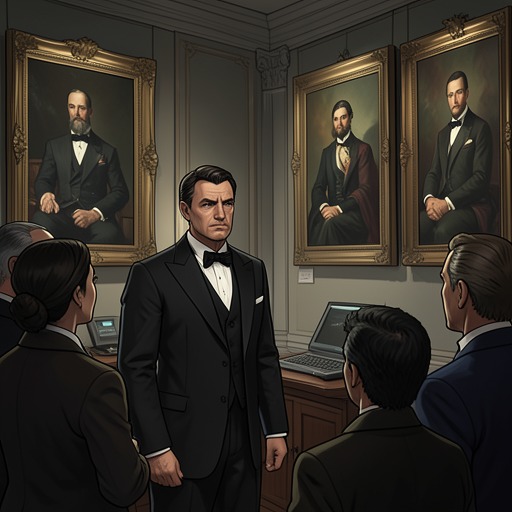
The Bouville museum’s portrait of Blevigne preserves this association between personal authority and civic memory. The painting presents him with a commanding gesture and an intense expression; the narrative observes that, through the portrait, the founder and president of Club de l'Ordre became immortal as an orator and political figure. The larger portrait gallery renders the city’s notables as holders of rights to life, work, wealth, command, respect, and immortality. In that setting, the club’s history belongs to a broader effort to portray elite power as both the conquest of human society over nature and a legitimate claim to posterity.