Roquentin and Anny Reunite and Part for the Last Time
NauseaRoquentin and Anny Reunite and Part for the Last Time is the Paris encounter in which Antoine Roquentin and Anny test whether their former intimacy can survive the years apart—and discover that it cannot be restored. Their reunion briefly revives familiar gestures and memories, but Anny’s account of passion’s exhaustion, their failed attempt to recover a past moment, and her imminent departure turn the visit into a farewell. Its decisive reversal is captured in her refusal of Roquentin’s claim that he has found her again: the meeting has happened, but the relationship he hoped to recover has not returned.
The reunion and its altered terms
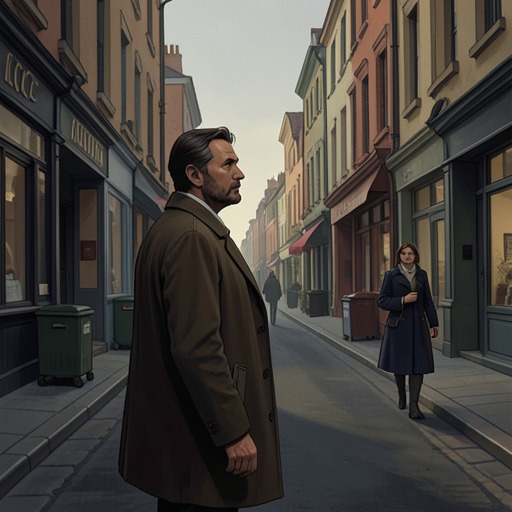
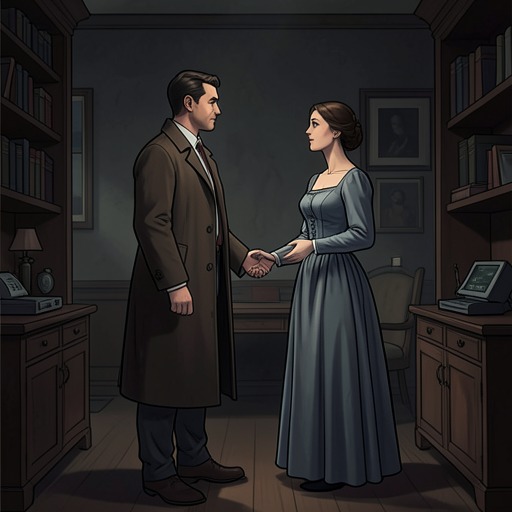
The encounter follows Roquentin’s Friday note from the Railwaymen's Rendezvous: his train leaves in twenty minutes, the gramophone is playing, and he feels a strong sense of adventure. Saturday brings a sharply different kind of arrival. Anny opens the door wearing a long black dress, does not offer her hand or say hello, and briskly directs him to sit anywhere except the armchair near the window. The reunion begins with a boundary rather than an embrace.
Anny is recognizably herself in her hanging arms and morose expression, which Roquentin associates with the awkward adolescent girl she once was. Yet her body has changed: she is heavier, and her breasts are heavy. The visual contrast makes the years apart present in the room before either of them can explain what has happened to their inner lives. Roquentin recognizes familiar habits in her—the laugh he remembers, the way she gets up and puts her hands on his shoulders, and her tendency to talk to herself—while also struggling to understand what she means when she announces that she has changed.
Anny does not immediately explain. She pours tea into white porcelain cups, waits for Roquentin to speak, and then says that she has changed. Her pause makes the announcement less a piece of information than a test of whether he can perceive the difference. Roquentin initially reaches for evidence of continuity: she still laughs as before, still moves in a familiar way, and still reads Michelet's History. Their exchange establishes the central tension of the reunion: recognizable gestures survive, but sameness of gesture does not mean that the former person or relationship can be recovered.
Passion and the loss of perfect moments
Anny gives the change a precise emotional meaning when she says there are no more perfect moments. Roquentin asks whether she means that none remain; her answer is no. What once served as a way of arranging experience into exceptional, meaningful occasions has ceased to be available to her. The declaration brings their old relationship into contact with the larger question of whether a life can still be shaped by the moments that once gave it intensity.
Anny is not simply mourning a lost capacity. Her face and tone convey a dry despair, but she says she is not sad and is often astonished by her own response. She recalls having been capable of splendid passions: she hated her mother passionately and loved Roquentin passionately. Both examples belong to a past in which emotion could organize her relation to another person. She insists that this is over and says she knows she will never again meet anyone who inspires passion.
Her explanation makes passion sound less like an involuntary feeling than a demanding act of commitment. To begin loving someone, she says, requires energy, generosity, and blindness; at the beginning comes a moment when one must jump across a precipice, because thinking it over prevents the leap. Anny does not believe she can jump again. Roquentin asks why, but she looks at him ironically and does not answer. Her refusal leaves the account without a recoverable cause: the certainty that her old capacity is gone is itself the fact he has to confront.
The pair’s failed attempt at physical intimacy gives this loss a concrete form. Anny explains that for more than twenty minutes, while Roquentin insisted on the kiss she had decided to give him and begged for it, she managed to anaesthetize herself completely. Though she describes herself as sensitive-skinned, she felt nothing until they got up. The kiss, administered according to form, cannot reproduce desire; the effort to stage an old intimacy instead exposes the absence of the feeling that once might have animated it.
Shared disillusionment and separate lives
The two former lovers recognize a parallel in their changed expectations. Roquentin says that there are no adventures and no perfect moments, that they have lost the same illusions and followed the same paths. His formulation makes the reunion more than a mismatch between one person who remembers and another who has moved on: each has undergone a loss, even if they do not experience or describe it identically. Their shared disillusionment creates a moment of understanding, but not a way back to one another.
Anny says that she has outlived herself. Roquentin does not answer with a reason for living. He distinguishes his own state from hers: he is not as desperate because he expected little, and is instead amazed by a life given to him for nothing. The contrast underscores the limits of their connection. They can recognize that something has ended, but their different responses to existence do not restore a common future.
Anny’s present life unfolds in movements and departures rather than settled attachment. She tells Roquentin that she has traveled, recently returning from Sweden after a week in Berlin, and begins to mention the man who is keeping her. By evening, the details of countries, cities, and men no longer stir Roquentin’s curiosity as they once might have done. They matter to him only insofar as Anny gives herself to them; he now senses that she has been indifferent to them at heart, like brief flashes on a cold, dark sea. After four years apart, they sit opposite one another with nothing more to say.
The practical reason for ending the visit makes the emotional separation immediate. Anny says that Roquentin will have to leave because she is expecting someone: a German painter. When he asks whether they will meet again, she says she does not know and that she is leaving for London the following evening. She plans to travel by way of Dieppe and thinks she may go on to Egypt; she might return to Paris the next winter and write to him. She will not see him again before leaving, despite his request, and asks for his address so that she can write from Egypt.
The parting and its aftermath
Roquentin writes the address on an envelope in the shadow. He has to give Hotel Printania so that letters can be forwarded when he leaves Bouville, but he already believes Anny will not write. His expectation of silence shapes the farewell before it is complete: he imagines that he may see her again in ten years, or that this may be their last meeting, and fears the return to solitude as well as leaving her.
At the door, Anny gets up and kisses him lightly on the mouth, saying that she wants to remember his lips and refresh her memories for her spiritual exercises. The kiss is real but deliberately limited. Roquentin draws her to him by the arm; she does not resist, yet shakes her head. The gestures hold contact and refusal together, offering no promise that physical closeness can undo the distance established in their conversation.
When Roquentin says that he must leave her after finding her again, Anny answers slowly that he has not found her again. She pulls her arms away and opens the door. Her statement corrects the reunion’s apparent premise: encountering the person after four years is not the same as recovering the relationship or the former Anny. She then laughs, calls him an unlucky boy, and tells him to get out. The door closes behind him, turning the visit’s final distinction into a physical ending.
The next day, Roquentin checks the Railway Guide and understands that, if Anny has told him the truth, the Dieppe train leaves at 5:38. He spends the morning in Menil-montant and the afternoon on the quays, remaining close enough to imagine that the separation has not yet become final. At five o’clock he hurries by taxi to the Gare Saint-Lazare. After waiting on the platform, he sees Anny in a heavy fur coat and short veil, accompanied by a large, handsome, tanned man in a camel's-hair coat, whom he thinks may be Egyptian. They board without seeing Roquentin. The man leaves briefly to buy newspapers; Anny lowers her compartment window and looks at Roquentin without anger, her eyes inexpressive. The train departs after the man returns.
As it leaves, Roquentin sees in memory the Piccadilly restaurant where they used to eat. Then, as he records the experience while half-asleep in a café, everything goes blank. The scene completes the transition from possible reunion to irretrievable memory: Roquentin has watched Anny leave, and the past returns only as a remembered place rather than a shared present. He plans to take the noon train back to Bouville, pack, settle his bank accounts, return his library books, and come back to Paris before the end of the week. The farewell therefore leads not to a restored romance but into the next movement of his life, while his fear of solitude remains unresolved.