Roquentin’s Artistic Change of Heart
NauseaRoquentin’s Artistic Change of Heart is the tentative decision that closes Antoine Roquentin’s search for a way to live with existence: listening to the old jazz record, he imagines writing a novel whose made form might outlast the shapelessness of experience. Music does not justify his life or cure his nausea. It offers something narrower and more demanding: the example of a work that exists without seeming superfluous, and the possibility that he, too, might make one.
The Record and the Crisis of Existence
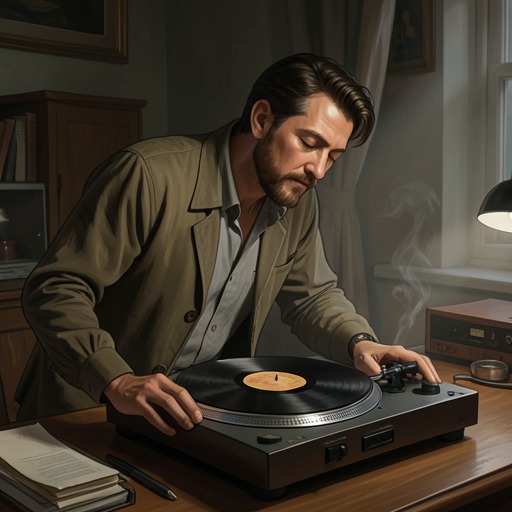
The turn begins when Madeleine sets the record spinning. Roquentin knows the song is old, expects he will search for it in vain in Paris, and regards this as his last chance to hear it. As the needle moves through the grooves toward the disc’s center, he pictures the singer’s voice falling silent when the record ends. That prospect gives the listening a boundary and an urgency his ordinary life lacks: the song has a beginning, a course, and an ending, while his days have seemed to drift without shape.
Before the music begins, Roquentin is not at peace. His thoughts of Anny and his wasted life lie beneath the mechanical act of counting his money; lower still is the nausea that has troubled him. The café’s stained glasses, mirror, apron, and people belong to the same ugly, familiar world, and that ugliness has made him feel at home. When the record sounds, the people and objects around him seem to abandon themselves to existence together. The change is not that the world becomes beautiful, but that its unchosen, everyday presence becomes newly disturbing beside the melody.
The music’s distinctness cannot be reduced to the physical record. Roquentin recognizes that breaking the disc would not let him reach the music itself: what can be seized is only the record, the voice, the violin note, or the vibrations that disclose it. The melody seems to stand beyond these material existents, not because it is another object hidden behind them, but because its form has nothing superfluous. Against a world in which everything simply exists, it appears to be exactly what it is.
The Limits of Consolation
Roquentin rejects the idea that art works as ordinary consolation. He thinks of people who turn to music in grief, treating beauty as though it were compassionate and their suffering could be transformed into something beautiful merely by listening. His own response is not that his troubles have disappeared or been redeemed. The song meets his unease without promising sympathy; the contrast between its exactness and the contingency around him sharpens rather than conceals the problem.
This distinction also separates the music from the historical work he has been doing. A history concerns what has existed, Roquentin reasons, and one existent cannot justify another. His attempt to resurrect the Marquis de Rollebon therefore cannot supply the justification he seeks. He begins to imagine a different kind of book, one whose words might lead a reader toward something not simply existing as another fact among facts. The record has not given him a formula for escape; it has made him question what kind of making might answer existence without pretending to undo it.
From Listening to a Possible Book
As the song continues, Roquentin imagines the unknown composer: a man working in the oppressive heat of a room in July, burdened by bills and perhaps by a woman who did not return his feelings. These possibilities do not make the composer’s circumstances grand or glorious. What moves Roquentin is that ordinary trouble and sweat have been made into music. He envies the composer, and for the first time in years finds another person moving—not because he knows the man’s life, but because the finished song gives that life a form he can encounter.
The singer’s performance intensifies this response. Roquentin thinks of the Jewish composer and the Black singer as, in a sense, saved: their song has washed away some of the burden of existing, though not completely. He does not claim the same gentle regard for himself, or even imagine that Anny regards him as he regards these performers. Their art offers a measure of distance from the lives that produced it, not a literal cancellation of those lives. The joy that brushes him is therefore small and fragile, and he is afraid to move in case it disappears.
The thought that follows is a practical one. Roquentin wonders whether he could try making something in another medium, since a tune is beyond his abilities and writing is what he knows how to do. The book would not be a history but perhaps a story, an adventure that could never happen, beautiful and hard as steel. He imagines it making readers ashamed of their existence—not through a sermon, but through the force of its made form. This is an aspiration, not a completed plan: he does not yet know exactly what kind of book it would be or whether he has the talent to write it.
An Uncertain Ending
At first, Roquentin imagines, writing would be troublesome and tiring; it would not stop him from existing or from feeling that he exists. The possible change lies further ahead, after the book is finished and stands behind him as a completed work. Perhaps some of its clarity would fall across his past, allowing him to remember his life without repugnance. He pictures a future reader identifying the author as Antoine Roquentin, a red-haired man who lingered in cafés, and thinking of his life as Roquentin now thinks of the singer’s and composer’s: as something precious, almost legendary.
The resolution remains conditional. Roquentin is waiting for the train, vacillates, and cannot be sure he has the necessary talent. He imagines that this gloomy hour may later appear as the moment when it all began, but the scene does not show him writing the book or establish what will follow. Its decisive change is in the kind of possibility he can now entertain: history cannot justify existence by retrieving the past, yet a made work might alter how that past can be borne. As night falls over Bouville, the artistic vocation is neither a cure nor a guarantee; it is the first form of action that Roquentin can imagine giving his life.