Luokadan Dan abandons the study of Rolerbon
NauseaThe abandonment of the Rollebon study is the collapse of Antoine Roquentin’s project of living through another person’s history. As doubts about his evidence interrupt his writing, the Marquis dies for him a second time—not merely as a research subject, but as the imagined partner who had furnished his life with purpose. The loss exposes the bargain at the heart of the project: Roquentin had used his existence to make Rollebon seem alive, and Rollebon’s constructed significance had allowed him not to feel his own. When that arrangement fails, historical reconstruction gives way to a stark, bodily awareness of existence.
The research project breaks down
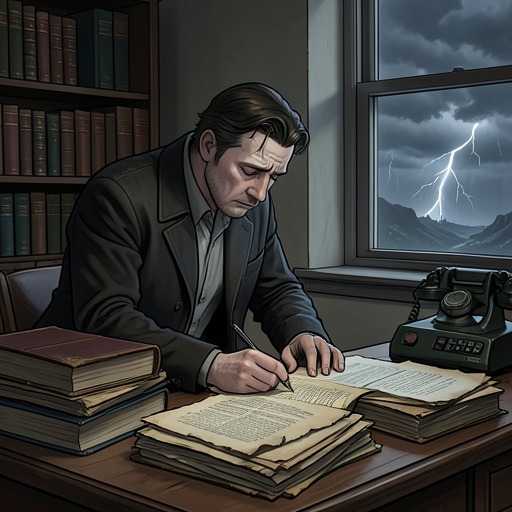
On Monday, Roquentin decides he can no longer write his book on Rollebon and asks what he will do with his life. At three o’clock he is still at his table, with a file of letters stolen in Moscow beside him, drafting an account of a sinister rumour and a letter in which Rollebon told his nephew that he had made his will. The passage is part of a historical argument Roquentin has been assembling from documents, but a complication opens a crack in its certainty: Rollebon might have invented the will to make himself appear innocent to his nephew, whom he hoped to use as a defence witness if the plot failed. Roquentin calls this objection minor, yet it is enough to stop his confident progress and leave him sunk in thought.
The interruption draws his attention away from the archive and back to the present he had been avoiding. He recalls the fat waitress at Camille’s, M. Achille’s haggard face, and the room where he had felt forgotten and forsaken. He tries to return to his unfinished sentence, but the familiar room and writing materials do not restore the old momentum. At the moment the pen falls from his hand, Roquentin distinguishes this sickness from the Nausea: the room retains its ordinary, paternal appearance, and neither the table nor the pen seems newly strange. What has changed is Rollebon’s status in his consciousness. The Marquis, who had seemed alive there, has just died for the second time.
A borrowed life comes to an end
Rollebon had not been only a name in documents. Roquentin describes him as a presence that could stir within him, disappear for days, then reappear on a mysteriously fine day, his pale face and bluish cheeks rising into view. Even in his absence, the Marquis weighed on Roquentin’s heart and made him feel full. Now that inward presence is gone. The dry ink on the page offers an image for the loss: as its traces preserve no memory of their former freshness, the written record cannot preserve the living figure Roquentin had experienced.
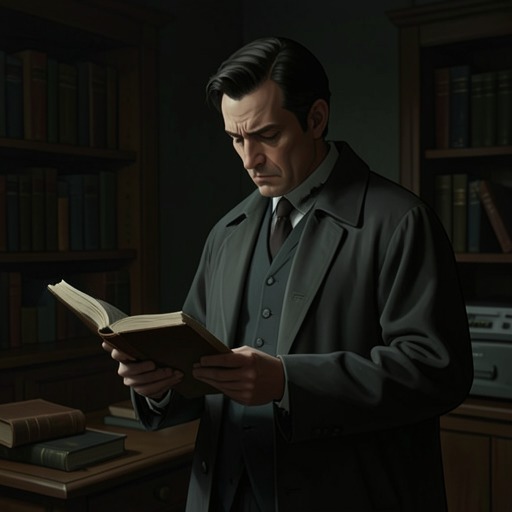
Roquentin blames himself for having said that the past did not exist. He makes one last attempt to call the Marquis back by repeating the description of Rollebon he usually used to evoke him: his small, wrinkled, pockmarked face, pointed nose, bluish cheeks, and malicious smile. The features appear obediently, and Roquentin can shape them as easily as before. But the appearance now has no independent life; it is only an image and a fiction in him. The ability to picture Rollebon survives, while the conviction that the image gives access to a living past does not. Roquentin leans back with an intolerable sense of loss.
The loss is also a practical ending. At four o’clock he has been sitting for an hour with his arms hanging as darkness begins to fall. The white paper, pen, and inkwell remain where they were, but he knows he will never continue the page he has begun. He also abandons the repeated route that sustained his research: he will not follow Rue des Mutiles and Boulevard de la Redoute to turn into the library and search its archives. The decision closes both the manuscript and the daily habits through which it had been pursued.
The purpose of the partnership
Roquentin’s account of his relation to Rollebon explains why the project’s end feels like the loss of a reason for living. The Marquis needed Roquentin in order to exist, while Roquentin needed the Marquis in order not to feel his own existence. Roquentin supplied the raw material—his existence—which he did not know what to do with; Rollebon supplied an imposing figure to organize it around. In writing, Roquentin ceased to attend to himself: eating, breathing, and moving seemed to acquire their meaning elsewhere, in the historical person whose life the gestures were supposed to reveal.
The partnership therefore reverses the apparent direction of biography. Roquentin thinks he is using documents and present-day labour to recover Rollebon, but the recovered figure has become the centre that gives Roquentin’s actions their borrowed significance. He does not see his hand writing or the sentence on the paper; beyond the page he sees the Marquis claiming the gesture and thereby seeming to consolidate his own existence. Rollebon is Roquentin’s reason for living, and the research delivers him from himself precisely by making his life a means to another man’s. Once the Marquis returns to nothingness, that arrangement can no longer shelter Roquentin from the fact of his own existence.
From historical absence to existence
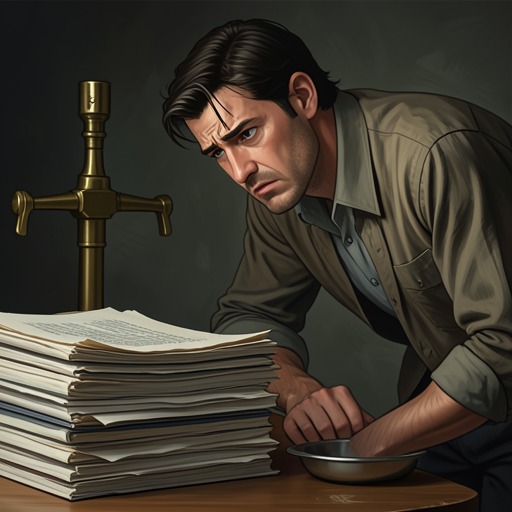
Roquentin initially tries to escape the loss through inaction. He wants to get up and go out, to do anything that might stupefy him, but believes that even moving a finger would bring on what is waiting for him. He remains still and mechanically rereads the unfinished paragraph about the rumour and the supposed will. The page holds the last visible trace of the enterprise even as he knows he will never write on it again. The more he tries to keep the moment suspended, the more insistently the unacknowledged present presses in.
That present arrives as a bodily experience, not as a new historical explanation. Roquentin jerks his shoulders, and what had been waiting seizes him and flows through him: he is filled with it, and identifies himself with the Thing. Existence, liberated and detached, floods over him. The shift is decisive. The collapse of the Rollebon project does not give him a replacement story or a new purpose; it removes the screen through which he had displaced his own life into the past.
The recognition that follows is intimate and unsettling rather than abstract. Existence feels sweet, slow, light, and almost self-moving; Roquentin registers it as bubbling water in his mouth, a pool against his tongue, and himself in his throat. He looks at the hand spread on the table and sees it living—his own hand, yet momentarily like an animal turned on its back, its fingers opening like crab claws. After the borrowed historical life has disappeared, even the ordinary body becomes vivid as existence. The episode thus joins the end of Roquentin’s work on Rollebon to a more fundamental change in attention: he can no longer make the past figure into the reason for his life, because his own existence, which the project had concealed, has become impossible to ignore.