Financial distress
NemesisFinancial distress in the novel is not merely a lack of cash but a condition that alters homes, relationships, memory, and access to action. At The Old Manor House, reduced incomes and scarce labour leave an old family property decaying around the Bradbury-Scott sisters; elsewhere, the wealth of Jason Rafiel supplies the money, legal capacity, and investigative opportunity needed to challenge Michael Rafiel’s conviction. The contrast makes financial hardship part of the mystery’s social landscape: poverty hides the past in neglected spaces, while inherited capital gives the truth a chance to be pursued.
Material Decline at The Old Manor House
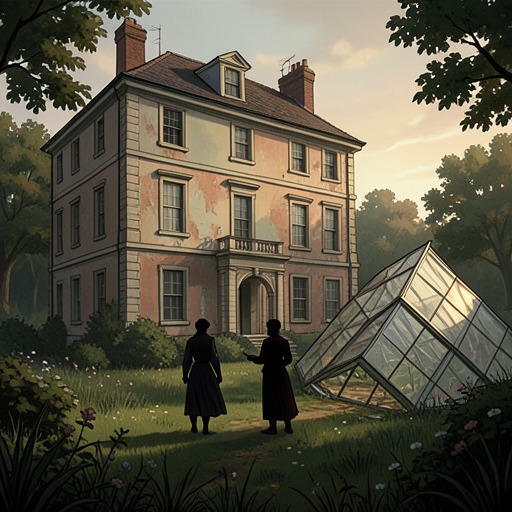
The clearest embodiment of financial distress is The Old Manor House, the inherited residence where Lavinia Glynne lives with her sisters. Jane Marple observes that the garden is neglected, little money has been spent on it for years, and very little work has been done. The house remains well proportioned and retains furniture that was once good, but both have suffered from a lack of polishing and attention. Its physical state suggests not sudden ruin but a long erosion of care: a house once built and cherished by a larger family is now inhabited by women whose resources have steadily contracted. The sisters’ circumstances are explained through inheritance, ageing, and the loss of labour. Mrs Riseley-Porter has inherited the house with her sisters from an uncle, and after her husband’s death came to live there with them. The family’s sons and daughters had married and left, while the three women grew older, their incomes dwindled, and labour became more difficult to obtain. The house therefore records a collective retreat from former security. Its decay is not presented as the result of extravagance or a single financial catastrophe, but as the accumulated consequence of insufficient income, shrinking domestic help, and a property too large for its remaining occupants.
Repairs, War, and the Failed Greenhouse
The financial pressure becomes concrete in the treatment of the outbuildings. Clotilde Bradbury-Scott explains that the house is too large and rambling, and that repairs are extremely expensive. The sisters must allow parts of the property to fall down, including many outhouses and a once beautiful greenhouse. During the Second World War they could not retain gardeners: a very young gardener was called up, and without the necessary labour repairs became impossible. The greenhouse consequently collapsed, as did the small conservatory near the house. The fallen greenhouse is both an economic fact and a charged landscape. It had contained a fine muscat grapevine, and Anthea Bradbury-Scott remembers Cherry Pie growing along its walls. Anthea later tries to engage an expensive firm of landscape gardeners to renovate the garden and rebuild the greenhouse, but the proposal is treated as absurd because even newly planted vines would not bear for two or three years. Her plan expresses a longing to restore the past, yet the estimate exposes how far that past has become financially inaccessible. Clotilde Bradbury-Scott’s anger at finding the estimate on Anthea’s desk turns a question of repair into a conflict over judgment, authority, and the right to spend scarce resources. The mound formed by the collapsed greenhouse shows how financial neglect can conceal more than architectural damage. Jane Marple pauses before the hillock of fallen bricks at the end of a grass path, while the sisters identify it as the remains of their greenhouse. The structure has been covered by Polygonum baldschuanicum, a fast-growing creeper useful for hiding a tumbledown building or any ugly feature. Its dense green and white growth overwhelms other plants and rapidly conceals what lies beneath. In the plot’s darker logic, the same landscape that arose from an inability to afford repairs becomes a cover for a buried crime: Verity Hunt’s body is hidden beneath the fallen bricks, and the plant grows over the improvised vault.
Wealth as Investigative Power
Against the sisters’ deprivation stands Jason Rafiel’s wealth. He dies a very rich man and has already arranged trusts and other beneficiary provisions before his death. His will is broadly simple in legal structure, but its financial arrangements are designed to produce action after his death. Jane Marple is told that money has been set aside to become hers absolutely at the end of one year, conditional on her accepting a proposition. The inheritance is therefore not simple charity. It is a financial instrument through which Jason Rafiel directs a living person toward a task he can no longer perform himself. Jason Rafiel also uses money to pursue justice for his son, Michael Rafiel. Though he regards Michael as morally incurable and has long accepted that his son is dishonest and repeatedly in trouble, he refuses to accept that Michael should remain imprisoned for a mistake in a murder case. He wants Michael vindicated and released, and he wants the identity of the actual killer brought to light. Because illness limits his own ability to act and his remaining time is measured in weeks, he offers a large fee for a search for the truth, with no expense spared. He rejects the idea that ordinary lawyers will be sufficient and instead appoints a chief helper to organize an investigation suited to his urgent purpose. Jason Rafiel’s money also makes the encounter with Jane Marple possible. Rather than simply giving his agent her address, he arranges for them to meet casually on a tour of historic houses, castles, and gardens, each with a reservation made for the appropriate date. The apparently harmless tour is financed as part of a covert investigative design. Jane Marple recognizes that Jason Rafiel did not spend money on her out of compassion for an old woman who found hills difficult; he wanted her to go to The Old Manor House. Wealth thus controls movement and timing, converts a social visit into an assignment, and supplies the setting in which financial distress and concealed violence become visible.
Dependence, Restoration, and Consequence
When Jane Marple’s work is complete, the contrast between distress and wealth produces a material consequence. The money held for her is placed at her disposal, with the option of payment into her bank or advice from brokers about investment. The sum is twenty thousand pounds, an extraordinary amount by her standards. Her reward confirms that the investigation has been funded and concluded through Jason Rafiel’s posthumous financial arrangement, even though its moral purpose is not personal enrichment but Michael Rafiel’s exoneration and release. Financial distress remains significant because money alone cannot restore what has been lost. The Old Manor House’s neglected garden and collapsed greenhouse preserve the effects of years of scarcity; Anthea Bradbury-Scott’s wish to rebuild it is bound to childhood memory, while the hidden body beneath the mound makes restoration inseparable from revelation. The same structure is first explained as a casualty of war, labour shortages, and unaffordable repairs, and later understood as the place where Verity Hunt was concealed. Economic decline therefore works as a form of slow concealment: it creates neglected spaces in which history can disappear, while Jason Rafiel’s wealth provides the counterforce that brings hidden responsibility into view.