Widowhood
NemesisWidowhood is presented as more than the loss of a husband: it is a social and narrative condition that alters where women live, how they are judged, and what kinds of choices remain available to them. Across the accounts of Esther Walters, Clotilde Bradbury-Scott, and Mr Rafiel’s family, widowhood links private grief with relocation, financial and domestic pressures, concealed histories, and renewed relationships. Its recurrence also provides a contrast with Jane Marple’s own position as an elderly woman who remains observant, mobile, and capable of turning the assumptions attached to age and gender to practical advantage.
Widowhood and Survival
Esther Walters recalls that Mr Rafiel lost his wife many years earlier, probably soon after their marriage, and that she died of cancer. The loss left him with two daughters and a son, although his relationship with the son had apparently been damaged by a scandal, and Mr Rafiel subsequently avoided speaking about him. Widowhood therefore appears here not simply as bereavement but as the point at which a family’s structure becomes permanently marked by absence, silence, and unresolved trouble.
Jane Marple’s reflection on Esther gives widowhood an especially sharp moral dimension. When Jane Marple last saw Esther, Esther had seemed to hate her; now she appears possibly grateful, having perhaps recognized that she might otherwise have been lying beneath a stone slab in a respectable churchyard instead of living what seems to be a happy life with Mr Anderson. The contrast makes survival itself consequential. Esther’s changed circumstances transform her from a threatened woman into someone able to smile at Jane Marple, and the possibility of gratitude signals that widowhood, or the prospect of it, can redefine both danger and allegiance.
Women’s Relocation After Loss
Clotilde Bradbury-Scott’s history is shaped by a later widowhood. She explains that she and her sisters were connected with the family home, but that she was abroad with her husband when her sisters moved in after their uncle’s death. She and her husband had lived in India for years, and he was still stationed there when he died four or five years before the events of the novel. His death left her uncertain about where to establish herself, and she eventually accepted her sisters’ invitation to join them.
This movement from India to the old family house shows widowhood as a condition of forced re-rooting. Clotilde Bradbury-Scott does not describe a simple return to an inherited home; she describes the difficulty of deciding where to put down roots after the death of a spouse and after a life shaped by overseas residence. Her widowhood thus intersects with age, geography, and family obligation, drawing her back into the household formed by her sisters.
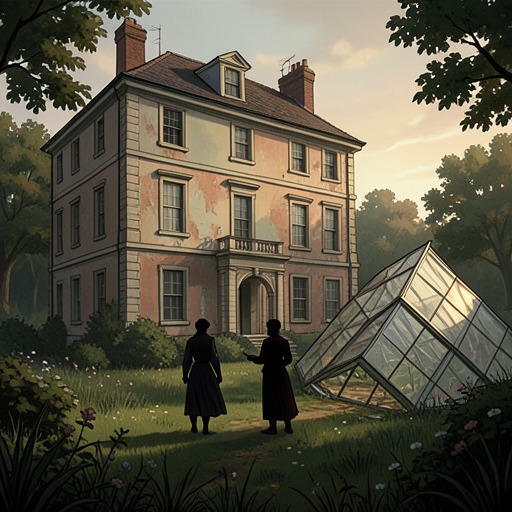
The house itself carries an earlier history of bereavement. A former housemaid recalls that the old Colonel lost his wife young, that his son was killed in the war, and that his only daughter died giving birth, with the baby dying as well. The Colonel became a sad man living alone and allowed the house and garden to deteriorate. After his death, the property passed to his niece Clotilde Bradbury-Scott and her sisters, who could not afford to restore it. Widowhood is consequently embedded in the property’s genealogy: the house is inherited through accumulated losses, and its neglected condition becomes an outward sign of lives reorganized by death.
Widowhood and Social Identity
The novel repeatedly places widowhood beside other visible identity markers. Jane Marple observes elderly travellers by their clothing, ailments, manners, and relationships, recording them in her notebook because any one of them may be a source of information, a person connected with the law, or even a murderer. Age and widowhood can make women appear socially legible, harmless, or confined to domestic roles, but Jane Marple treats such appearances as provisional rather than definitive.
That contrast is important when Miss Cooke’s identity emerges through a change in appearance. Jane Marple recognizes her because she had previously seen her with hair that was almost black, whereas on the tour it is bright yellow. Miss Cooke had earlier approached Jane Marple near her garden in St Mary Mead under the name Bartlett, pretending to understand gardening and claiming to live in the village while working in another woman’s garden. The disguise depended on altered hair, clothing, and biography. In a world where women are read through names, dress, age, and domestic respectability, widowhood belongs to the same field of social signs: it may describe a genuine condition, but it can also become part of how a person is categorized, concealed, or misread.
Narrative and Thematic Significance
Widowhood also intensifies the novel’s interest in hidden histories. Jane Marple’s conversation with Esther turns toward Mr Rafiel’s interest in criminology and what happened in the Caribbean, but Esther’s voice hardens at the reference, showing how apparently ordinary personal histories can conceal violence and fear. Mr Rafiel’s family story likewise contains a dead wife, a troubled son, and an unspoken past. The condition of being widowed is therefore repeatedly placed near secrets that have not been fully narrated.
At the same time, the novel refuses to reduce widowhood to helplessness. Esther appears to have moved into a happier life with Mr Anderson; Clotilde Bradbury-Scott has travelled, married, been widowed, and then chosen to join her sisters; and Jane Marple, though herself an elderly woman navigating assumptions about female fragility, continues to investigate, take risks, and extract information from social encounters. Widowhood marks the damage left by male absence, but it also reveals women adapting to altered circumstances, negotiating family structures, and becoming active interpreters of the worlds around them. Its recurrence gives the story a quiet pattern of loss followed by rearrangement, in which survival may be outwardly modest yet decisively changes the balance of power.