Jason Rafiel’s death
NemesisJason Rafiel’s death is not merely a background fact but the mechanism that sets the entire investigation in motion. His passing releases a chain of instructions, money, and staged encounters through which he attempts to obtain justice for his son Michael Rafiel and expose the real circumstances of Verity Hunt’s death. Rafiel’s physical absence becomes a form of continuing power: he cannot investigate for himself, yet his wealth, foresight, and knowledge compel Jane Marple to do what he could not.
Death and Immediate Recognition
Jason Rafiel’s death reaches Jane Marple first through the newspaper’s deaths column. The name is printed among many others, accompanied by the address Belford Park, Maidstone, and the notice that there were no flowers. At first the name only stirs an uncertain memory. Jane Marple cannot place the address and wonders whether she has merely encountered the unusual name somewhere before. The recognition arrives through association rather than through the obituary itself.
While knitting a small child’s woolly jacket in pink wool, Jane Marple remembers a blue Caribbean sea, a sandy beach, sunshine, and the island of St Honoré. The memory restores Jason Rafiel to her mind as the difficult, elderly man she had met on that journey. His death therefore links an ordinary domestic present with a past marked by danger and murder. The pink wool becomes the small material trigger that brings back not only Rafiel but the entire moral pressure of their earlier encounter.
Jane Marple recalls him as immensely rich, obstinate, irritable, and sometimes shockingly rude. His wealth meant that people tolerated his conduct, while his physical condition meant that he could not move about easily without assistance. He travelled with Esther Walters, his secretary, and Arthur Jackson, a qualified masseur and attendant whom Jane Marple regarded as a doubtful character. Rafiel’s death is thus presented alongside a sharply defined social presence: money had insulated him from resentment, but illness had made his dependence on others increasingly visible.
The Posthumous Design
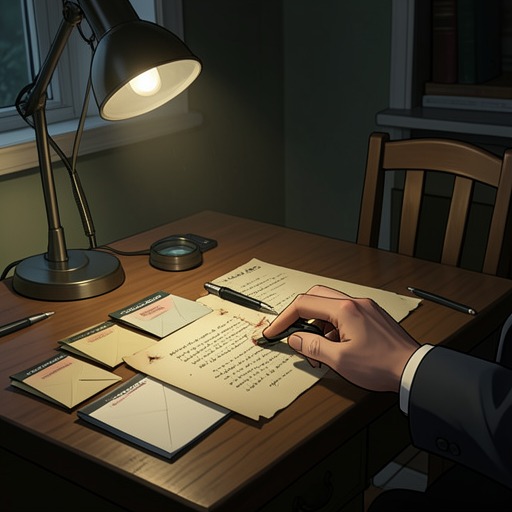
About a week after his death, Jane Marple receives a formal letter from the London firm of James Broadribb and Mr Schuster, solicitors and notaries public. The letter asks her to visit their Bloomsbury office to discuss a proposition that may be to her advantage and identifies the firm as solicitors to the late Jason Rafiel. The timing turns his death into an active summons. Rafiel has arranged for his wishes to reach Jane Marple only after he is gone, converting the legal aftermath of death into the opening of a new personal obligation.
James Broadribb explains that Rafiel died a very rich man and had already distributed much of his fortune through trusts and other beneficiary arrangements. The remaining provision for Jane Marple is deliberately conditional: a sum of money is set aside to become hers absolutely at the end of one year, but only if she accepts a proposition. The will therefore functions as more than a financial instrument. Rafiel uses economic capital to secure an investigation that ordinary persuasion might not achieve, while the one-year condition gives the mission a measured duration and keeps his presence in the story tied to a future reckoning.
The arrangement reflects Rafiel’s characteristic combination of ruthlessness and purpose. He does not leave Jane Marple money as an act of compassion for an elderly woman who dislikes walking up hills. He sends her toward a particular place and a particular mystery. When she later explains the matter, she recognizes that there could be no other reason for his generosity: Rafiel wanted her to go where the evidence was waiting.
Justice for Michael Rafiel
Rafiel’s decisive motive is revealed through his concern for Michael Rafiel. He has long regarded his son as morally corrupt, dishonest, and incapable of being changed, but he distinguishes moral failure from responsibility for a murder. He has continued to provide for Michael Rafiel when necessary, even while believing that his son was a bad lot; yet he refuses to accept that Michael Rafiel should remain imprisoned because of a mistake made in the law’s understanding of Verity Hunt’s death.
Rafiel tells his intermediary that he wants Michael Rafiel vindicated, released from confinement, and restored to the possibility of continuing his life, even if that life may include further dishonesty. The bluntness of this objective is important. Rafiel does not need Michael Rafiel to become a better man before deserving justice. He wants the truth recognized because an innocent person must not remain imprisoned for a crime committed by somebody else. His paternal responsibility is therefore neither sentimental nor reformative. It is a hard, selective commitment to legal justice.
Rafiel also understands that his own time is limited. He is seriously ill and describes his remaining life as measurable in weeks rather than years or months. His illness gives the posthumous plan its urgency. Lawyers alone, he believes, will be useless within so short a period; he must arrange what can be arranged immediately. He offers a large fee for a search for the truth, authorizes his chosen helper to act with no expense spared, and acknowledges that death may come at any moment. The mission is designed as an extension of action beyond the point at which his body can act.
The Mission After His Death
Rafiel chooses Jane Marple as the person capable of carrying out the work. He does not simply give his solicitors her address. Instead, he arranges for her to encounter his investigator in the surroundings of his own choosing: a harmless-looking tour of historic houses, castles, and gardens. Jane Marple is to be present on the tour, and the meeting is to appear casual. This elaborate staging allows Rafiel to preserve secrecy while using the ordinary structure of a holiday as cover for an investigation.
The posthumous mission leads Jane Marple to The Old Manor House, where Lavinia Glynne lives with her sisters Clotilde Bradbury-Scott and Anthea Bradbury-Scott. At first, Jane Marple finds only three apparently ordinary women in poor circumstances, living in a neglected house inherited from an uncle. Their poverty, the dwindling income, the shortage of labour, and the unmaintained garden contrast with Rafiel’s wealth and the resources he has placed behind the investigation. Yet the house’s decay also conceals a history that Rafiel’s instructions have brought Jane Marple close enough to read.
The decisive setting is the collapsed greenhouse at The Old Manor House. A mound of fallen bricks, earth, turf, and vegetation marks the site, while Polygonum baldschuanicum spreads rapidly over anything beneath it. Jane Marple knows the plant as something useful for hiding a tumbledown or ugly structure, but its beauty and speed make it ominous: it covers everything and suppresses whatever it overtakes. Anthea Bradbury-Scott remembers the old greenhouse’s grapes and longs to recover it, yet her distress around the mound suggests that the site is not only a relic of family nostalgia.
What Rafiel’s Death Makes Possible
Rafiel’s death sets in motion the chain by which Jane Marple connects the three sisters, Elizabeth Temple, Verity Hunt, and Michael Rafiel. The Archdeacon confirms that Michael Rafiel and Verity Hunt intended to marry secretly and that he was to conduct the marriage. He also explains Verity Hunt’s dependence on Clotilde Bradbury-Scott after the death of her parents, and the intensity of Clotilde’s attachment to her. These disclosures transform the case from an abstract appeal for Michael Rafiel’s release into a history of love, guardianship, secrecy, and possession.
Jane Marple’s later reconstruction identifies the hidden consequence of the murder. She concludes that the woman killed was not the girl Michael Rafiel loved, that Verity Hunt remained at The Old Manor House, and that Clotilde Bradbury-Scott gave her a painless overdose of sleeping medication before carrying her body to the greenhouse mound. The fallen bricks became a vault beneath the floor, and Polygonum baldschuanicum was planted over it. The plant’s annual growth concealed the remains while preserving the site as a distorted monument to the past Clotilde refused to relinquish.
Rafiel’s death therefore produces a reversal in the meaning of absence. He is absent from every later confrontation, but the arrangements made before his death expose the absences that matter: Verity Hunt has disappeared, Michael Rafiel has been confined for a crime he did not commit, and the truth has been covered by both human silence and vigorous vegetation. When Jane Marple identifies the buried body and confronts Clotilde Bradbury-Scott, Rafiel’s intention is fulfilled indirectly. His wealth has purchased time, access, travel, and assistance; his knowledge has supplied direction; Jane Marple’s perseverance has converted those resources into recognition of the truth.
Consequences and Significance
The eventual consequence of Jason Rafiel’s death is not only the exposure of a murderer but the correction of a legal and emotional misreading. Michael Rafiel’s imprisonment can be challenged because Verity Hunt’s actual fate is brought to light. The secret relationship between Verity Hunt and Michael Rafiel, the false appearance of his guilt, and Clotilde Bradbury-Scott’s possessive attachment are all reinterpreted through the evidence that Rafiel arranged for Jane Marple to seek.
The financial condition attached to the will is finally discharged after the investigation. James Broadribb tells Jane Marple that the money is now at her disposal and offers advice about placing it in the bank or investing it through brokers. Jane Marple identifies the amount as twenty thousand pounds, an extraordinary sum by her standards. The payment is the final material sign that Rafiel’s death has completed its intended work: the fortune that once expressed his social power becomes the reward attached to truth, while his last command survives in the freedom secured for Michael Rafiel.
As an event, Jason Rafiel’s death belongs to the novel’s main narration but operates structurally like a delayed beginning. The reader encounters the death before understanding its purpose, first as a newspaper notice and then as a solicitor’s letter, and only later learns the full design behind the inheritance and the investigation. Death closes Rafiel’s life while opening his final act. His enduring significance lies in that paradox: the most forceful intervention he makes in the story occurs after he can no longer witness its resolution.