The discovery of Verity Hunt’s remains
NemesisThe discovery of Verity Hunt’s remains beneath the greenhouse mound at The Old Manor House resolves the central concealment behind the case. The body is found where Jane Marple predicted it would be, but the discovery also overturns the story on which Michael Rafiel was convicted: Verity had not been strangled, and her face had not been disfigured. The grave therefore proves both a death and a deliberate fabrication of evidence, revealing that Clotilde Bradbury-Scott killed the woman she could not bear to lose and used another victim’s corpse to make Michael appear guilty.
Causes and Concealment
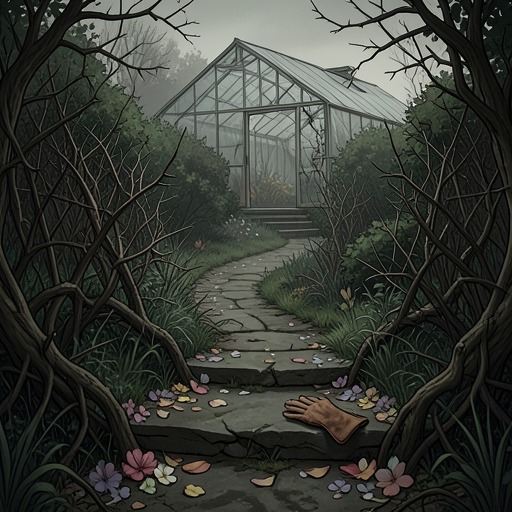
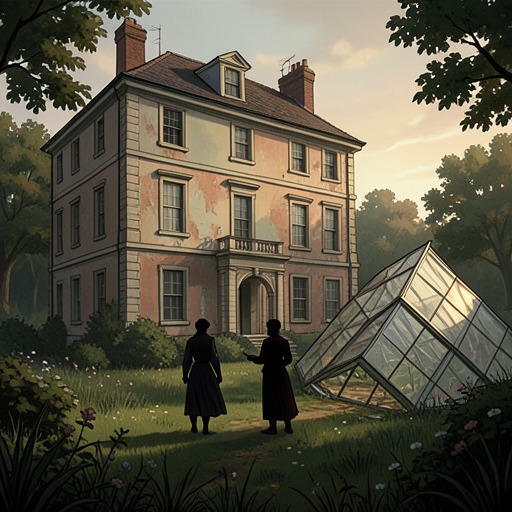
The hiding place is prepared within a landscape already marked by neglect and loss. The Old Manor House has declined with the Bradbury-Scott family: its once-good furniture is no longer maintained, its garden has received little money or labour, and its inhabitants have grown older while their incomes have dwindled. At the end of a grass path stands what Anthea Bradbury-Scott calls the remains of the family greenhouse, reduced to a hillock of fallen bricks, earth, and turf. The ruin once produced prized grapes, and Anthea remembers it as part of the house’s happier childhood past.
Clotilde uses that ruin as a tomb. Jane Marple concludes that Verity was given a painless overdose of sleeping medication, carried into the garden after death, and placed beneath the fallen bricks. The mound was then covered with earth and turf and planted with Polygonum baldschuanicum. Jane Marple recognizes the creeper as exceptionally rapid-growing, capable of swallowing and drying up whatever it covers. Its attractive white flowers conceal an aggressive material process: the plant naturalizes the grave while steadily erasing the structure beneath it.
The setting consequently operates as both memorial and camouflage. Clotilde keeps Verity at The Old Manor House rather than allowing her to leave with Michael Rafiel, while the growing Polygonum baldschuanicum turns concealment into a yearly recurrence. Anthea’s fear of the mound, and her repeated sense that something stands behind her, give the garden an emotional witness before it becomes a forensic one. What appears to be a neglected remnant of domestic history is also a carefully maintained secret.
The Discovery and Its Physical Evidence
Jane Marple’s reconstruction identifies the grave through a chain of spatial and botanical clues rather than through the accepted identity of the earlier body. She notices the mound beside the ruined greenhouse, remembers the family’s account of its formation, and connects the sisters’ conduct with the fear surrounding it. Her final accusation describes Verity as still present in the garden, beneath the bricks and the flowering creeper, where Clotilde has preserved her through burial rather than accepting her death.
The later report confirms the discovery. Mr Schuster is told that Verity Hunt’s body was under the mound in the garden exactly as the old lady had said. The confirmation is striking because the body contradicts the public account in two essential respects: Verity had not been strangled, and the face had not been disfigured. Those negative findings are as important as the location itself. They distinguish the body hidden by Clotilde from the corpse previously presented as Verity and expose the earlier identification as part of the crime.
The discovery also separates two forms of bodily violence. Verity’s death is attributed to an overdose of sleeping medicine and concealed burial; Nora Broad’s body, by contrast, is strangled, disfigured, and arranged to carry Verity’s identity. The corpse found in the earlier investigation had been dressed in Verity’s clothes and accompanied by her handbag and personal objects, allowing the damaged face to support a false conclusion. The grave beneath the greenhouse restores the distinction between the two women.
Consequences for Michael Rafiel’s Case
Before the remains are found, Michael Rafiel has been treated as the obvious suspect. He had been seen with Verity, had been noticed in his car, and was regarded by the police as their first suspect even before the body was recovered. His previous record, including earlier proceedings involving assault and rape, strengthened the prosecution’s case. The discovery of a strangled and disfigured corpse apparently belonging to Verity made the accusation appear conclusive.
The body under the mound reverses that conclusion. Because Verity was not the woman whose corpse had been used to establish the murder, the physical foundation of Michael’s conviction collapses. The earlier corpse was Nora Broad, dressed and identified as Verity so that Michael would be tried for killing the woman he loved. Clotilde had recognized the body herself and had confirmed the identity she wanted the authorities to accept, turning personal knowledge into a mechanism of judicial deception.
The later report therefore changes the meaning of Michael Rafiel’s wrongful conviction and release. It does not merely add a second grave to an already known crime; it demonstrates that the original murder case depended on substitution. The discovered remains establish that Michael was not responsible for Verity’s death and that the supposed certainty of the prosecution was manufactured through clothing, belongings, facial disfigurement, and a strategically discovered body.
Emotional and Narrative Significance
For Jane Marple, the discovery confirms a more disturbing interpretation of love than the first theories allow. Elizabeth Temple’s description of love as a frightening word initially seems capable of suggesting suicide or a destructive romantic revelation. Jane Marple ultimately understands it as the force through which Clotilde refuses Verity’s freedom. Clotilde loves Verity possessively, prevents her secret marriage to Michael, and keeps her physically at The Old Manor House after death. The grave is the material form of that refusal to let her go.
The discovery also gives retrospective meaning to the sisters’ contrasting reactions. Anthea Bradbury-Scott appears intensely frightened by the mound and by the possibility that an old crime might return. Lavinia Glynne presents the outwardly wholesome respectability that can conceal a utilitarian crime, while Clotilde’s attachment turns into an extreme and enduring form of possession. The garden holds the secret among three sisters who have lived with different degrees of knowledge, fear, and complicity.
The event’s decisive value shift is from apparent certainty to exposed uncertainty, and then from uncertainty to a harsher truth. The earlier body seemed to convert suspicion into proof; the body beneath the mound converts proof into evidence of manipulation. Yet the discovery does not restore Verity’s lost future. Jane Marple emphasizes that Verity had been close to a life of love, devotion, and service with Michael Rafiel, but nothing can return what she missed. The grave proves the truth while also measuring the irreversibility of the loss.
The discovery is thus both forensic resolution and spatial revelation. The collapsed greenhouse, once a neglected family ruin, becomes a tomb; Polygonum baldschuanicum, once merely a useful covering plant, becomes the emblem of memory smothered by growth; and the garden, previously associated with fear and nostalgia, becomes the place where the suppressed history finally emerges. When the body is found, the story’s hidden architecture is exposed: Verity was buried not far from the people and house that had claimed her, while Nora Broad’s body was sent into the world carrying a false name.