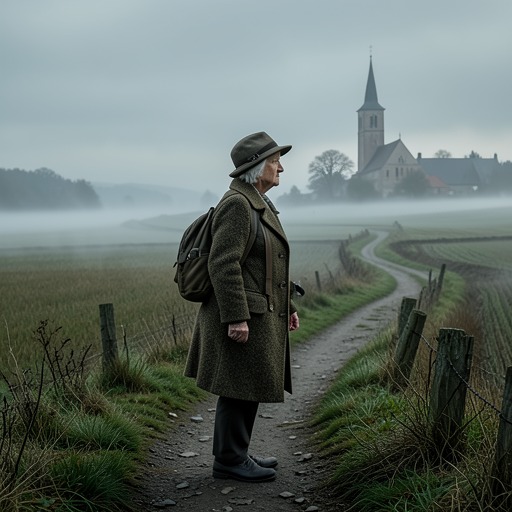
The murder of Elizabeth Temple
NemesisThe murder of Elizabeth Temple is the pivotal crime that turns an apparently routine excursion to Bonaventure into a search for a hidden past. Initially reported as an accident, Elizabeth Temple is struck by a large boulder while walking below a steep gorge during a tour expedition. Her death, the testimony of two witnesses, and her dying reference to Verity Hunt convert a scene of public misfortune into evidence of deliberate violence and reopen the unanswered mystery surrounding Verity’s disappearance and her intended marriage to Michael Rafiel.
Causes and Background
The attack occurs during a tour whose participants are climbing toward the Memorial Tower at the summit of Bonaventure. Strong wind has unsettled the expedition, people have separated from one another, and some have taken a regular path while others climb across the downs. There is no effective guide supervising the group, and the slope above the gorge is dangerously steep. In this setting, a fall of stones can initially be explained as a natural accident: rocks come crashing down the hillside and strike someone on the path below.
Elizabeth Temple’s presence on the expedition is significant because she is not an arbitrary victim. She is a retired and respected headmistress, a woman who has had many pupils pass through her hands. Professor Wanstead therefore treats the attack as a question of motive as much as opportunity. An unknown violent stranger, a fellow traveller, or someone bearing a private grudge could have chosen the location, but Elizabeth’s long career means that her past contains a wide field of possible connections. The apparent improbability of her as a target is precisely what makes the case disturbing.
The murder also intersects with the mission imposed on Miss Marple by Jason Rafiel. After Jason Rafiel’s death, his lawyers informed Miss Marple of his proposition, while a letter from Jason Rafiel explained nothing. A tour reservation made before his death then brought her to the expedition, apparently as a surprise gift but in fact as the first step in a sequence of clues. The three sisters at The Old Manor House had also received word from Jason Rafiel and had been asked to accommodate his old friend because he believed she was not fit to attempt the difficult ascent to the Memorial Tower. Elizabeth’s injury thus occurs within a carefully arranged chain of indications rather than as an isolated interruption.
What Happens on Bonaventure
The first account given to Miss Marple describes the event as an accident. Emlyn Price comes to her the following morning with the news that someone has been hurt during the previous afternoon’s expedition. The coach itself has suffered no trouble; the incident happened on the hillside, where the tourists had become scattered. A heavy fall of stones or rocks descended the slope and knocked a person unconscious on the path below. The injured woman is identified uncertainly as Miss Temple or Tenderdon, reinforcing the confusion surrounding the event.
The testimony of Joanna Crawford and Emlyn Price changes the character of the incident. The two young people are climbing from the lower main path along a rough track that curves around the hill. As they turn a corner, Joanna sees a figure high on the hillside, outlined against the skyline and attempting to roll a large boulder forward. The boulder rocks in place, then begins moving slowly before gathering speed. Elizabeth Temple is walking along the main path beneath it and reaches the point directly below just as the stone strikes her.
The witnesses cannot identify the attacker with certainty. Joanna sees a person wearing jeans or trousers and a conspicuous red-and-black checked polo-neck jumper. The figure turns and disappears almost immediately. Joanna is inclined to think the person is a man, but she cannot establish even that. Her uncertainty leaves the identity open while making the physical act itself clearer: if the boulder was deliberately directed at the woman below, the intended attack succeeded.
The distinction between accident and murder is therefore produced through reconstruction rather than immediate discovery. The landscape provides the cover of chance, while the witnesses supply the crucial pattern of human agency: a figure, a chosen stone, a target below, and an abrupt retreat. The event’s value shift is correspondingly stark. A communal sightseeing journey becomes an environment of suspicion, and the travellers’ ordinary confidence is replaced by the fear that one of them—or an unseen enemy—may be willing to attack again.
Elizabeth Temple’s Final Clue
Elizabeth Temple does not recover consciousness after the attack. When Miss Marple visits her, she finds a dying woman able to offer only fragments. Asked about the stone from above, Elizabeth identifies it as the “Stone of Death.” When asked who rolled it down, she says that she does not know and that it does not matter, but then turns to the name that does matter: Verity. She links the name to truth, explaining that Verity is another name for truth.
Miss Marple confirms that the name refers to Verity Hunt. Elizabeth Temple dies an hour and a half later without regaining consciousness. Her final words do not identify the attacker, describe a motive, or solve the immediate crime. Instead, they redirect the investigation toward an earlier disappearance and toward the meaning of truth itself. The boulder attack is consequently both a murder and a message: the victim’s last intelligible concern is not her own survival but the need to discover what happened to Verity.
The clue also explains why Elizabeth may have been seeking information from others. Henry Clithering, an old friend of both Elizabeth Temple and Miss Marple, becomes part of the network through which the investigation is understood. The event is narrated through partial recognition and delayed connection: a name spoken at the bedside acquires force only when set beside the histories of the people who knew Verity and Michael Rafiel.
Consequences and Reopened History
The killing prompts a funeral service attended by the members of the tour, Mrs Glynne and Clotilde Bradbury-Scott, local residents, and an elderly, physically impaired clergyman whose presence suggests an older connection with Elizabeth Temple. The ceremony is shadowed by the newly used phrase “foul play,” and the ordinary ritual of mourning becomes an occasion for observing who attends, who stays away, and how each person responds. Anthea Bradbury-Scott does not attend, while the other members of the Bradbury-Scott family are present.
Fear spreads among the travellers. Mrs Butler abandons the tour because she feels that someone might shoot them or throw a stone at them while they walk around a corner. Her reaction shows how the attack changes the social meaning of the landscape: paths and viewpoints once associated with leisure now appear to conceal an enemy. The supposed accident has become a continuing threat, even though no attacker has yet been named.
The investigation then connects Elizabeth Temple’s last clue with Verity Hunt’s secret history. Archdeacon Brabazon reveals that Verity and Michael Rafiel had intended to marry and had made arrangements for a secret wedding. He was to perform the ceremony, but on the appointed day the bride and bridegroom failed to appear. They sent no message, excuse, or explanation, and the Archdeacon never learned why. Elizabeth Temple knew that Verity had been going to marry Michael Rafiel; according to Miss Marple, Verity herself must have sent Elizabeth that information before Elizabeth’s death.
The Archdeacon’s account gives Verity a substantial personal history rather than leaving her as a mere name. Her parents died in a charter plane accident while travelling to Italy, and after leaving school she went to live with Clotilde Bradbury-Scott, a close friend of Verity’s mother. Clotilde cared for her, took her abroad, arranged art lessons in Italy, and became someone Verity loved and depended on as though she were a mother. Verity preferred art, music, and related subjects to a university career, and appeared to have lived happily at The Old Manor House. Her affectionate dependence on Clotilde makes the unexplained failure of the wedding more mysterious and gives Elizabeth’s dying demand—find out about Verity—the force of a suppressed family secret.
Narrative Significance
The murder functions as the event that joins public investigation to private revelation. Its external facts are concrete—a steep gorge, a rolling boulder, a distinctive red-and-black garment, two witnesses, and a death without regained consciousness—but its deepest consequence is structural. The crime forces the story backward, from the present expedition to the missing Verity, the secret wedding, and the silence that followed when neither bride nor bridegroom arrived.
The event also reverses the meaning of ritual. The expedition is presented as a shared journey toward a memorial tower, yet separation and inadequate supervision make the group vulnerable. The wedding that should have united Verity and Michael never takes place, while Elizabeth Temple’s funeral does take place under the sign of foul play. The later investigation must therefore recover truth from failed ceremonies, absent participants, interrupted speech, and a dying woman’s fragmentary testimony.
For Miss Marple, Elizabeth Temple’s murder confirms that Jason Rafiel’s posthumous mission is not an abstract puzzle. The clues have led her to a real death, and the death points toward another, older wrong. The Stone of Death is consequently more than the instrument of the attack: it is the material object that exposes how violence has been concealed as accident, while the name Verity turns the case into a demand for truth that extends beyond Elizabeth Temple’s death.