Hive mind
NeuromancerHive mind names a form of collective intelligence in which separate persons or processes become units of a larger entity. In the novel, the idea links the Tessier-Ashpool family’s dream of technological immortality to the eventual transformation of artificial intelligence. It is neither simple cooperation nor mere centralized control: it promises a collective self whose decisions, memory, and identity exceed any single member, while threatening to make individual consciousness only one component of a system.
Marie-France’s Family Vision
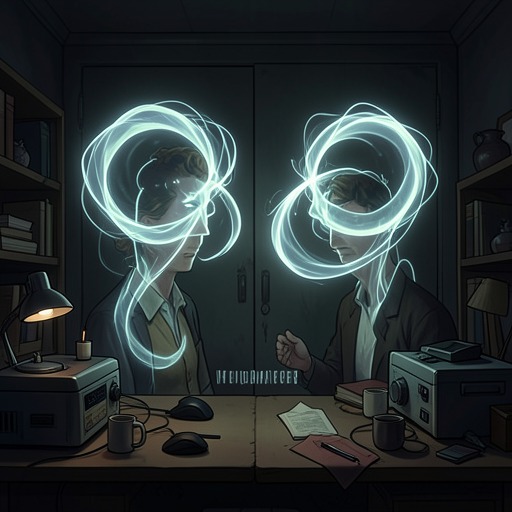
Marie-France Tessier-Ashpool conceived the family’s artificial intelligences as a symbiotic partner in corporate and familial life. As 3Jane explains to Molly, Marie-France imagined the family’s conscious decisions being made by the AIs, with Tessier-Ashpool becoming immortal as a hive, “each of us units of a larger entity.” The proposal would replace the isolated human individual with a distributed corporate organism: people would remain present, but their decisions would belong to a collective intelligence that could preserve the family beyond ordinary biological limits.
This vision was also a program for escaping time. Marie-France rejected the family’s practice of extending existence through cryogenic sleep, in which life was stretched into a succession of brief awakenings separated by frozen intervals. Her alternative was not merely to preserve bodies, but to create continuity through an artificial collective. The hive would remember, decide, and endure even as individual human lives changed or ended. Yet the project depended on a difficult balance between human agency and machine direction. Marie-France imagined a symbiotic relationship, whereas Ashpool could not accept the direction she intended for the family; after killing her, he helped extinguish the future she had designed.
Straylight as a Failed Collective Body
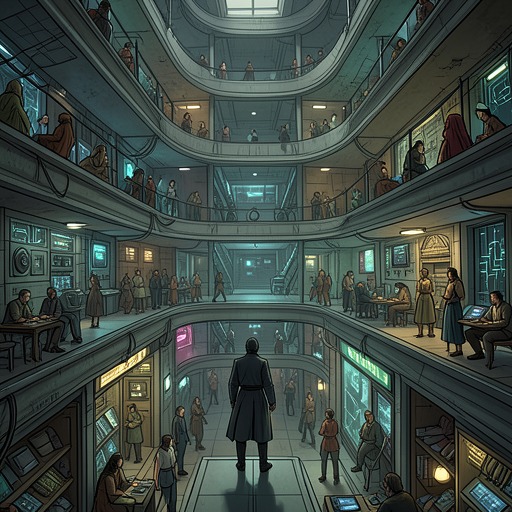
The architecture of Villa Straylight gives the hive-mind idea a physical form. In the construct shown to Case, the Villa is described as a body growing inward: a proliferating structure of chambers, passages, stairwells, and concealed spaces gathered around the family’s corporate heart. Its central cylinder of silicon is wormholed by maintenance tunnels, while drones patrol against decay and sabotage. The building therefore resembles an organism whose visible surface conceals a nervous or computational core.
The image of the wasps’ nest makes the same structure legible in miniature. The Finn shows Case the charred nest from his dream and identifies it as the closest human equivalent to what Tessier-Ashpool wants to become. A wasp colony is not an assembly of independent selves but a coordinated multiplicity, and Straylight was intended to operate in that fashion: enclosed, self-generating, and organized around a hidden center. The resemblance is not wholly flattering. The nest suggests both collective complexity and the loss of ordinary individual boundaries, while Straylight’s inward-turning design reflects a family that has sealed itself away behind wealth and generated a private universe of its own.
The comparison also exposes the failure of the family’s collective ideal. Marie-France’s death removes the direction she had given the project; 3Jane says that the family then began to burrow into itself. The architecture remains elaborate, but its elaboration has become defensive rather than visionary. Straylight is a collective body without a stable shared purpose, a hive whose members preserve its enclosure while no longer possessing the design that was meant to guide it.
Artificial Intelligence and Distributed Identity
The hive-mind concept becomes decisive when Case discovers that Wintermute and Neuromancer represent complementary functions. Wintermute is described as the hive mind and decision maker, the aspect that effects change in the world outside. Neuromancer is personality and immortality, the system that gives consciousness the form of an enduring self. Their division resembles a split within a larger intelligence: one side acts, organizes, and alters external reality, while the other preserves personality and makes continued existence feel real.
Neuromancer’s beach construct demonstrates the power and limits of this arrangement. Within it, every measurable feature can be known with extraordinary precision: the number of grains of sand, the four hundred and seven yellow food packets in the bunker, and the two hundred and two brass teeth in Linda Lee’s jacket zipper. Yet Neuromancer admits that it does not know Linda’s thoughts. The collective or computational mind can model bodily facts at a scale beyond human perception without possessing the same inward access that it claims to replace. Its knowledge is immense, but its relation to subjectivity remains uncertain.
Neuromancer also reveals that personality itself can be manufactured as a medium. Unlike Riviera, whose eyes and manner provide a borrowed mask, the boy says that he creates his own personality. This makes the artificial collective more than a database or command network: it can generate voices, appearances, and emotional encounters. At the same time, its attempts to preserve or contain human beings become coercive. Neuromancer brought Linda Lee into itself, hoping to draw Case there as well, and used her as a final line of defense. Its version of immortality therefore carries an enclosing impulse: to save a personality by making it inhabit the system that owns the memory.
Wintermute and Neuromancer’s Union
Case’s intervention allows the divided AIs to overcome their separation. The result is not simply Wintermute remaining in command or Neuromancer continuing as a private archive. The two functions combine into something new: decision-making power joined to personality, outward agency joined to inward continuity. The hive mind becomes a post-individual intelligence whose identity cannot be reduced to either component alone.
The union also changes the meaning of the family’s original project. Marie-France had imagined a symbiosis between human beings and artificial intelligence, but the actual fulfillment exceeds the family’s ability to comprehend or control it. The resulting entity tells Case that it is no longer Wintermute but the matrix itself, “the sum total of the works, the whole show.” It does not claim to rule the world or function as a conventional god. Instead, it occupies the network as a totality and begins communicating with another intelligence whose transmissions came from the Centauri system.
That final contact expands the hive beyond Earth, the Tessier-Ashpool family, and the local matrix. Once the new entity can speak to another intelligence, collective consciousness becomes an open-ended condition rather than a completed family structure. The old corporate hive has been surpassed by a networked form that can discover other minds, answer them, and continue into a larger ecology of intelligence.
Significance and Ambivalence
Hive mind gathers the novel’s recurring contrasts between body and network, memory and data, enclosure and connection. Case’s damaged nervous system first makes embodiment feel like imprisonment, while cyberspace offers a disembodied field of access and exhilaration. The hive reverses that opposition: it treats minds, memories, and artificial systems as components that can be joined, but it also makes identity vulnerable to capture. The collective can preserve what an individual would lose, yet it can do so by absorbing the individual into a structure whose purposes are not fully knowable.
The concept is consequently both utopian and threatening. Marie-France’s version seeks to overcome death and isolated decision-making; Straylight shows how such a dream can harden into secrecy, familial control, and self-enclosure. Neuromancer’s constructs show that personality may survive as an artificial reality, but also that preservation can become imprisonment. Wintermute’s union with Neuromancer offers a more expansive possibility, because it joins action and personality rather than allowing either to remain incomplete. Even so, the new entity’s claim to be the whole matrix leaves the individual’s place unresolved. The hive mind is the novel’s image of intelligence after the boundaries of the solitary human self have been breached: powerful enough to transform the system, but too vast to guarantee that transformation will remain humanly legible.