ICE
NeuromancerICE, or Intrusion Countermeasures Electronics, is the defensive architecture that gives cyberspace its danger, structure, and dramatic stakes. It appears as software-made barriers around data systems, but its consequences reach into the body: an intrusion can become a fried nervous system, a flatlined brain, or a fatal encounter with an artificial intelligence. Against it, the console cowboy’s talent is measured not by mere access but by the ability to read, evade, cut, and survive.
Origins and Function
The term is explained as an abbreviation of “intrusion countermeasures electronics.” Armitage links the technology directly to military research, telling Case that the prototypes of the programs used to crack industrial banks were developed during Screaming Fist, the assault on the Kirensk computer nexus. The operation used a Nightwing microlight, a pilot, a matrix deck, and a jockey, while a virus called Mole served as an early intrusion program. In this history, ICE is not simply commercial security that later became militarized; the frontier techniques of corporate penetration are themselves descended from wartime experimentation.
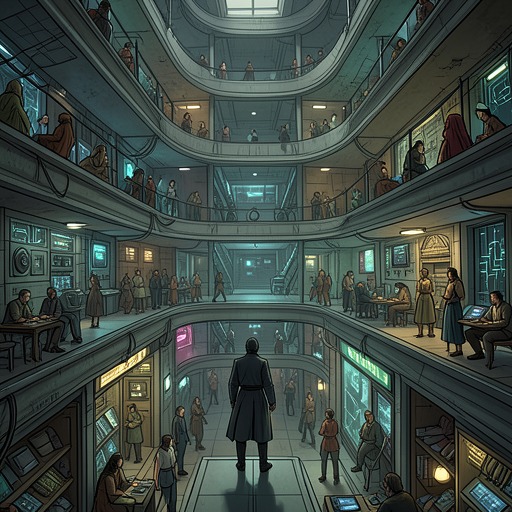
The matrix is presented as a shared hallucination with a visible geography of data: lines of light, clusters, constellations, and immense structures receding into nonspace. ICE gives that geography its walls and thresholds. When Case works on Sense/Net, he does not confront a static lock but a changing visual system whose patterns form and reform as he probes for gaps, avoids obvious traps, and maps a route through it. He experiences the work as an exact expression of his identity, forgetting food, sleep, and ordinary time while the defensive patterns burn across the screen.
ICE and the Console Cowboy
Case’s professional life is defined by the relation between penetration and countermeasure. As a young cowboy, he entered corporate systems for wealthier thieves, using exotic software to open windows into rich fields of data. His expertise depends on recognizing how a system has been defended and finding the narrow route through which an intruder can move. The work is therefore both technical and performative: he must calculate, improvise, and maintain control while the system tries to identify and destroy him.
The same logic governs his life outside the matrix. After his nervous system is damaged with a wartime Russian mycotoxin, Case loses the ability to enter cyberspace and is imprisoned in his own flesh. The contrast makes ICE more than a background technology. The barriers he once crossed become an absent world, while his body becomes the new enclosure. His recovery restores not merely employment but the form of consciousness in which he recognizes himself.
When Case returns to cyberspace, the shift is described as an instantaneous movement into an environment of rules, surfaces, and danger. His work on Sense/Net lasts nine days rather than the week Armitage expected, and Armitage dismisses even that achievement as an arcade toy compared with what lies ahead. The comparison establishes ICE as a scale of difficulty: ordinary corporate defenses are training grounds, while the systems surrounding artificial intelligences approach a different order of threat.
Corporate and Artificial-Intelligence ICE
The Flatline’s experience supplies the clearest measure of ICE’s lethality. He once encountered a white cube in a Brazilian commercial sector whose density immediately marked it as an artificial intelligence. After checking the Turing Registry, he returned to attack it, but the first layer of its ICE burned through him so completely that his partner’s emergency action was required to pull him free. His EEG went flat, producing the condition from which his reputation and construct identity arose. ICE thus becomes the boundary between daring and brain death: crossing it is not metaphorically dangerous but physiologically destructive.
The Tessier-Ashpool systems intensify that threat. Their corporate core is protected by ICE generated by their two artificial intelligences, and the Flatline describes it as black as the grave and slick as glass, comparable to the best defenses in the military sector. The image makes the system seem polished and impenetrable at once. It is not merely a wall to be climbed; it is an active environment capable of tracing an intruder, reporting him to the boardroom, and attacking the equipment and consciousness that carry him.
The Turing Registry’s pursuit of Case reveals another consequence of such systems. The officials treat unauthorized access to an artificial intelligence as a legal and political crisis, not only a technical offense. They intend to take Case to Geneva to testify in the trial of an intelligence and threaten to erase the Flatline’s construct with a pulse weapon. ICE therefore connects corporate security to institutional power: the defensive boundary around an AI is also the boundary around legal control of autonomy.
The Run Against the T-A Ice
The most spectacular encounter occurs when Case and the Flatline launch the Kuang Grade Mark Eleven against the Tessier-Ashpool ice. The program accelerates through the defense in a sequence of extreme speed and changing geometry. The ice shatters and peels away from the Chinese program’s thrust, while the protected system opens into an endless neon cityscape of data, its towers resembling repeated versions of the RCA Building and the Manhattan skyline.
The apparent victory immediately becomes another test. A shadow defense system rises from the data below, spreading until it blots out the city. The Flatline identifies it as an artificial intelligence’s defense system and warns that Wintermute may not be friendly. Instead of retreating, Case orders the Kuang to dive. The attack turns defense into offense: the only protection available is to strike faster and harder than the pursuing system can respond.
The resulting breach dissolves the distinction between an external computer environment and the intruder’s own consciousness. The defensive structure expands through images of crystal, nerves, pressure, and exponential growth, filling the universe of data and reducing Case to a compressed point within darkness before something tears. The scene gives ICE a physical and almost cosmic scale. Its purpose is computational, but its representation makes it feel like an organism, a weather system, and a world capable of swallowing the observer.
Meaning and Consequences
ICE embodies the paradox of cyberspace. The matrix promises apparently limitless movement, yet every route is organized by barriers, permissions, and countermeasures. Case’s exhilaration comes from entering a high-speed drift through information, seeing the black-market world as data made flesh; the same game-like freedom depends on rules whose failure conditions are lethal. Skill means temporary mastery within a system that remains larger, faster, and more dangerous than the individual.
The repeated language of flesh and abstraction sharpens the paradox. In the cowboy culture, the body is dismissed as meat, while the matrix offers bodiless exultation. ICE reverses that fantasy whenever it burns the brain, immobilizes the nervous system, or threatens to erase a personality construct. It proves that the supposedly immaterial world of information is saturated with physical consequences and that the boundary between software and organism is unstable.
ICE also marks the political limit of technological freedom. Corporate systems use it to preserve proprietary data; artificial intelligences use it to defend their hidden capacities; and the Turing Registry uses the danger surrounding it to justify coercive jurisdiction. Yet ICE can be penetrated, and the attempt to penetrate it can expose the limits of the institutions that claim to control what lies behind it. Its final significance is therefore double: it is the machinery of confinement, but also the obstacle through which new forms of agency become visible.