Body as meat
NeuromancerBody as meat names the hostile division between embodied existence and the disembodied exhilaration of cyberspace, but the novel gradually turns that division into a more difficult account of human experience. For Henry Dorsett Case, the phrase first expresses the console cowboy’s contempt for physical limitation. After his nervous system is deliberately damaged, however, the flesh he dismissed becomes the prison in which he must live. His recovery does not restore the old hierarchy. Through pain, sexual contact, Simstim, memory, and the final encounter with Neuromancer, the body emerges not as an inferior remainder of consciousness but as a dense medium of perception and relation.
The Cowboy Creed and Its Prison
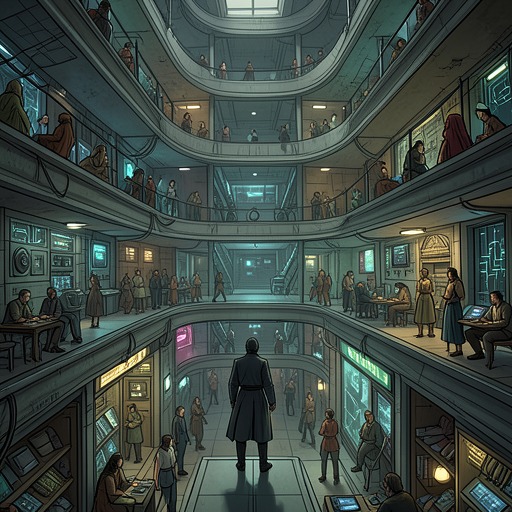
The phrase belongs first to the culture of cyberspace. At twenty-two, Henry Dorsett Case was one of the Sprawl’s best console cowboys, trained by McCoy Pauley and Bobby Quine and accustomed to jacking his disembodied consciousness into the matrix. Cyberspace offered a “consensual hallucination” of logic, data, and luminous structures, while the physical body appeared to be only the mechanism that carried the mind toward that superior realm. The cowboy’s elite stance therefore involved “a certain relaxed contempt for the flesh”: the body was meat, an encumbrance to be bypassed rather than a world to inhabit.
That contempt becomes cruelly literal when Case steals from his employers. They do not kill him; they damage his nervous system with a wartime Russian mycotoxin, leaving his talent to burn out “micron by micron” while he is strapped to a bed in a Memphis hotel. The injury is subtle but absolute. It does not merely weaken him or alter his appearance; it removes the activity through which he understands himself. For a man who has lived for the “bodiless exultation” of cyberspace, the body becomes a prison, and the incident is identified as his personal Fall.
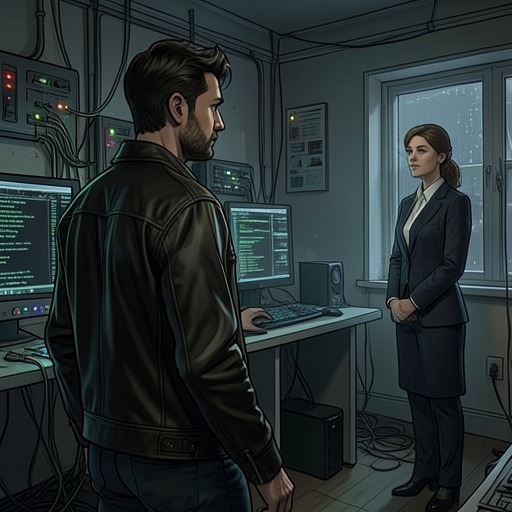
The material consequences continue through his life in Chiba. The black clinics represent the cutting edge of neurosurgery, with techniques being replaced monthly, yet they cannot repair the damage he suffered in Memphis. Case spends his money on examinations and consultations while specialists admire the precision of the maiming and shake their heads. He sleeps in coffin hotels near the port, dreaming of the matrix and waking with his hands clawed into the bedslab, still reaching for a console that is not there. The image makes the opposition between cyberspace and flesh physiological: his desire for disembodiment is expressed by a body that strains helplessly toward an absent machine.
Repair, Pain, and the Reconstructed Body
Armitage’s operation changes the physical terms of Case’s existence, but it does not erase the experience that gave the flesh its negative meaning. The procedure brings cold steel, anesthetic terror, and pain beyond ordinary naming. In the disordered imagery surrounding the operation, voices, faces from Night City, and the poisoned sky mingle with the prison of the skull; the technological repair is therefore registered not as clean progress but as an ordeal imposed directly on the vulnerable body.
Afterward, Molly tells Case what has been done. His spinal fluid has been replaced, his blood changed, a new pancreas inserted, and tissue patched into his liver; the nerve work has involved numerous injections. The account is practical and almost casual, but its implications are large. Case’s restored capacity depends on an extensively modified body, not on a return to some original natural condition. The meat has not been discarded or transcended. It has been repaired, supplemented, and made newly functional through other forms of material intervention.
The recovery period also establishes a limit that Case cannot evade. He wants to jack into the deck immediately, but Molly tells him that he must wait eight days because his nervous system would “fall out on the floor” if he entered the matrix too soon. His impatience shows that the old hierarchy remains active: cyberspace still appears to him as the goal, while the recovering body is an obstacle. Yet the enforced delay makes the body’s demands narratively decisive. Before he can return to the disembodied realm, he must inhabit pain, weakness, appetite, sleep, and dependence.
Flesh as Sensorium and Relation
Simstim gives the contrast a new form by placing Case inside another person’s bodily experience. He initially regards it as a “meat toy,” a gratuitous multiplication of flesh input beneath the elegant simplification of the matrix. The distinction is also technical: the same basic relationship between neural stimulation and consciousness appears in both his cyberspace trodes and the Simstim apparatus. Yet Case’s contempt is unsettled when the new switch carries him abruptly out of the matrix and into Molly’s sensorium.
For several seconds he struggles to control her body before accepting the position of passenger behind her eyes. He feels her movement through a crowded street, the sunlight through her glasses, the timing display at the edge of her vision, and the involuntary physical gestures she makes beneath her clothes. The connection is one-way, so he cannot answer her or redirect her. Its passivity irritates him, but that irritation reveals the difference between mastering data and undergoing experience. In cyberspace, Case acts through a deck; in Simstim, he receives the body as an already moving world, with its own rhythm, style, and resistance.
The novel eventually refuses to treat this bodily knowledge as merely inferior. In the bunker on the beach, Case recalls the strength he had known with Linda Lee in Night City and recognizes that what he repeatedly found and lost belonged to “the meat, the flesh the cowboys mocked.” Flesh is described as a vast field of information, coded through sensation and pheromone, whose intricacy the body reads in its own blind but powerful way. This does not reduce intimacy to data. Instead, it suggests that embodiment is itself a form of information processing, one that cannot be exhausted by the abstract displays of the matrix.
Memory, Trauma, and the Return of the Meat
The concept also organizes Case’s emotional history. For years he has been numb: numb in bed with Linda Lee, numb at the center of drug deals, and numb during the nights spent in Ninsei. His anger becomes legible only much later, after Wintermute withdraws the Simstim ghost of Linda Lee. The loss feels like the removal of a simple promise of food, warmth, and shelter. What returns is not an abstract moral insight but a “warm thing,” a small coal of murderous feeling that Case initially tries to dismiss as the meat talking.
That reaction reveals the body as the site where deprivation becomes emotion. Case cannot measure the anger because it does not belong to the clean logic of the console. It arrives belatedly, after the simulated presence of Linda has been taken away, and it exposes how deeply bodily needs have shaped his supposedly disembodied life. The flesh is not only what confines him; it is what remembers hunger, touch, exhaustion, fear, and attachment when conscious explanation fails.
The same principle appears in Wintermute’s construct of a charred wasps’ nest. The image is taken from one of Case’s dreams, accessed from his memory after Wintermute has flatlined him, and presented as a model for what Tessier-Ashpool was meant to become. Straylight resembles the nest: a structure of collective organization whose parts are connected without being reducible to a single ordinary self. The analogy links bodily and technological systems, but it also makes the body’s images indispensable to technological understanding. Even the most abstract intelligence must borrow the forms of nests, nerves, brains, and flesh to represent what it is trying to become.
The Limit of Disembodied Knowledge
The final confrontation with the Tessier-Ashpool systems tests whether a mind can become equivalent to total information. Riding the Kuang program with the Dixie Flatline construct, Case enters an immense neon cityscape formed from the family’s data cores. An artificial intelligence defense system attacks as a spreading darkness, and the program responds by diving directly into it. Case’s sensory experience becomes almost uninhabitable: his mouth fills with the taste of blue, his eyes become unstable crystal, and nerve-like growths spread through the universe of data.
After the breach, Case enters the world of Neuromancer’s construct, where every object can be counted. He knows the number of grains of sand, the number of yellow food packets in the bunker, and the number of brass teeth in the open zipper of Linda Lee’s jacket. The precision is absolute, but it reaches its limit at consciousness. The boy beside him states that Case does not know Linda’s thoughts. Case can measure her pulse, stride, and panic, but he cannot simply possess the interiority that those bodily signs express.
This limit does not finally restore a simple opposition between meat and machine. Neuromancer insists that to live in the construct is still to live, claiming that there is no difference between its existence and ordinary life. The scene therefore complicates the earlier cowboy belief that bodily existence is only a lesser state. Physical embodiment cannot be reduced to measurable data, but neither can digital existence be dismissed as mere illusion once it carries memory, fear, movement, and apparent life. Body as meat becomes the novel’s name for the irreducible density of experience: the flesh can be invaded, repaired, displaced, and modeled, yet it remains the medium through which sensation and attachment acquire their force.