Battle at the Expatriates’ mountain camp
NeverthelessThe Battle at the Expatriates’ mountain camp is the moment when a refuge concealed in the forest becomes a battlefield—and when Mabel chooses to fight beside Shai’s band and the exiles rather than remain a bystander. The attack exposes both the vulnerability created by Navon’s isolation and the possibility that people separated by exile and distrust can defend one another.
Causes and Setting
Navon’s crisis had been building before the first alarm at the camp. The kingdom had never previously faced a direct threat, but Tzara wanted its gold and land. Earlier battles had largely been fought on behalf of other kingdoms; alliances had offered Navon’s soldiers to defend the territories of powerful neighbors. Many men became deserters rather than fight wars that did not belong to them. Now Navon had too few soldiers, and its longtime ally was too afraid of Tzara to stand with it. The kingdom’s need for protection therefore grew just as its old sources of military support failed.
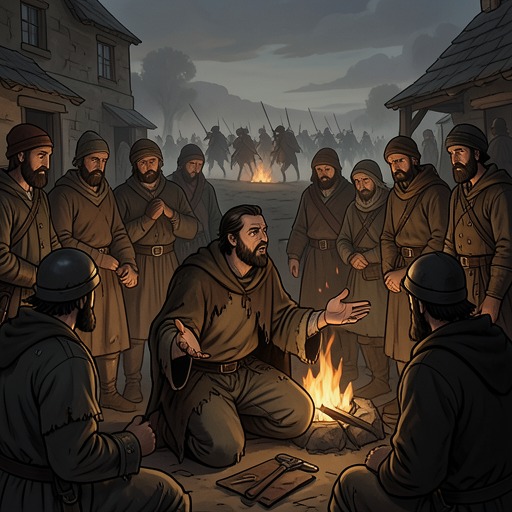
The exiles’ refuge lay high in the forest, reached on horseback by climbing a hill through a narrow canyon. A tavern stood amid the wooded landscape, while the outlaws’ hideaway above it offered concealment from the king’s eyes. That isolation had worked: Alastair said his people had been there for months without being discovered. When a boy burst in shouting that Balthasar’s men were coming, Alastair immediately accused Shai and his men of bringing the danger to them. Shai denied it, calling the arrival a coincidence. Another voice suggested that someone might have stolen a bag in Tzara, but did not believe that theft alone would explain the pursuit. The camp’s attackers had arrived; their exact reason for finding it remained disputed.
The Defense and Mabel’s Choice
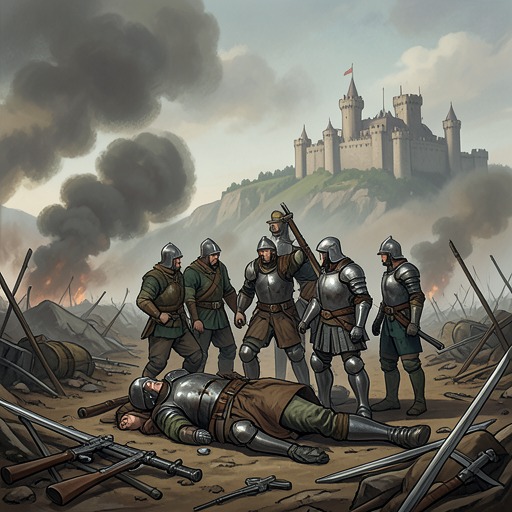
The defenders chose to strike before Balthasar’s men could reach the mountaintop. Archers concealed among rocks and on the roof shot at the soldiers climbing the mountain, while fighters on the ground met those who made it through. The position gave the exiles a chance to turn the difficult approach into a defense, but the attackers still pressed far enough to bring the fight to the camp itself.
Alastair rejected the order to hide. He told everyone to take up guns and declared, "We are the Expatriates' Order, we don't hide!" Then he pointed Mabel toward safety, calling her a soldier. The distinction recognized her place among the fighters even as he offered her a way out. Mabel initially tried to get a bow and arrows, but the man responsible for the arsenal refused, saying she would waste them. She found a position among the rocks instead, where her shots struck targets without revealing where she was.
At first, Mabel’s arrows helped her take part while remaining unseen. When the soldiers moved beyond her range, however, she felt that she was hiding while Shai’s band and Alastair’s people risked their lives. Her first target had been a soldier beating the young messenger, who could not defend himself. Seeing further acts of cowardice, and remembering what had happened to her parents, Mabel dropped the bow and took up her sword. The change in weapon marked a change in the way she entered the battle: she no longer fought from concealment, but joined the close combat directly.
The fighters around her briefly stared at the girl holding a sword, then responded to her presence in the battle by doing what they could with axes and spears. Shai fought with knives, attacking in several directions; Gaspar brought down soldiers without Shai’s grace, and Alastair fought ferociously. Their different styles made the defense a collective effort rather than a contest led by one fighter. Mabel, who had come among the exiles as an outsider, was now fighting in the same field as they were.
The force sent by Tzara was smaller than the defenders had expected. Its general had dispatched what the narrative calls an insignificant number of soldiers, apparently believing that force sufficient to defeat the camp. Instead, Tzara’s men could not match Shai’s band and Alastair’s entourage, and they began to flee. Their defeat suggested to Mabel that Navon’s soldiers might also be able to resist Tzara—and that the kingdom might rid itself of the threat if its forces remained united.
Reversal and Political Consequences
The defenders’ advantage did not make the battle harmless. As the remaining Tzara soldiers fled, Mabel was celebrating with the others and failed to notice one who stayed behind. He knocked her down, pinned her legs beneath his weight, and repeatedly struck her face. The victory’s momentum abruptly became a struggle for her immediate survival. Shai, having left a soldier dead on the ground, saw Mabel fighting her attacker and moved toward her; Alastair spread his arms to stop him. The scene leaves the intervention unresolved at this point, but makes clear that Mabel’s decision to join the fighting exposed her to the same bodily danger as the men beside her.
The battle also changed the terms of the political conversation that followed. When Navi asked Shai what the exiles wanted in exchange for their help, he specifically asked how much money they expected. Shai answered that they wanted nothing and were not fighting for money. Their stand at the camp had shown that they could resist Tzara’s forces; their refusal of payment made that resistance something other than a hired service. The episode thus turns a military demonstration into the basis for a possible alliance, while leaving its defining condition not as a price but as a shared cause.
A Model for Later Defense
A later threat to Navon gives the mountain-camp battle a wider resonance. As danger approaches, Navi orders the village brought inside the castle walls before the army is called and its soldiers gathered. Shai’s men wake the villagers in the night and escort them to shelter, turning the cooperation first tested in the camp into practical protection for civilians. The defense now involves not only fighters confronting an enemy, but also the movement of a population out of danger.
The arrangement distinguishes those directed to seek safety from those expected to fight: women and children are told to enter the castle, while the men are expected to stand against the attack. Mabel understands the plan but is unsure she can leave the soldiers after standing with them; to her, withdrawing at the most frightening moment would betray what it means to be one of them. The camp battle’s significance therefore extends beyond its defeat of a force sent against the exiles: it belongs to a developing effort to make defense a shared responsibility, even as Mabel insists that solidarity carries obligations for her personally.