Navi and Mabel’s separation over Soray
NeverthelessNavi and Mabel’s separation over Soray is the scene in which political responsibility becomes an intimate rupture: Navi chooses the match he believes Navon needs, while Mabel is left to reckon with a love he acknowledges only after insisting that he cannot act on it. Their exchange turns on more than whether a wedding will take place. It exposes the unequal cost of his decision, the hope Mabel had attached to their kiss, and the kingdom’s claim on Navi’s private life.
Background and stakes
The immediate spark is a report that Soray, the Princess of Tantam, has come to become familiar with Navon and its politics because she and Navi are to marry. Yelsew tells Mabel of the rumor. She rejects it at first, reasoning that Navi would not have kissed her if he intended to marry Soray. The rumor instead makes the kiss newly difficult to interpret: Mabel realizes that Soray’s arrival may be connected to a political future Navi has already begun to accept, and she thinks she herself helped bring that future about.
The conflict carries particular weight because Mabel’s attachment to Navon is bound to home as well as romance. Navon’s castle stands atop a hill amid forest, and its only passage in from the front is a stone bridge; reaching the village from the castle is itself difficult, so Mabel has taken the long way along the river when she could. She has described her memories and future there as something larger than comfort. When she later argues that Soray could endanger the kingdom, she is speaking from that attachment, even though her fears about Soray’s temper and judgment remain Mabel’s accusations rather than established fact.
The confrontation
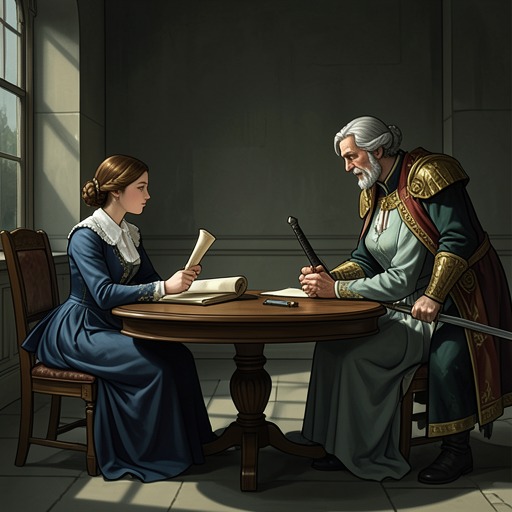
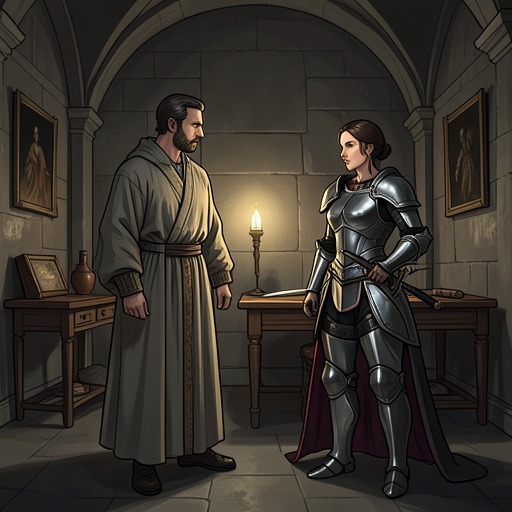
After Navi leaves the tavern, Mabel calls after him and follows until he stops and turns to face her. She asks directly whether he is going to marry Soray. His answer, “Maybe,” leaves the possibility open, and Mabel takes that uncertainty as grounds for hope. She pleads with him not to marry Soray, arguing that Soray could be bad for Navon, provoke a war, or act recklessly to attract attention. Mabel’s appeal is both political and personal: she presents the match as dangerous to the country, while nearly saying aloud that she herself should be the one suited to him.
Navi comes close to her and asks, “What can I do?” The question marks a turn in the scene. He does not answer as a man free to choose between two women; he presents himself as someone constrained by a responsibility larger than his wishes. He says that he has no choice and that Soray is what he and Navon need. His explanation does not reassure Mabel. She challenges the distinction between duty and desire by recalling that he did choose to kiss her, leaving her to carry the memory of an intimacy that his present decision cannot honor.
Duty against private feeling
Navi describes his kiss as a mistake because he believed he had no right to want anything for himself. He calls Soray necessary to Navon and frames marrying her as doing the right thing for everyone. Mabel hears a painful disparity in that claim: what he calls right for everyone is also the decision that excludes her. She says she could have been a princess and could have tried to become better, then accuses him of letting her go. Her words reveal how the political match has become, in her understanding, a judgment on her worth and suitability, not simply a choice of alliance.
Navi’s reply deepens rather than resolves the break. He tells her that she could have had him and that, if she had not abandoned him, the present crisis might not have come about. Mabel answers that he made her feel inappropriate. Then he says he would have fallen in love with her if he had been given time, calling her incredible and brave, but stops as he recognizes what he has said. The confession confirms that his feelings are real while making clear that he considers the chance to act on them lost. He asks her to forgive him for kissing her; apology and affection arrive together, too late to restore what the kiss led her to hope for.
Separation and consequence
Navi straightens, turns his back, and walks away. The narration presents his departure as painful for him too, but distinguishes his burden from Mabel’s: he is bound to a nation that depends on him, while she is left alone with what his choice has taken from her. The scene returns to the image of his back where she wishes she could hold his hand. Its language of strength does not make her grief disappear; instead, it shows the pressure on her to continue without leaning on the person who has just rejected their possible future.
Mabel understands the encounter as the heartbreak she had expected from the beginning. When she turns back toward the tavern, Yelsew sees that she is upset, puts a hand on her shoulder, and guides her inside without trying to joke. Vilanis asks what happened, and the attention of the men in the room shifts to her. This small aftermath makes the private rupture visible to the company around them, even though they do not immediately know its cause.
The event leaves the marriage question unresolved: Navi says “Maybe,” not that the marriage has already happened. What it settles is the emotional separation. He chooses the duty he believes Navon requires and relinquishes Mabel while admitting that he might have loved her; she is left with both the knowledge of his feeling and the certainty that he has acted against it. The scene therefore makes political obligation no abstract principle but a force that divides two people, and makes the delayed confession a final measure of how much their timing has failed them.