Mabel’s abduction to Tzara and the revelations about Shai
NeverthelessMabel’s abduction to Tzara is both a forced removal from home and a devastating rupture in what she believes about Shai and her missing brother, Gael. Confined in a guarded carriage, she learns that the man she knows as Shai is Golnar, Balthasar’s missing brother, and hears the King's Winner claim that Golnar killed Gael. The revelations make Mabel’s own loyalty newly dangerous: her captors say Golnar’s attachment to her is the means by which they intend to bring him to Balthasar.
Capture and Awakening
Mabel wakes when the carriage lurches over a rough road and her head strikes the seat. Still disoriented, she briefly wonders why she is in a moving vehicle when she should be on dry land; then she remembers what has happened. The carriage offers no practical route to freedom. Balthasar’s guards surround it, bars block the openings, and there is too little room for her to slip out. The vehicle seems specially made to transport a valuable captive, rather than to carry an ordinary passenger.
Her body bears evidence of how close the capture came to killing her. Mabel lifts her blouse to check the wound in her belly, remembering that it had bled until she lost consciousness. It has healed. The King's Winner, concealed in the carriage’s shadow, tells her, “I told you that you wouldn't die.” When she demands to know why anyone has taken such trouble to keep her alive, he answers that Balthasar wants to speak with her. The explanation is not reassurance: it makes clear that her survival is part of a plan whose terms she does not know.
Mabel asks why Balthasar would kidnap her if he does not need a ransom. The King's Winner connects her capture to her having joined Shai and says Balthasar intends to use her to bring him in. He claims that Golnar is attached to Mabel and that the captors will exploit that connection. If Golnar does not come, he says, they will get rid of her. The threat gives her continued life a bleak condition: she is not being held because her captors value her safety, but because they believe she can draw someone else within their reach.
The Revelations About Shai and Gael
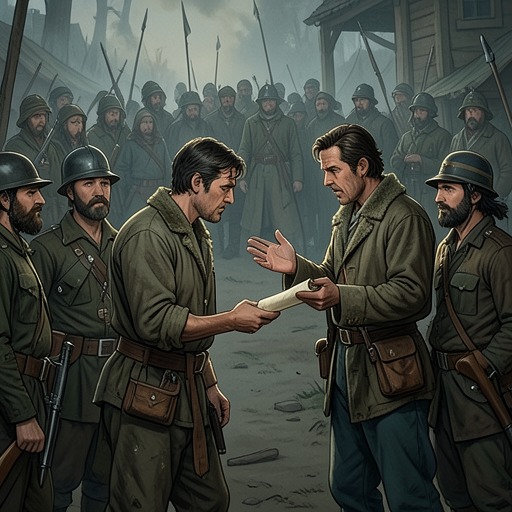
The King's Winner identifies Shai as Golnar, Balthasar’s missing brother. Mabel resists the claim by recalling Shai’s exile status and marked neck, and the reason he had needed her help entering Navon’s royal city. To her, his banishment had seemed incompatible with his being a missing heir. The King's Winner counters that Golnar could not have been marked in Navon because he had never belonged there. He further accuses Golnar of using Mabel to obtain an army and overthrow Balthasar, turning both Navon’s army and the outlaws who call themselves expatriates into instruments of his ambition.
These accusations recast Mabel’s involvement with Shai’s band. She had understood Shai as an exile who needed help; now her captor offers a rival account in which her help served a concealed dynastic struggle. Mabel does not simply accept it. She recalls the King's Winner pursuing Shai in Tenerife and reasons that his earlier efforts to capture him make his present claims harder to dismiss outright. But that circumstantial detail does not resolve whether the King's Winner is telling the truth about Shai’s motives. The scene leaves Mabel caught between an account that threatens to invalidate her judgment and a captor whose violence gives her reason to distrust him.
The confrontation becomes still more personal when the King's Winner turns to Gael. He says that Mabel has been searching for her brother and then, after making her demand an answer, tells her, “Your brother is dead.” He claims that Golnar killed Gael and insists that he witnessed the stabbing: “Because I was there,” he says, adding that Gael was betrayed. The assertion changes the question Mabel has been carrying from whether she will find Gael to whether she has lost him for good—and whether the man she trusted was responsible.
Mabel cannot verify the claim in the carriage. She recoils from the possibility that the King's Winner is right about both Gael and Shai, and the news brings her own past anger toward her brother into painful focus. She recognizes that her arguments and punishments had not amounted to hatred; they had been ways of keeping him present in her life. The prospect that she will never see him again transforms those old conflicts into guilt and grief. Her captor’s disclosure therefore does more than add a fact: it attacks her understanding of her brother, her judgment of Shai, and the purpose of the help she gave him.
Captivity and Arrival in Tzara
The King's Winner’s cruelty makes the carriage a place of physical as well as psychological confinement. After Mabel demands that he stop teasing her with partial answers, he elbows her in the face. When she tries to strike back, he shoves her against the metal wall, hitting her back and head. He declares that no woman talks to him that way. Mabel is hurt and unable to look up, but the account emphasizes her rage and sense of having been used. The exchange exposes the power imbalance on which the journey depends: she can question her captor, but he controls the space, the violence, and the information he chooses to disclose.
Her captivity is also measured by time. While Mabel sleeps for five days, a healer treats her wound and gives her herbs to keep her unconscious until she is fully healed. She wakes not completely restored, but strong enough to ask for answers. The imposed sleep has preserved her body while leaving her to confront, on waking, both the loss of control over her movement and the possibility of Gael’s death. Recovery does not return her to safety; it enables her to understand more fully what has been done to her.
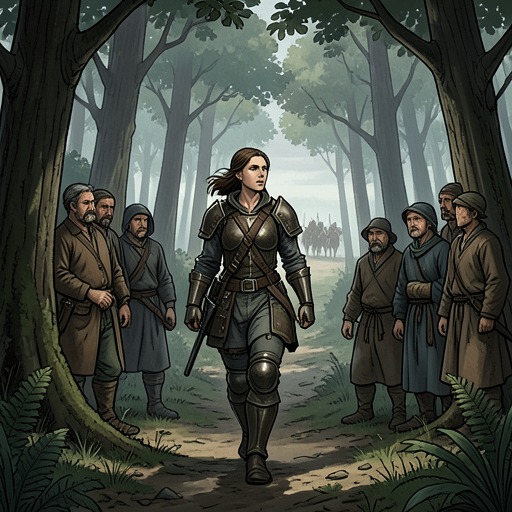
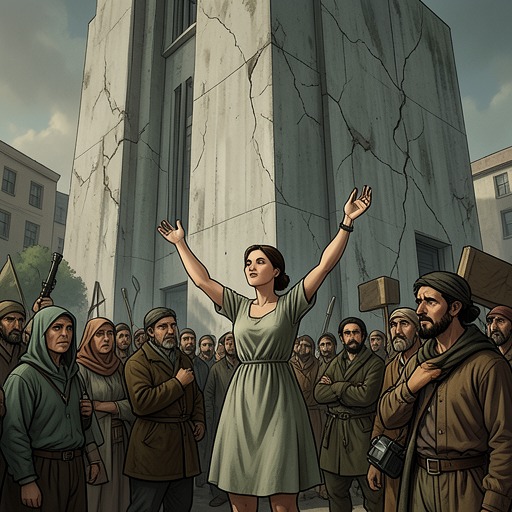
Tzara’s approach turns the carriage’s confinement into a larger geography of exclusion. A massive wall hides the city from the desert outside, while from within, only the tops of high buildings are visible. The villages and plantations are protected behind it; the royal city is described as easier to leave than to enter. Mabel sees a dark castle that contrasts with Navon’s, which stands among trees on a hill and can be reached by a passage across a stone bridge. Elsewhere, her departures from the castle and her journeys through forest refuges and across a long, elevated bridge have involved difficult crossings; here, the wall and armed escort make entry into Tzara a passage controlled entirely by her captors.
When the carriage stops, its door opens onto a large formation of armored soldiers. Mabel wonders whether they regard her as dangerous or valuable, but neither description seems to fit her own understanding of herself: she is a girl and a soldier who wanted to help save her city. The King's Winner pulls her toward the castle, and she sees no way to escape while surrounded in enemy territory. The heavy iron doors close behind her. Her abduction has ended not in release or explanation, but in a new enclosure—and in the knowledge that the truths she most needs to test are now bound to the people holding her captive.