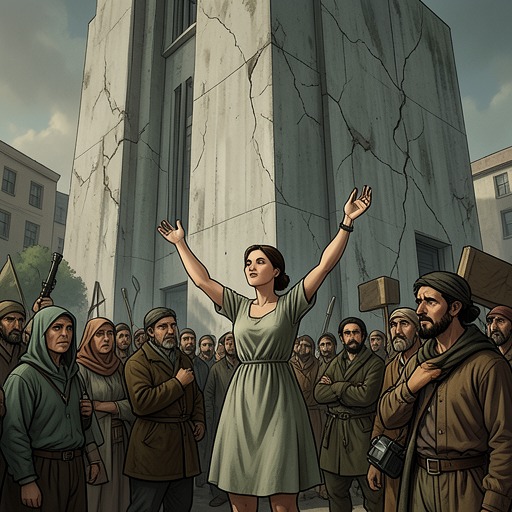
Gender Norms and Women's Agency
NeverthelessGender Norms and Women's Agency in Navon are defined by a persistent conflict between prescribed femininity and a woman's claim to choose her own life. The expectations appear in ordinary routines as well as in formal exclusion: girls are directed toward sewing, cooking, marriage, and conformity, while Mabel Peloponnese repeatedly insists that her abilities and purposes cannot be settled by those expectations. Her struggle shows that agency is more than access to a forbidden institution; it is the continuing effort to define what she can do, where she can go, and what kind of person she may become.
Expectations and Early Resistance
The social script is introduced through the contrast between Mabel and other village girls. At the hour when they might be at fairs, buying provisions, choosing fabric for gala dresses, or learning sewing and cooking from their mothers, Mabel is in the fields with her father. The domestic skills are presented as preparation for becoming a good wife, making marriage-oriented labor seem less like an individual preference than an expected destination. Mabel's daily attachment to fieldwork sets her apart before she enters any explicitly political or military conflict.
That difference is visible as well as behavioral. Mabel has golden skin and wild, burnt hair, and the narrative marks her as an eccentricity in Navon. Her father and Mabel do not consider this a problem, but Darice worries that a good life depends on blending in so as not to be noticed. Their disagreement establishes two different responses to social pressure: conformity as protection, and a refusal to treat difference as something requiring correction. When the king's servants arrive for Mabel, Darice's question about what her daughter has done wrong shows how readily her difference is interpreted as trouble, even though the reason for the summons is not yet known to her.
Class, Place, and the Possibility of Movement
Mabel's position as a peasant shapes the conditions under which she can exercise agency. The royal servants have to search for her in the fields because that is where they find a peasant girl, rather than in the spaces and activities associated with the village's expected feminine life. Later, after leaving the castle, she cannot simply take one of the horses in its full stables. Reaching the village is difficult without one, so she walks the long route beside the river and valley. Her attachment to walking is a preference, but the journey also makes visible how access to movement is conditioned by available resources.
The places in which Mabel moves have sharply different protections and thresholds. Navon's castle stands on a wooded hill; its palace can be approached from the front by a stone bridge, while reaching it otherwise means negotiating a mountain range and forest. By contrast, Mabel's childhood home is a rustic village house where her father sharpens his sword and Darice prepares food over a fire. Mabel remembers that home as her world and remains satisfied by the prospect of living in Navon. Her agency is therefore not a simple wish to escape her origins: she seeks a larger life without surrendering her attachment to home.
Her movement later extends beyond the village she had never left until three months earlier. She becomes involved in revolutionary plans with bounty hunters, rides with others to a forest tavern, and climbs on horseback through a narrow canyon to reach a high refuge where outlaws hide from the king's gaze. These journeys do not erase the dangers or restrictions surrounding her; they show how much her practical range has changed. A long bridge encountered on the road is wide enough for three horses abreast or two carriages, but its height above the river frightens her. The detail preserves both sides of movement: a route can make passage possible without making it safe or emotionally easy.
Exclusion from the Army
The clearest institutional test comes when Mabel approaches the military base after her parents' deaths. Navon is summoning young people from towns across the kingdom, including peasants, blacksmiths, philosophers, artists, and aristocrats. Many are inexperienced and uncertain, but they have been called to join the army. Mabel sees herself as the exception: she believes she should not be there, yet wants to belong to something that matters. The contrast makes exclusion especially stark because the institution is drawing in inexperienced recruits while refusing the willing woman at its gate.
The commander assumes that Mabel may be seeking a paycheck and offers to arrange a hearing with the king or help her family. She rejects that interpretation and says she wants to be a soldier. His objection is explicitly gendered: he says a soldier must be a man and argues that women lack men's strength and endurance, invoking the danger of a man overpowering her. Mabel answers that Navon needs every kind of help. The commander nevertheless orders a soldier to take her to the gate and declares that his army does not need her. The physical act of escorting her out turns an abstract rule into a public humiliation, witnessed by the young men who have been accepted into the recruitment field.
Conditional Access and Gendered Labor
Mabel later gains a place near the army, but entry does not mean equal membership. She spends five silver coins on leather pants and a vest, three times what a dress would cost, because she does not want to move around camp in one of her conspicuous dresses and give the soldiers another reason to ridicule her. Clothing becomes a practical calculation: she adapts her appearance to reduce the mockery that might further obstruct her work. Yet the narrative makes clear that this adjustment does not itself give her the chance to prove herself.
She is not properly inserted into or introduced to the troop. Instead, her duties include polishing weapons and checking that they work and remain sharp, inspecting armor and cavalry outfits, and following the commander so she can respond to what he or the soldiers need. She continues to endure nasty comments about being a woman in that setting. Though she observes the soldiers closely and recognizes their features after only a few days, the army treats her as an extra rather than as a prospective fighter. The distinction is important: she has crossed the boundary into the military environment, but its hierarchy channels her labor into service and withholds the recognition that would make her presence full participation.
A later job arranged through Navi exposes the same assumption in a different form. Amir arrives to take Mabel to work, but the position is tailoring: a domestic, low-risk occupation unrelated to kitchens or weapons. Mabel is unsuited to it by her own account; she is poor with needles, cannot stay still, and dislikes being indoors. The offer may be intended as a better alternative to field labor, but it still places her in work that conflicts with her stated capacities and desires. Her refusal makes agency concrete: she does not accept safety or respectability as adequate substitutes for the life she is trying to choose.
Agency, Risk, and Social Judgment
The pressure to restrict women is also enforced through other people's looks. At the tavern, Mabel recognizes that the soldiers' expressions imply she has no right to be there simply because she is a girl. She leaves quickly for air, and as men enter, their malicious attention makes her feel watched as prey. She stares back rather than showing fear. The moment does not remove the threat, but it distinguishes the gaze imposed on her from the judgment she makes of herself: other people may treat her presence as an invitation to assess or intimidate her, while she refuses to accept that their assessment determines her right to occupy the space.
The narrative's spatial contrasts extend to the approach to Tzara. Its border is enclosed by a huge wall; from outside, the view is only desert, while from the city side only the tops of tall buildings can be seen. The villages and plantations are protected, and the royal city is described as easier to leave than to enter. When Mabel reaches the castle, its darkness and growing proximity make her shudder. This setting does not grant her freedom merely because she has traveled far: movement can carry her into places where her safety and choices are sharply constrained. Read alongside the difficult walk to the village, the forest refuge, and the bridge high above the river, the route through the story makes access and vulnerability material rather than abstract.
Significance
The novel presents gender norms as both a cultural ideal and an institutional practice. Domestic instruction, pressure to blend in, assumptions about appropriate work, and the army's refusal to accept a woman all reinforce one another. Mabel's peasant status compounds these barriers: she has fewer resources for travel and arrives among recruits without the standing or equipment that might secure her place. Yet she does not confine her resistance to a single argument. She keeps moving between village, castle, military camp, forest meeting place, and distant border; she identifies what she wants, rejects jobs that contradict it, and challenges the claim that Navon can spare the contribution of someone like her.
Her agency is consequently neither effortless nor complete. Admission to a setting can leave its rules intact, as her menial army duties demonstrate, and choosing to move does not cancel danger, as the bridge and Tzara's fortified approach make plain. The central tension lies in the distance between being physically present and being recognized as entitled to act. By making that distance recur across domestic expectations, public spaces, and military authority, the narrative treats Mabel's insistence on self-determination not as a departure from the story's social world, but as a direct challenge to the rules that world takes for granted.