Defending Navon and Uniting Against the Enemy
NeverthelessDefending Navon and Uniting Against the Enemy is not simply a military campaign but a test of whether Navon can turn a threatened homeland into a common cause. Its leaders seek soldiers and diplomatic partners, while Mabel and Shai press them to recognize the claims of people whom the kingdom has excluded. As the danger becomes immediate, defense also means moving villagers to safety and deciding who will remain to fight.
A vulnerable kingdom and the cost of earlier choices
Navon enters the crisis with a serious disadvantage: the story describes the kingdom as having faced no direct threat in its history until Tzara sought its gold and land. Earlier wars had largely been fought on behalf of other kingdoms, as in the service of Mabel’s father, Amyntas. Navon’s alliances had exchanged its men for the defense of more powerful rulers’ territories. Many soldiers deserted rather than fight battles that did not belong to them, and the kingdom’s harsh, irrevocable punishment of deserters left it with fewer people available when its own land came under threat. The danger is therefore presented not as an unforeseeable misfortune alone, but as the consequence of political arrangements and choices that left Navon exposed.
The external danger is embodied by Balthasar, a conqueror whose campaigns take villages and kingdoms, kill defeated kings, and enslave conquered populations. Mabel has heard of the scale of his forces and the weapons he has accumulated; she understands that Navon’s defeat would put its people under his power. The threat reaches beyond royal prestige or territory. Her testimony includes the forced removal of women and the mistreatment of older people, making the stakes civilian survival as well as military resistance.
Diplomacy under pressure
Navi’s first response is to seek help beyond Navon. A month before receiving an answer, he sent a letter to a neighboring kingdom and waits for its reply knowing that his people’s lives may depend on it. Navon’s existing troops are described as capable, but too few, with many of the remaining soldiers young. The neighboring kingdom declines to risk its forces against Tzara, fearing that intervention would leave it vulnerable. Navi recognizes the calculation: a weaker kingdom asking for help might itself be a danger to assist. The refusal leaves Navon isolated and makes diplomacy’s limits concrete.
In another negotiation, Navi asks Behrooz for troops and offers substantial resources in return: a share of Navon’s wood production, a supply of weapons, and, if necessary, a third of its crops. Behrooz considers the losses his own kingdom might suffer and does not make the agreement. Navi warns that Balthasar will move on to other kingdoms after destroying Navon, but the warning cannot erase the risks Behrooz sees. The exchange exposes the central problem of coalition-building: each ruler can understand the danger and still hesitate to bear the immediate cost of resisting it.
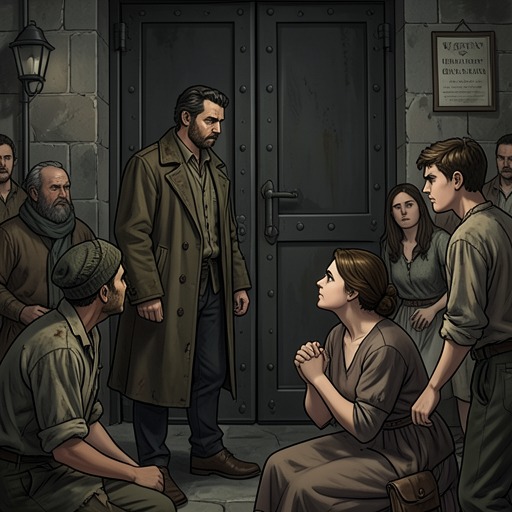
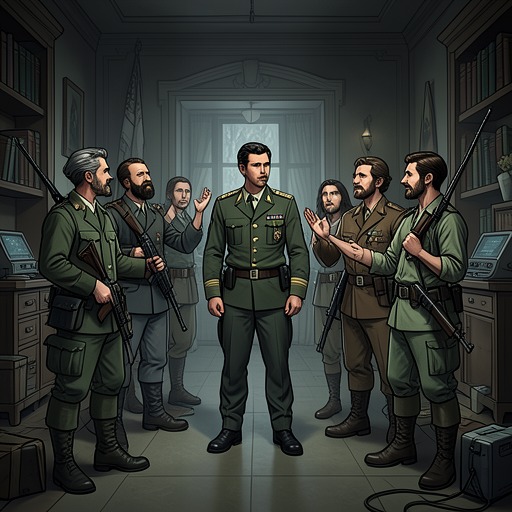
Navi also confronts the question of whom Navon will accept as defenders. Shai proposes that his band fight alongside the kingdom. The group is associated with bounty-hunting and other paid services, and Navi initially objects to opening Navon’s doors to men who have been banished. Mabel challenges the assumption that the exiles are simply outlaws: their offense, as she describes it, was cowardice, while Shai’s proposal is to fight for Navon. He argues that roughly fifty additional men, perhaps more, could give the kingdom an advantage, and asks for three weights of gold. Later, Navi asks Shai about the band’s conditions and learns that they are not fighting for money. Their participation changes the proposed alliance from a purchase of services into a commitment to a shared defense.
Mabel and Shai widen the meaning of defense
Mabel’s commitment grows from her attachment to Navon and from what she has seen. Her childhood home and memories are rooted there; leaving the castle for the village, she takes the long road beside the river rather than treating the kingdom as an abstract possession. After her parents die, she does not return to the palace, but goes to the military base, where recruits from across Navon gather. Many are young, inexperienced, and uncertain about why they have been summoned. Mabel sees herself as the one who should not be there, yet wants to take part in something that matters. Her resolve to contribute begins in grief but extends toward the fate of the community around her.
On the journey to Turilessa, Mabel learns that Navi’s mission is to establish an alliance and stresses how badly Navon needs one. She also encounters Shai’s band in a forest refuge reached by a narrow canyon and a climb to a hilltop. Shai hopes she can intercede with the king. The exiles do not welcome the prospect of returning home to the ruler who banished them, yet they say they will defend their land. This distinction matters: they can refuse reconciliation with Navon’s authority without abandoning the people and place they consider theirs.
Mabel makes the danger personal when she describes what she witnessed in Navon and warns that the kingdom may be destroyed and its people enslaved. Not everyone among the exiles accepts her appeal; one responds that Navon’s fate is not their problem. Her question about what kind of criminal would refuse to care for others presses against the very label that has defined the group. Shai’s plan to bring the exiles and Navon together offers a practical alternative to waiting for a powerful kingdom to act. He wants both sides to see that two forces together are stronger than one, and that people without noble status can still contribute to a defense.
From alliance to protection of the population
The argument for resistance is balanced by Navi’s more limited account of political responsibility. He tells Mabel that he cannot save the whole world; his duty is to protect his city and the people he loves. Mabel, by contrast, has urged him to respond when others suffer, including the women under Behrooz’s power. Their disagreement clarifies that unity does not mean agreement about every intervention. Navi draws a boundary around what he believes he can protect, while Mabel keeps testing whether that boundary leaves people in danger when help is possible.
When the threat reaches the village again, defense takes an immediate, organized form. Navi orders that the whole village be brought to the castle before the army is called, recognizing that the evacuation will take time. In the middle of the night, Shai’s men help villagers leave their homes and reach shelter; people initially fear another attack, but discover that the disturbance is a warning and an effort to protect them. Women and children are directed inside the castle walls, while men are expected to stand and fight. Mabel understands the arrangement but doubts whether she can leave the soldiers after having stood with them. The plan thus reveals both the practical logic of civilian shelter and the unequal burdens that wartime roles impose.
Territory, belonging, and the unfinished defense
The places through which the story moves give defense a physical shape. Navon’s castle stands on a hill among trees, with a stone bridge providing the approach from the front; the forest and mountain range make other routes difficult. Mabel’s walk along the river connects the palace to the village and to the home that gives her loyalty its personal ground. Later, the road to the outlaws’ meeting place passes through a narrow canyon to a high refuge outside the king’s immediate reach. These are not interchangeable settings: castle, village, and forest refuge represent different forms of access, authority, and protection.
The contrast becomes sharper at the border of Tzara. Its wall conceals the city and protects its villages and plantations, while the account emphasizes that entry into the royal city is harder than departure. Mabel’s arrival there marks the distance between Navon’s exposed position and a power that has fortified its territory. By this point the defense of Navon has grown from Navi’s search for royal alliances into a broader effort involving recruits, exiles, and civilians. The story establishes the preparations and the coalition’s moral stakes, but the evidence here does not resolve the outcome of the coming battle. What it does establish is that defending a kingdom depends on more than walls or a ruler’s decision: it requires deciding who belongs to the community being defended, and whether those people will act together before it is too late.