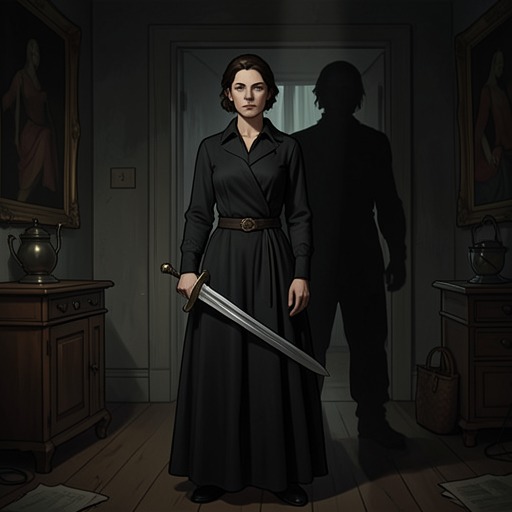
Justice and Revenge
NeverthelessJustice and Revenge names a central distinction in Mabel’s wartime choices: the distinction between answering personal loss with retaliation and resisting violence to protect others. Her parents’ deaths make the desire to fight immediate and personal, but the story does not leave her purpose at vengeance. Mabel disputes Navi’s interpretation of her motives, and her later actions repeatedly place defense and the preservation of life beside the use of force.
Origins in Loss and Exclusion
Mabel’s ideas about justice take shape against both the destruction of her home and the limits imposed on her. She is a peasant girl whose life in the fields with her father sets her apart from the domestic training expected of other girls. When the king’s summons draws her away from that life, and later the kingdom’s military recruitment gathers young people with little experience, she remains the one person who is understood not to belong. The commander initially assumes she might need money, but Mabel makes clear that she wants to become a soldier. The barrier is explicit: she is told that a soldier must be a man. Her struggle for a place in the Navon King's Army therefore begins as a demand to act, not merely as a response to bereavement.
The destruction of her village turns that demand into a question of justice. Mabel runs toward her family home while residents are being driven from their houses and attacked. She sees people in danger but cannot stop to help, because she is trying to reach her father. She finds him dead beneath a wooden storage structure, having been killed away from a battlefield. The manner and setting of his death matter: this is not a loss incurred in combat, but violence visited upon her family amid the destruction of the village. Afterward, Mabel does not return to the palace. She joins the crowd of new recruits, believing that she must make up for those killed, beginning with her parents. Her grief supplies the cause for resistance, while the scale of the attack makes that resistance larger than a private family reckoning.
Mabel and Navi Disagree About Revenge
Mabel states that the enemy killed her parents and that she wants justice for what has been done; she also expresses the wish to see Tzara fall. Her resolve is not presented as an absence of anger or personal stakes. Rather, she insists that those stakes do not make revenge an adequate description of her purpose. Navi argues that he has taken an oath for her and suggests that her pursuit of the fight is revenge, which he believes her father would not have wanted. He offers to act in her place. Mabel rejects his reading: she tells him he is wrong, and the narration clarifies that revenge is not what she wants.
That disagreement is significant because Navi’s offer appears protective, yet it also takes the decision away from Mabel. She does not accept protection as a substitute for agency. Her insistence that she is not fragile and not afraid accompanies her argument that she has a right to fight back. The conflict is therefore not simply between a desire for vengeance and a call to restraint. It is also between Navi’s attempt to define what her loss means and Mabel’s insistence on naming her own purpose. Her anger can coexist with a claim to justice without making the two identical.
Force as Defense, and Its Cost
The distinction is tested when Mabel is threatened by men who assume they can take any woman they choose. She recalls her mother’s warning that the world is not safe for women and recognizes that remaining indoors would not necessarily have prevented the danger. Although she has never hurt anyone before, she decides she must defend herself. She uses her father’s sword, keeps her attention on protecting vulnerable parts of her body, and draws on advice he once gave her. The encounter connects personal survival with the wider question of whether she can defend her town, but it does not make violence effortless or morally weightless.
In the fighting against Balthasar's Army, Mabel again resists passivity. When the Expatriates' Order prepares to defend its mountain camp, she asks to use a bow and is refused. During the ensuing battle, she joins the action; a soldier attacks her, and she takes his sword. She did not leave Navon intending to kill anyone. The narrative frames the killing as a consequence of war and assigns responsibility for the conflict to Balthasar, rather than treating Mabel as either an aggressor or a helpless victim. Shai helps her afterward, but Mabel cannot speak. Her first killing thus registers not as a triumphant completion of revenge, but as a grave threshold crossed under attack.
Protection and Restraint
Mabel’s later choices broaden justice from resistance to the protection of a community. When villagers are warned of danger and told that women and children should shelter inside the castle walls while men fight, she questions whether she can leave the soldiers after having stood with them. She puts on her armor and takes her sword instead of joining the procession to safety. Her reasoning turns on solidarity and the belief that the world contains more good people than bad; their existence makes it worth saving. The choice is dangerous, but the stated aim is defense, not punishment for her family’s loss.
The clearest counterweight to revenge comes when Mabel captures an enemy general. She has him restrained and tells him that he is her prisoner; she will take him to the King's Army as a hostage and will not kill him. The decision does not erase her earlier anger or the deaths that brought her to battle. It does show that fighting back need not mean killing an enemy whenever the opportunity arises. Across these episodes, justice remains bound to resistance, protection, and answerability, while revenge is the interpretation Mabel rejects when it reduces her choices to personal retaliation. The tension is never made abstract: it is measured in whom she tries to defend, what she is forced to do, and what she chooses not to do once she has power over an opponent.