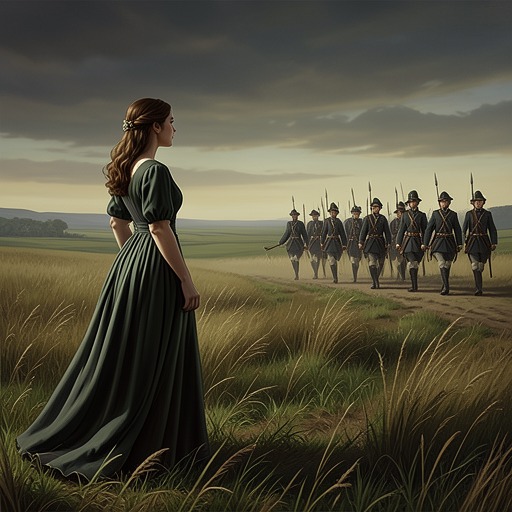
The Female Warrior Motif in The Ballad of Mulan
NeverthelessThe Female Warrior Motif in The Ballad of Mulan gives Mabel Peloponnese’s story a second narrative track: epigraphs from The Ballad of Mulan appear at pivotal thresholds, inviting comparison between a familiar image of female military service and a plot shaped by royal pressure, bereavement, and choices made under constraint. The novel preserves the question of how a woman enters a role reserved for men, but transforms the motif into a frame for Mabel’s pursuit of agency—and ends by withholding the secure homecoming that the epigraphs might lead a reader to expect.
The Ballad as a Framing Device
The first quoted image is domestic and apparently still: “Click, click. Click, click. By the doorway Mulan weaves, when all at once the shuttles cease.” It precedes Mabel’s introduction in the field with her father, where she is summoned to present herself in the king’s hall. The juxtaposition does not make Mabel a simple counterpart to Mulan. Instead, it sets the ordinary world of a daughter beside the interruption of royal demands, so that the loom’s sudden stillness becomes a compact frame for a life redirected by forces beyond the household.
Later epigraphs return at moments when Mabel’s options narrow or change. Chapter III asks, “Oh, my daughter. Who is in your mind? Oh, my daughter. Who is in your heart?” The question is placed beside Mabel’s efforts to imagine a tolerable future in the arranged marriage to Navi Spyridaki: she hopes that if he understands she is not foolish, they might at least become friends. The inherited lyric of a daughter’s inner life thus frames not a simple romance, but a young woman attempting to find room for herself inside a future being negotiated by others.
The pattern continues with the epigraph about a father’s name being entered for war. Its appearance beside the aftermath of Mabel’s parents’ murder shifts the familiar father-and-daughter motif into a harsher register. Mabel does not merely face an abstract duty to substitute for a male relative: she has lost the people who cared for her, and the palace she had been expected to return to now represents a life she refuses to resume. The epigraphs offer recognizable points of contact, while the prose gives those points different emotional circumstances and consequences.
From Household Roles to Chosen Service
The clearest correspondence appears in the chapter VIII epigraph: “But I'll buy a saddle and a horse and I will join the army in the place of my father.” The adjacent episode makes Mabel’s decision concrete. After an envelope is delivered to her door, she spends five silver coins on leather pants and a vest, three times the price of a dress. The expense is practical: she expects the clothing to spare her from marching around camp in one of her conspicuous dresses and becoming a target of ridicule. The juxtaposition links the legendary decision to the material preparations required to enter a male-coded military world.
But the novel changes the motive and shape of that inheritance. Mabel’s military path grows out of a sequence of pressures, including her parents’ deaths, her refusal to return to the palace, and her effort to determine what she will do next. She negotiates with Navi, secures her freedom from the expected royal future, and later prepares to enter the army. The echo of taking a father’s place remains legible, yet Mabel’s action is also an assertion of self-direction: the epigraph makes substitution the recognizable motif, while the surrounding story emphasizes her own decision and its practical cost.
The earlier chapter VII epigraph—“Oh, my father does not have a grown son. Ah, Mulan does not have an older brother.”—also frames a reversal in Mabel’s circumstances. In the adjacent scene, she approaches Navi with a proposal and a hand extended in negotiation. Her freedom is bound to the decision not to accept the future being offered to her; the echo of Mulan’s lack of a male sibling therefore resonates with a different kind of escape from prescribed roles. The novel connects female agency not only to entering the army, but also to bargaining, refusal, and the power to leave.
Gender, Ambiguity, and Difference
The epigraphs do not erase the risks Mabel faces as a woman entering a military setting. Her clothing purchase is shaped by her anticipation of soldiers’ ridicule, showing that practical adaptation includes managing how she will be seen. The motif consequently reaches beyond the heroic image of a woman taking up arms: it attends to the everyday material and social adjustments that make her participation possible. Mabel’s choice is neither effortless nor detached from the gender expectations around her.
The epilogue’s hare passage makes the question of gender legibility explicit. It describes signs supposedly distinguishing male and female hares, then asks, “But when a pair of hares run side by side, who will be so wise to tell if the hare is a male or a female?” This returns the reader to the problem of reading gender from outward signs, a problem already present in Mabel’s effort to move through a world that treats military service as a male role. Set at the close, the image does not simply celebrate disguise or announce that appearances are irrelevant. It leaves the act of classification unsettled, just as the story has shown Mabel’s identity and choices resisting the categories imposed on her.
An Unfinished Return
The novel’s relation to The Ballad of Mulan is repetition with substantial difference rather than a direct retelling. Its epigraphs preserve a series of inherited motifs—interrupted domestic life, a daughter’s private wishes, a father associated with military duty, the absence of a grown son, and a woman’s entry into war. The episodes beside them relocate those motifs into Mabel’s particular circumstances, where the pressures of royal marriage, family loss, and military exclusion shape what choice can mean.
The closing juxtaposition makes the difference especially sharp. After the hare riddle, Mabel wakes in a moving carriage, her head striking the seat as she realizes she is no longer on dry land. The King's Winner has tied her, escaped his own restraint, and covered her mouth when she tries to call for help; she is now his prisoner. The epilogue therefore does not conclude with a safe return or a settled reintegration. Its gender riddle is followed by Mabel’s captivity, turning the motif’s question of who a woman may be into an open question about what will happen to her. The frame honors the resonance of the older story while leaving Mabel’s own route home unresolved.