Women in the Military and Gender Norms
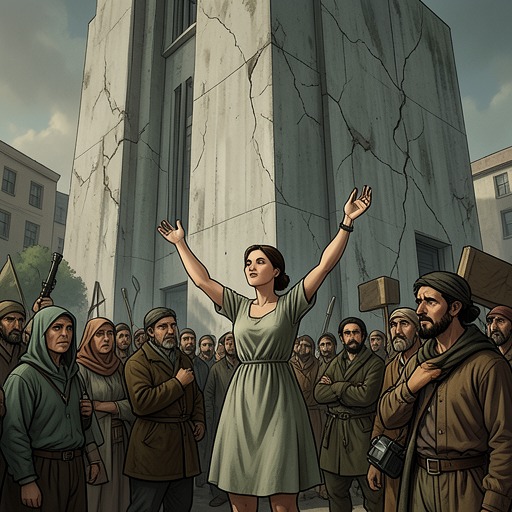
NeverthelessWomen in the Military and Gender Norms is a recurring conflict in Navon: women are expected to prepare for marriage and domestic life, while soldiering is defined as male work. Mabel’s effort to enter the army exposes how that boundary is maintained not only by an explicit refusal to recruit her, but also by assignments, jokes, judgments about her appearance, and doubts about what a woman can do. As Navon faces a shortage of soldiers and the threat of Tzara, her presence in military spaces tests a convention the kingdom can no longer afford to treat as unquestionable.
Domestic expectations and social difference
From childhood, Mabel differs from the model of a respectable village girl. While other girls might shop for household supplies, choose dresses, or learn sewing and cooking, she spends her days working beside her father in the fields. She returns with dirty clothes and untidy hair, absorbed in the work rather than in the behavior expected of a future wife. Her mother worries that standing out will prevent her from blending into the community; Mabel and her father are less concerned. The contrast establishes that gender conformity is taught as preparation for an ordinary, socially accepted life, not simply imposed when Mabel asks to join the army.
Class also shapes how she encounters authority. Mabel is a peasant, and the king’s servants have to search the fields to find her when she is summoned to the palace. Later, when she presents herself among young people recruited from across Navon, she is the one person who is not supposed to be there. The army’s recruitment of inexperienced people makes her exclusion especially visible: military need has brought in people without established skill, but being a woman remains a separate reason to deny her entry. Her position is therefore not captured by gender alone; her peasant background distinguishes her from the court, while her ambition places her at odds with the domestic future expected of women in her village.
Entry into military service and its limits
When Mabel arrives at the recruitment field, the commander assumes that financial hardship must explain her presence and offers to arrange help from the king. She refuses that interpretation and makes clear that she wants to be a soldier. The commander answers that a soldier must be a man. His response makes the restriction explicit: her desire and the kingdom’s need do not, by themselves, qualify her for the role.
Mabel nevertheless finds a place in the army, but not as a member of the troop. She buys leather trousers and a vest for five silver coins, three times the cost of a dress, partly to avoid giving the soldiers another reason to mock her. Yet the clothing does not translate into acceptance. She is not properly introduced to the troops and is assigned the work of a squire: polishing and checking weapons, inspecting armor and cavalry equipment, and following the commander in case he or the soldiers needs something. The promise that she would prove herself is exposed as misleading, because her actual position keeps her outside the soldiers’ ranks. Military participation is allowed in a narrow, subordinate form while the distinction between support work and soldiering remains in place.
The same pattern appears when Navi arranges a job for her after promising to help. Rather than work with weapons or in the army, Mabel is sent to a tailor. She objects that she is poor with needles, cannot stay still, and dislikes indoor work. The assignment may be intended as safer or more suitable for her, but it repeats the assumption that a woman’s place is domestic, even when that work is ill suited to her. Against the field, the palace, and the army, tailoring represents another attempt to redirect her toward an approved occupation instead of the one she has chosen.
Ridicule, scrutiny, and military credibility
In the company of soldiers and other men, Mabel’s claim to military belonging is repeatedly treated as comic or implausible. When she identifies herself as being in the King’s Army, the men laugh; Alastair questions whether Navon has become so desperate that it must recruit women. Mabel answers by pointing to the vacancy left by men who failed to serve. Her retort links the mockery to a practical contradiction: the men ridicule her presence even as their absence has helped create the need for her.
Shai sees a possible public meaning in her service. He argues that a woman on the battlefield could make others reconsider what they themselves can do, and that Mabel might give frightened soldiers a more accessible example than Navi, whose position as heir sets him apart. Shai’s argument is not that the danger is unreal: he describes the men as afraid of Tzara and says they need a reference point. Alastair objects that sending Mabel to war to motivate inexperienced soldiers risks treating her life as expendable. Their disagreement makes her representation politically consequential but ethically unsettled. Mabel is not merely a symbol chosen by others; she has already insisted on her own desire to serve, while those around her debate what that service should mean.
Even when she acts with persistence, acceptance is incomplete. The soldiers complain about her decisions and make her the target of their hostility, but intimidation and ridicule do not make her abandon her position. In another encounter, Sven scrutinizes her neckline and tells her to adjust it. Later he questions whether she, as a woman he considers weak, could have killed one of Balthasar’s men. Mabel counters by recalling that she fought Sven himself. The exchange shows two forms of gender policing at once: attention is directed toward how she presents her body, and her capacity for violence is doubted even when her own experience contradicts the doubt.
Femininity, belonging, and divided expectations
The narrative extends the conflict beyond formal military rules. At a festival, Mabel compares herself with the women around her: their elaborate dresses and perfumed hands contrast with her plain clothes and hands marked by sword use. She feels out of place and wonders how Navi could have kissed her. The scene measures her against a feminine ideal organized around appearance, courtship, and social ease, while her life has centered on training and conflict.
Yelsew invites her to dance when others have not, and Sven later does the same, recognizing that she has been ignored. Their gestures briefly change her place in the gathering, but they do not resolve her uncertainty about how to belong among the women of Navon. The attention also makes her the object of jealousy from other girls. Mabel has learned to handle swords and fights rather than the social customs of clothing, friendship, and competition. She is therefore pulled between the girl she is expected to be and the soldier she has worked to become; neither role comes to her as a simple, complete identity.
The army’s gaze also persists after she demonstrates capability. Those around her continue to see a helpless or fragile girl, despite what she has done. The narrative sets that judgment beside an idealized image of a princess as vulnerable, delicate, sweet, and beautiful. Mabel’s experience makes the contrast pointed: femininity is treated as a recognizable appearance and demeanor, while her military actions fail to dislodge the assumption that she should be protected rather than regarded as a capable participant.
War, protection, and the limits of change
The pressure to reconsider women’s service grows from Navon’s political and military circumstances. The kingdom has not previously faced a direct threat like Tzara’s attempt to take its gold and land. Earlier conflicts were fought on behalf of other kingdoms, and men deserted rather than fight battles they believed did not belong to them. Alliances had offered men in exchange for defending powerful kingdoms’ territories; now Navon lacks soldiers and cannot rely on its former ally. In this crisis, the question of who may fight is inseparable from the question of whether the kingdom can defend itself.
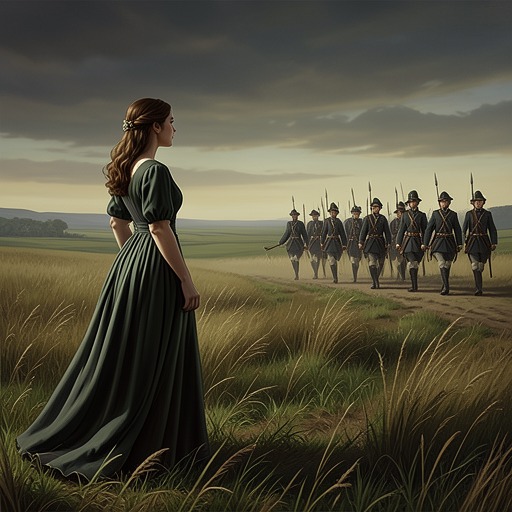
That pressure does not erase exclusion. When danger returns, villagers are warned in advance and Shai’s men help move them to the castle. Women and children are told to shelter within its walls while men are expected to stand and fight. Mabel understands the arrangement but is troubled by the prospect of leaving the soldiers after having shown that she stands with them. Her hesitation reveals the cost of a rule that assigns protection and combat by gender: the designated refuge may be safer, but it can also deny a woman the role and responsibility she has claimed.
The concept therefore develops through a continuing gap between recognition and acceptance. Mabel’s service can be useful, her actions can challenge assumptions, and her persistence can command respect; none of these automatically removes the formal or social barriers around her. The story presents women’s military participation not as a single victory over prejudice, but as a struggle over work, credibility, public visibility, and the right to decide how one will contribute when Navon is threatened.