Expatriate identity and freedom from obligation
NeverthelessExpatriate identity and freedom from obligation describe the double meaning of life outside Navon: deserters are violently cast out by the kingdom, yet build a community that claims independence from the duties and labels of the state. The novel makes this freedom neither simple escape nor uncomplicated ideal. It is born from punitive exclusion, sustained by shared life beyond the borders, and tested when Tzara makes the exiles’ homes part of the war they once refused to fight.
Exile as a State-Imposed Identity
Navon’s deserters are not merely soldiers who leave their posts. The kingdom’s punishment detaches them from society and condemns them to irrevocable exile beyond its boundaries. A deserter is branded at the back of the neck with a hot iron D, making the sentence visible on the body and allowing guards to identify the person as someone who must not rejoin Navonian society. If caught on Navonian soil, an exile faces death. The mark therefore does more than record a past act: it turns state judgment into a permanent public identity and enforces the boundary between the kingdom and those it has expelled.
The sentence also leaves exiles to survive outside Navon, where their most important sustenance comes from farms and houses they attack. The kingdom’s policy thus creates a contradiction: it disowns deserters as outsiders but sends them into conditions in which survival may place them in conflict with settled communities. The stigma attached to the word criminal obscures that coercive history. When Mabel asks what kind of criminal he is, Alastair objects that most of the men are deserters and exiles who refused to fight battles that did not belong to them. His correction does not deny their status under Navon’s law; it contests the assumption that the state’s label gives a complete account of their choices or character.
Freedom and the Community Beyond the Border
Alastair describes the exiles’ life through what it lacks: taxes, obligations, and duties owed to Navon. Their freedom is expressed as a refusal of political and social claims on them. He even insists that exile has released them from the feelings that might bind them to the kingdom. Yet his assertion that he has to believe in something leaves the claim unsettled. Freedom from obligation is also a belief the group must sustain, not proof that exile has erased loss or danger.
The forest community gives this declared independence a daily form. For several weeks, Mabel lives with Shai and his men among the trees and open air. They hunt in the morning and bring food back for everyone to share; the group eats the same food and maintains a small communal life with wives and children. Its members are not all related, and the account notes that no more than one person in a family has been exiled or branded as a criminal. The repeated sharing of food and work offers a practical counterpoint to the identities assigned by Navon: people who have been separated from the kingdom make a society together.
That society is not presented as entirely settled or wholly free of strain. The group’s early relationships are described as a make-believe social order, with people pretending to have relationships and a life that are not fully real. Over time, however, the band grows; anyone may join, and no one leaves. Mabel recognizes its appeal in the absence of rules, moorings, obligations, duties, and labels. The tension matters: the community’s belonging is made rather than guaranteed, while its freedom depends on living outside the institutions that once defined its members.
Names, Representation, and the Right to Belong
The struggle over identity appears in the language used within the group as well as in Navon’s law. When Shai calls the men criminals, Alastair corrects him to expatriates. The correction refuses to let a history of desertion stand as the group’s only name. It also exposes a distinction between legal classification and self-understanding: Navon can call its expelled soldiers offenders, while those soldiers can describe themselves as people who would not fight for other kingdoms’ interests.
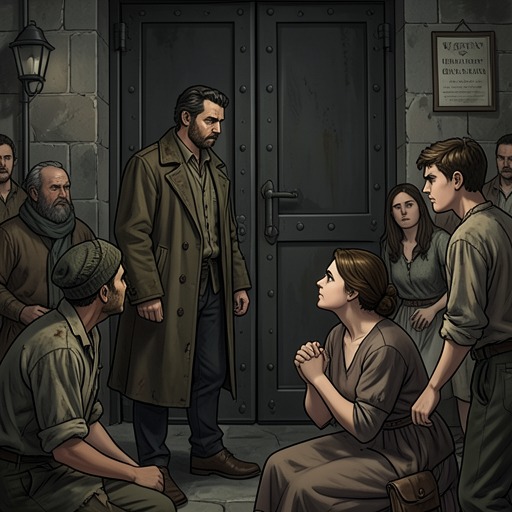
Mabel’s question to Alastair, and his response, make that disagreement explicit rather than merely theoretical. She challenges the community’s detachment by asking whether its members care that Navon is threatened. Alastair answers that they do not have those feelings and presents life without obligations as fortunate. His words sound like a defense of the exile’s bargain, but the exchange also shows how demanding that defense is: the group must decide whether refusing responsibility is genuine independence or a way to live with having been rejected.
Shai proposes a different kind of public identity for Mabel. He argues that a woman on the battlefield could stimulate Navon’s soldiers and become a symbol, while pointing out that the exiles look at her with respect. Alastair rejects the idea that a woman will represent him. Their disagreement places limits on any easy claim that the community has escaped social labels or hierarchies. The exiles resist being spoken for as criminals, yet Shai’s proposal risks turning Mabel into a representative figure; Alastair’s objection insists that his own allegiance cannot simply be assigned through her.
The Threat to Home and the Return to Navon
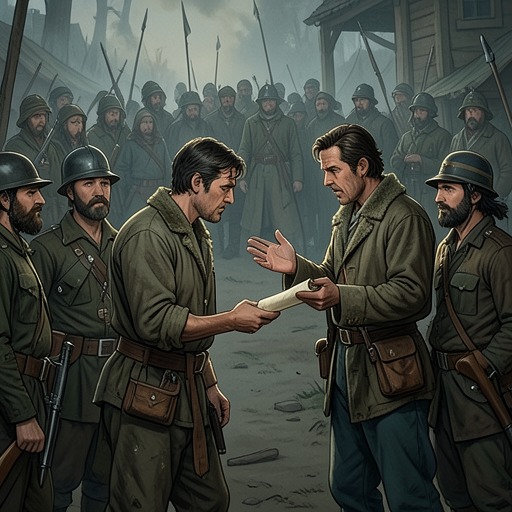
Tzara’s threat changes the force of the exiles’ refusal. Mabel argues that the approaching battle is different because it concerns the protection of their home, not a conflict between kingdoms that has nothing to do with them. Shai takes that distinction into the political arena: he says he has convinced the deserters to join Navon’s King’s Army because they need help, and Navon needs them to win the war. The alliance proposal makes belonging a matter of present action rather than a status the kingdom can settle by branding and expulsion alone.
Navi voices the obstacle from Navon’s side. He remembers the men as offenders whom the kingdom had to drive out and asks how he can trust those who have let Navon down once. Shai answers that their circumstances have changed: their homes were not previously under threat, but now the exiles face the same danger as the people inside the kingdom. The dispute reframes military obligation. The men who once refused to fight other people’s battles are now being asked to defend a home they share with those who excluded them.
Mabel’s return with Shai gives the change a personal and concrete shape. She tells Navi that she was with the expatriates before she was with Shai and describes the community she has encountered. After Navi had searched for her and believed she was dead, she returns not simply as someone recovered from the forest but as a witness to a different social order. The exiles’ identity has not vanished, and Navon’s suspicion has not been instantly resolved. But through Shai’s proposal and Mabel’s account, freedom from obligation ceases to mean only refusal: when the threat reaches their own homes, the exiles choose to take responsibility together.