Navon Under Attack by Balthasar's Army
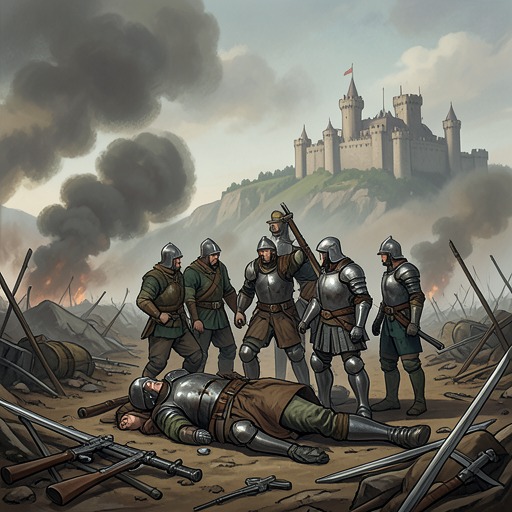
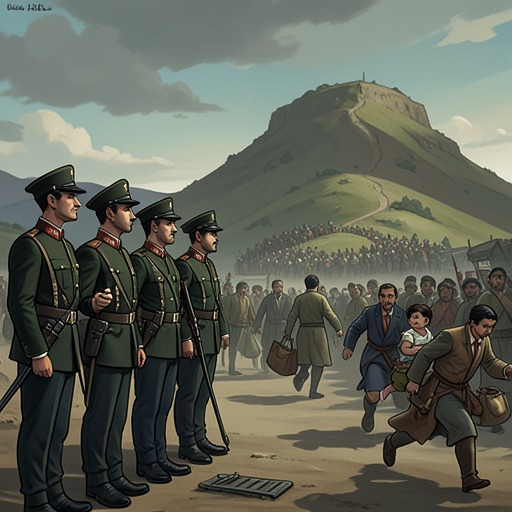
NeverthelessNavon Under Attack by Balthasar's Army is the point at which a forecast of conquest becomes immediate violence against Navon's people. The assault devastates Mabel's village and kills her parents, leaving her to understand the kingdom's danger through the loss of the home and family she had believed would always be hers.
Threat and Unanswered Appeal
Balthasar's approach had been presented as more than a border dispute. He was described as a conqueror who took villages and kingdoms, killed defeated kings, and sought power over the whole country. The account also emphasizes the scale of his military preparations: his stores of weapons and soldiers had grown beyond what his existing base could accommodate. His aim, as Mabel was warned, was to enslave those he conquered. Navon's attack therefore arrives against a stated background of expansionist violence, not as an isolated clash.
Navon had tried to secure help before the attack. A month earlier, Navi had sent a letter to a neighboring kingdom seeking an alliance. When he considered its response, he understood that the neighbor feared losing its own troops and becoming vulnerable to Tzara if it joined the fighting. It chose to stay away from the battlefield. Navi recognized the logic of that refusal from the position of a weak kingdom asked to take a dangerous risk, but the result was that Navon faced the threat without the additional troops he had hoped to obtain. The episode places the assault within a political landscape where the danger is visible but aid is withheld.
The Assault Reaches the Village
Navon's castle stood on a wooded hill, with a mountain range and forest obstructing approaches to the palace. Its direct entrance was guarded by a fortress and a stone bridge. The village, however, was the place Mabel knew through ordinary journeys rather than defensive architecture. Reaching it from the castle was difficult without a horse; she usually preferred to walk the long road beside the river and valley. That familiar route would become the path she ran in haste when the attack made the village's safety uncertain.
The attackers were carrying out orders to destroy what they found. Residents were forced from their homes and beaten. Mabel saw a woman being shoved from her house and an old man being kicked. She felt she ought to stop and help them, but continued toward her own home. The choice is presented as a painful consequence of urgency: she could see others in danger, yet feared that delaying would cost her the chance to reach her family. Her journey does not carry her out of the violence; it leads her directly to its most personal consequence.
Mabel Finds Her Parents
Mabel reached the rustic house where she had grown up, but it did not offer the welcome she had expected. She searched for her parents and found Amyntas beneath the wooden place used to store pots. He had been beaten and killed outside a battlefield. For Mabel, the manner of his death matters: he was a commander, yet his death was not a death in battle. The attack has stripped away the distinction between a soldier's preparation for war and a civilian home's vulnerability to it.
She then found Darice beside an unfinished dress. The scene leaves the dress as a concrete trace of a life interrupted, rather than a completed farewell or explanation. Mabel held her mother and cried out in grief. Only later, alone in the small house, did she fully understand that she had become an orphan and had lost the people she thought of as the only ones who cared for her. The loss is thus both immediate and belated: she encounters her parents' deaths in the house, while the meaning of being left without them settles afterward.
Consequences and Significance
The massacre is described as a catastrophe that should not have fallen upon children, women, or a kingdom not born to war. That judgment widens the scene beyond Mabel's private bereavement: the village's destruction exposes the human cost of Navon's vulnerability and of the wider conflict. The castle's hilltop defenses and the stone bridge may define the palace's approach, but they do not protect the homes and residents beyond it.
Before the attack, Mabel had told herself that Navon was her home and that she could live there for the rest of her life. Her childhood memories, her parents' house, and her attachment to the kingdom belonged together. The attack destroys the secure family life at the center of that attachment, while leaving Navon itself under threat. It therefore marks a decisive rupture: the kingdom's war is no longer a political danger discussed at a distance, but the event that makes Mabel an orphan and permanently changes what home means to her.