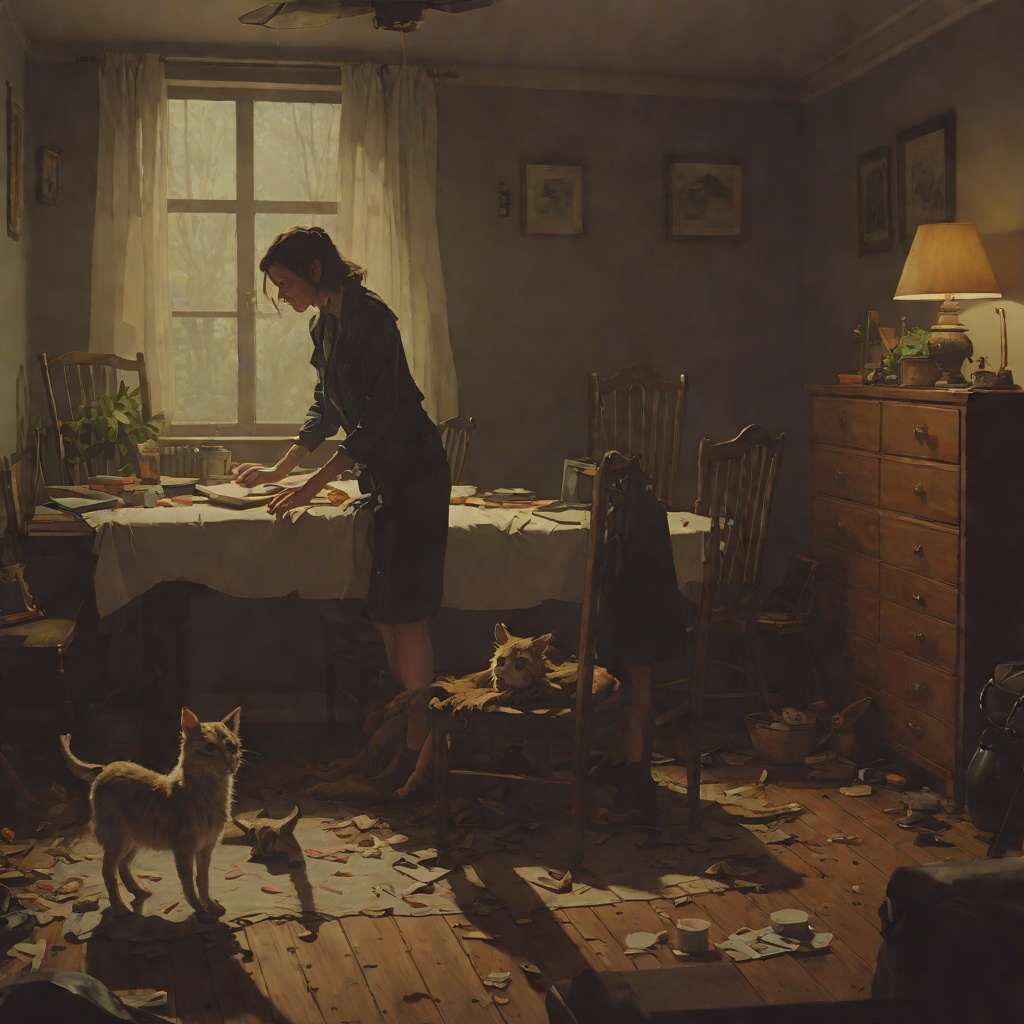
Where do you go at night
Nightbitch“Where do you go at night?” is both a question and a public emblem of Nightbitch’s transformation. It names the unexplained territory she enters after dark, when the roles of mother and wife cease to exhaust her identity and her body becomes responsive to instinct, violence, hunger, and movement. By the end, the phrase has migrated from private experience into merchandise and performance culture: fans wear pins showing a ferocious dog about to attack, making Nightbitch’s disappearance into a shared riddle and a declaration of allegiance.
Origin in a Private Naming
The expression gains its force from the contrast between Nightbitch’s ordinary self-description and the reality that follows. When she first called herself Nightbitch, she intended a good-natured, self-deprecating joke, presenting herself as relaxed, able to laugh at herself, and unlike anyone excessively uptight. The joke changes meaning when coarse black hair appears at the base of her neck. Her question to The Husband about whether she is turning into a dog is not met with serious inquiry; he laughs, while she does not. The gap between her alarm and his response establishes the nocturnal question as an unanswered demand for recognition. Nightbitch is trying to describe a bodily fact that domestic language cannot accommodate, and The Husband’s laughter confirms that the available social vocabulary will not take her experience seriously.
The question therefore points beyond literal whereabouts. Nightbitch’s night movements begin as an escape from a life organized around work, pumping, hurried meals, and the exhausting requirement to hold or serve The Boy while remaining productive. Her mother-rage expands into arguments against capitalism, the patriarchy, religion, gender roles, and biology; these systems appear to her as interconnected structures that have made care both compulsory and invisible. The expression condenses the distance between the woman those systems expect her to be and the creature she discovers in the dark.
The Night World and the Animal Body
Nightbitch’s nocturnal identity is not simply a disguise. During her encounter with The Dog Pack, she is stripped of clothing, surrounded, and forced into a physical contest governed by survival rather than explanation. She raises her head among the dogs, bares her teeth, feels her hair and mane expand, and recognizes herself as an animal. The resulting transformation suspends the distinctions that ordinarily separate human subject from animal object: she becomes hair, blood, bone, instinct, anger, and movement, experiencing the night through bodily sensation rather than reflective judgment.
This animal state offers a freedom unavailable in her daytime roles. Nightbitch likes being a dog because barking and snarling require no justification, running requires no permission, and existence can be reduced to body, urge, hunger, rage, thirst, and fear. She recalls childbirth as another moment when instinct ruled: she screamed, shat, swore, and followed her body’s knowledge of how to turn The Boy. The nocturnal body thus does not represent an escape from motherhood so much as a return to the animal force that motherhood itself contains and that polite society attempts to sanitize.
Her night also produces a new relation to The Boy. She and he share drinks from a stainless-steel dog bowl, laugh over the experiment, and share with The Cat because they are good dogs. She concludes that becoming a better dog may make her a better mother, since dogs do not need careers, artistic recognition, or explanations of their desires. The expression’s implied destination is consequently unstable: Nightbitch goes into darkness to escape domestic obligation, yet the freedom she finds there alters how she inhabits care rather than simply abandoning it.
Transgression, Violence, and Release
The nocturnal question is inseparable from acts that violate the moral and spatial rules of ordinary life. Nightbitch defecates beside Stanley’s carefully tended lawn, tears up clods of turf, and kicks freshly scattered grass seed onto the sidewalk. The act is deliberately petty and bodily, but its target matters: Stanley’s property, political hostility, and policing of The Boy’s movements become objects of animal retaliation. The night gives Nightbitch a way to answer social authority with territory, waste, and physical force.
Her first hunt intensifies that release. She carries a dead animal home in her mouth, buries it as a treasure, and rolls in the grass to gather the smells of her household, her son, the car, The Cat, the crab-apple tree, and her own human presence. The experience revises her understanding of what she needs. She realizes that medical attention, psychotherapy, positive thinking, and an improved attitude could not supply the bodily discharge she sought; one night of violence lets her stop caring what anyone thinks, stop being needed by any living thing, and become only a body moving through darkness.
The same logic reaches its most brutal form in the killing of The Cat. After bloodthirst provoked by the news, an aching head, and a search for something to cut, Nightbitch trips over The Cat and attacks her with a knife. She opens the animal’s body, bites its neck, shakes it until it goes limp, and stands amid blood, organs, and extraordinary chaos with an almost investigative animal curiosity. The scene makes the expression’s hidden destination unmistakable: the night leads not to a picturesque wilderness but to a zone where suppressed rage becomes action and where the boundary between liberation and murder is violently tested.
A Counter-History of Motherhood
The phrase also carries Nightbitch toward a reinterpretation of women’s history. She remembers her mother as responsible, distracted, frequently unavailable, and always urging her daughter away from the house and toward a serious, sensible life. What once seemed abandonment now appears as her mother’s best available form of love: an attempt to prevent another woman’s time and talent from being consumed by self-sacrifice. Nightbitch understands that generations of women have delayed their ambitions until time extinguished them, while men were not required to surrender their futures in the same way.
This realization complicates the expression’s apparent opposition between motherhood and freedom. Nightbitch has been trained to regard domestic work as lesser even while it consumes her physically and psychically. She resents the loss of her career, figure, ambition, and familiar hormonal equilibrium, and sees marriage and motherhood as structures designed to put a woman in her place. At the same time, she recognizes capacities gathered through her Appalachian upbringing: tracking animals, preserving food, making yarn, baking, singing, photographing with vegetable juices, and building a world through practical knowledge. The night does not create an entirely new self; it uncovers a self whose powers were already present but subordinated.
Her reading about the WereMothers gives the nocturnal question a communal horizon. She is enchanted by women who live together in cold woods, help one another, remain in a constant state of babies, and organize society around their own needs. The fantasy includes twenty other wives, shared efficiency, and friendship, even though it also requires accepting a partly wolfish identity. In this vision, leaving established society is not merely antisocial destruction. It is the possibility of a social form suited to women’s actual bodies, desires, and dependencies, where being monstrous can become beautiful rather than shameful.
Public Mystery and Final Meaning
By the later public life of Nightbitch’s work, “Where do you go at night?” has become a carefully circulated question. The phrase appears on pins designed by Jen, accompanied by the image of a ferocious dog with its mouth open in preparation for attack. Jen’s publicity turns the question into a campaign involving merchandise, bunnies placed in conspicuous and peculiar locations, social-media activity, and a cultivated mystery surrounding Wanda White. The once-out-of-print A Field Guide to Magical Women rises in sales, although reporters cannot locate Wanda White: University of Sacramento is defunct, and White exists only as an online profile at a school no longer operating.
The public question therefore preserves the uncertainty that first surrounded Nightbitch’s transformation while converting uncertainty into power. Audiences may not know where she goes, whether Wanda White is a person, or how the mythology was assembled, but they recognize the question as a summons to imagine another mode of existence. It makes secrecy participatory: the fans wear the dog, carry the unanswered question, and join a community formed around the possibility that the unbelievable is another way of knowing.
At the deepest level, “Where do you go at night?” asks where a person can arrive after the inherited identities of woman, wife, worker, and mother have failed. Nightbitch’s answer is not a stable location. It is the warm cave of shared animal life, the darkness of instinct, the dangerous release of violence, the recovered knowledge of female ancestry, and the possibility of a community beyond established social rules. The expression remains deliberately unresolved because its power lies in refusing to name the destination too soon: the night is where Nightbitch becomes capable of discovering what daytime society had taught her to suppress.