Earthship
NomadlandAn Earthship is a self-sufficient home designed to make shelter, water, power, climate control, and food less dependent on utility networks and the market. Built from earth and scavenged materials, it joined ecological design to Linda May’s practical search for security: she hoped to build one herself as a home that could sustain her and remain for her children and grandchildren. In the book, the Earthship is at once a building system and the destination toward which Linda tries to redirect a life shaped by low-wage work, rent, and travel.
Design and Systems
Developed by architect Michael Reynolds, who had been experimenting with the form since the 1970s, the Earthship uses discarded cans and bottles and tires packed with earth. The tire walls bear the structure’s weight and store heat: sunlight enters through south-facing windows, warms the walls during the day, and is released at night to help regulate indoor temperatures. The design aims to reduce the need for conventional heating and cooling systems.
Its other systems are intended to work together. Rain and snowmelt run from the roof into a cistern; collected water is filtered and reused for drinking and washing, to irrigate indoor fruit and vegetable gardens, and to flush toilets. Solar panels provide electricity, sometimes supplemented by windmills. The linked functions matter to the concept: a building is meant not only to enclose its inhabitants but also to help supply everyday necessities.
Earthships are not presented as uniform or dependent on advanced construction techniques. The materials and methods allow amateur builders to participate and leave room for individual design. Some buildings use arches, columns, spires, or turrets; others incorporate bottles into walls as colored panels. The combination of utilitarian systems and creative form is central to their appeal, though the cost and scale can vary widely. Most Earthships cost about as much as conventional houses, while examples range from a New Zealand family’s reported budget of less than $20,000 to a 10,000-square-foot home built by actor Dennis Weaver for $1 million.
A Building Form Beyond One Community
Dozens of Earthships stand outside Taos, New Mexico, in the Greater World Earthship Community. The form is not limited to that development: Earthships have been built on every continent except Antarctica, including by disaster-relief volunteers after the 2004 Indian Ocean tsunami, the 2010 Haiti earthquake, and Typhoon Haiyan in the Philippines in 2013. Their use in different settings reflects the design’s stated aim of combining shelter with systems for meeting basic needs.
The book also places the Earthship within a contest over what can be built and under whose rules. Linda admired Michael Reynolds for challenging building regulations he considered restrictive; his conflicts with officials and his efforts to realize his architectural vision are documented in the film Garbage Warrior. The regulatory struggle is relevant to the form itself: an experimental structure may promise independence from utility systems while still depending on access to land and permission, or an exemption, to build.
Linda May’s Long-Term Plan
Linda’s interest in Earthships began after she saw a documentary about Dennis Weaver’s construction project. She later searched online for floor plans, system diagrams, and interior photographs, organizing her favored examples in a three-ring binder. In her own account, the attraction was that the home would not be mass-produced, could be built by hand, and might allow her to live without utility bills. She imagined its systems as a practical route to self-sufficiency rather than simply an unconventional retirement house.
The plan answered a particular financial worry. Linda had spent years in low-wage work and paying rent, and she expected little relief from Social Security. She began collecting benefits at sixty-two, though she later thought she should have waited until sixty-five; the amount seemed so small that delaying did not appear worthwhile to her. The book also sets her concern against the economic vulnerability of older women: in 2015, more than one in six older women living alone were below the poverty line, and women’s average Social Security benefits were $341 a month lower than men’s. For Linda, a home with its own food, water, electricity, heating, and cooling offered the prospect of reducing the costs she would otherwise have to meet through continued work.
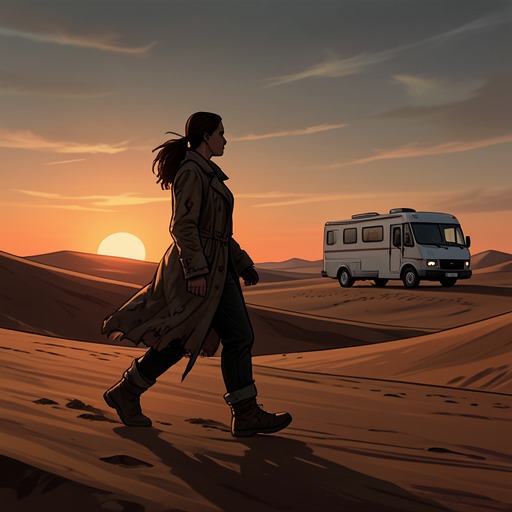
She did not expect to build immediately. She needed land, materials, help, and a way to keep earning while reducing living expenses. Work and travel in her vehicle offered a bridge toward the project, but age made time part of the calculation: she wanted to begin while still physically able to do demanding work. She hoped the finished home would last for generations, leaving her children and grandchildren something that carried her labor and knowledge forward.
The Douglas Site and Preparations
After the Rubber Tramp Rendezvous, Linda found an advertisement for five acres near Douglas, Arizona, in the Chihuahuan Desert. She had previously considered the region too remote, but now judged that she could rely on friends from the nomadic community to visit. The parcel’s rural zoning was a crucial feature: homesteaders on four or more acres were exempt from county building codes, making the site one of the places Michael Reynolds described as Pockets of freedom. At an elevation of 4,200 feet, it also seemed more manageable in summer than a lower desert site, with camp-hosting work possible in nearby mountains.
The land was unimproved, with no electricity, well, or septic system. Mesquite had overgrown the bordering roads, and one road crossed a dry gulch that could flood during thunderstorms. Linda nevertheless accepted these limitations. The seller’s price was $2,500, payable in installments of $200 down and $200 a month without interest. The low entry cost made the parcel attainable, while its lack of services made the Earthship’s independent systems especially pertinent.
Linda’s plans addressed the site’s conditions in concrete steps. During a remote visit, she asked about the soil because she wanted to install earth-cooling tubes: pipes buried five to eight feet underground, where temperatures fall to about 55 degrees, to circulate air through the house and a greenhouse. The ground appeared workable for digging. She also saw a dry arroyo across the northwest corner not only as a feature to navigate but as a possible way to collect rainwater.
From Vision to a Building Site
As construction drew closer, Linda sought the infrastructure the Earthship could not immediately provide. She found a water-delivery service able to fill large tanks, important because rainfall might not meet her needs during the building period. She planned to have the land surveyed to determine elevations before cutting berms for permaculture, and to ask the county about setbacks and zoning. She had read that clearing up to an acre could be done without a grading permit, which matched the limited area she wanted to prepare.
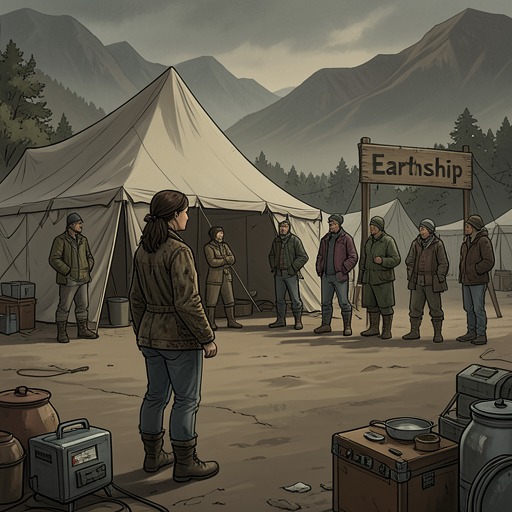
Her equipment plans show the difference between a finished off-grid home and the work required to reach it. Linda bought a 4,000-watt portable generator for $26, an inexpensive source of electricity far more powerful than the 45-watt solar panel then available to her. She intended to start construction after the Rubber Tramp Rendezvous, with Gary Fallon returning to the land and LaVonne Ellis joining them to build a greenhouse. The greenhouse was meant to support organic farming and protect plants and workers during construction of the house.
By the book’s account, the Earthship remains a project in preparation rather than a completed dwelling. Linda had found an excavator operator charging $35 an hour, with no added fee for gas or travel, and reserved a late-January date to break ground; she estimated the work would take eight hours. The plan’s significance lies in how far it had moved from the binder and the imagined future: land, payment terms, water, survey work, equipment, companions, and a scheduled first step had begun to connect. The Earthship promised a stable home, but its realization depended on precisely the practical resources Linda had spent years trying to secure.