LaVanne
NomadlandLaVanne was LaVonne Ellis’s maroon 2003 GMC Safari, a vehicle she turned into both a home and a means of pursuing a more financially independent life. Its story traces the precarious balance of nomadic living: a van could make mobility possible, but its breakdown could also leave its owner stranded, in debt, and facing the loss of a home.
Purchase and Conversion
After attending a smaller Rubber Tramp Rendezvous near Flagstaff, Arizona, in the summer of 2013, LaVonne decided to buy a van. She found LaVanne at a used-car lot in El Cajon for $4,995; it had 129,000 miles on the odometer. She converted the rear seats into a couch and bed and arranged a kitchen on the tailgate, adapting the vehicle for daily life rather than occasional travel.
LaVonne’s aims were practical and specific: live within the means of her Social Security income, pay off the van, build an emergency fund, and try to write a memoir. Two months before meeting Linda May, she moved into LaVanne and went to see Bob Wells. The transition was difficult, especially during cold nights. Bob lent her a warm sleeping bag and insisted she keep it. Later, two new friends helped install a solar panel on the roof, adding a source of power to the converted vehicle.
A Home Within a Nomadic Community
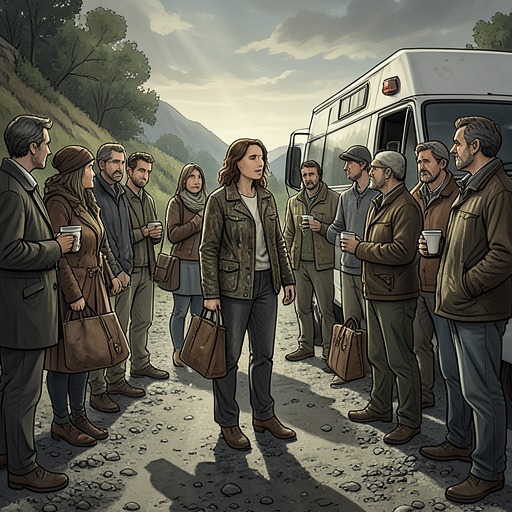
By the time LaVonne attended her first Rubber Tramp Rendezvous as a full-fledged vandweller, LaVanne was more than transportation: it was the small, adaptable space from which she joined camp life. She volunteered to lead the group’s daily walks, which set out from the fire ring at 8:30 each morning, and invited people to her campsite for a scrambled-egg-and-potato breakfast. These routines placed her vehicle within a shared social world of campmates, practical help, and informal hospitality.
That community mattered because van living depended on more than a vehicle’s capacity to move. LaVonne’s plan relied on a modest fixed income, the ability to maintain the van, and places where nomads could stop. On public land near Quartzsite, for example, free camping was limited to two weeks before campers had to move at least twenty-five miles away or pay to stay in the La Posa Long Term Visitor Area. Rules requiring nomads to maintain a fixed official address also meant that movement did not remove the need for an administrative home base. LaVanne made a mobile life possible within these constraints; it could not make the constraints disappear.
Breakdown and Forced Replacement
After the last Rubber Tramp Rendezvous, LaVanne broke down and left LaVonne stranded in Ehrenberg without money for repairs. The van had failed several times before, and she still owed a few thousand dollars in payments on a vehicle that was now unusable. She later parked alone in San Diego, California, where she was stealth camping and waiting for her Social Security checks. For nearly a month and a half, she continued living in the dead van as temperatures rose and other nomads gradually left the area.
When she could finally afford a tow to a repair shop, the estimate to fix the engine was $3,000—more than she could pay. While walking Scout, a puppy she had taken as a travel companion, LaVonne saw a nearly new twelve-person Chevy Express at a used-car lot. The salesman offered to help her obtain a loan despite her bad credit. She was uncertain about the terms but felt she had no viable alternative: without another vehicle, she believed she would be homeless. She named the replacement LaVanne Two.
Significance
LaVanne’s arc turns the promise of mobility into a concrete material problem. Its layout—the rear-seat bed and couch, tailgate kitchen, and later roof-mounted solar panel—shows how a mass-market van could be remade as a home. But the breakdown exposed how completely that home depended on a functioning engine and money for repairs. LaVonne’s continued debt on the failed van compounded the loss: the vehicle that had supported her effort to pay off debt became an additional financial burden.
The replacement did not mark a simple return to security. LaVonne acquired another vehicle through a loan while still facing the consequences of the first one’s failure. LaVanne therefore stands in the narrative as both an instrument of independence and a point of vulnerability: it gave LaVonne a way to live on the road, but its mechanical failure narrowed her choices until obtaining another van seemed necessary to preserve that way of life.