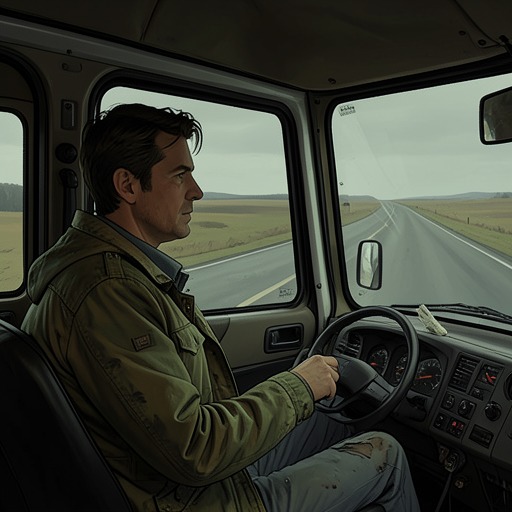
How can you afford to not be a vandweller
Nomadland“How can you afford to not be a vandweller?” is the question Bob Wells posed to readers seeking advice after losing work and facing eviction. Its force lies in reversing the usual framing of vehicle dwelling: rather than asking whether someone can afford to adopt a mobile life, it asks whether they can afford to remain in conventional housing. The phrase makes mobility sound less like a lifestyle preference than a practical answer to economic insecurity, while the book’s examples show how much that answer depends on work, legal arrangements, and access to places to stop.
The question behind the phrase
In a 2012 budgeting post, Bob described receiving emails almost every week from readers who had lost their jobs and were now being evicted. He answered their other questions, then posed the challenge that gives the expression its name. His conclusion was that living in a car, van, or RV was the cheapest way to live over the long term. The question thus turns an apparent choice—whether to become a vandweller—into a comparison between housing costs and the costs of having no secure conventional home.
The argument sits within a broader shift following the housing collapse. The book contrasts the newer wave of nomads with the trailerites of the 1930s, many of whom eventually returned to fixed housing: the people approaching Bob for advice seemed to be preparing for a more lasting transition. His phrase condenses that change into a pointed calculation. It offers a means of thinking about survival, not a guarantee that the road will be easy or free of costs.
Mobility’s administrative requirements
The practical difficulty begins with a contradiction: people may live on the move, but they must still maintain an official domicile. The book explains that nomads need a fixed address for vehicle registration and inspection, driver’s licenses, taxes, voting, jury service, and health insurance for those not on Medicare. Because there is no clear count of the country’s full-time travelers, their required legal addresses also make them difficult to distinguish statistically from the settled population.
Some travelers choose states with fewer administrative hurdles and no state income tax, including Florida, South Dakota, and Texas, and use mail-forwarding services to receive correspondence. South Dakota’s process is described as especially simple: spend one night in a local motel, register with a mail-forwarding service, and present both receipts to the state department of public safety. The question’s promise of affordable movement therefore rests partly on paperwork and a stable official identity, even when a person has no stable physical home.
Parking, public land, and limits
The road also requires somewhere to stop. In the seasonal cycle described in the book, nomads leave jobs as layoffs begin, travel in search of work, friends, family, or warmer weather, and sleep in places such as Walmart parking lots, quiet suburban streets, and truck stops before setting out again. A parking place can provide immediate shelter, but it is not necessarily a secure or lasting home.
Around Quartzsite, public desert land offers one version of that refuge. The Bureau of Land Management allows free camping for up to two weeks; after that, campers must move at least twenty-five miles away or pay to stay in the La Posa Long Term Visitor Area. Its permits—bright stickers bearing a roadrunner and a snowflake—mark vehicles as part of a dispersed community, but can also make extended stays visible. The same recognizable presence that helps travelers identify one another can expose them to official scrutiny elsewhere.
In Coconino National Forest, rangers have questioned people in vans and RVs about their home addresses and can ticket and evict campers they judge to be making residential use of the forest. A Quartzsite boondocking sticker may be treated as evidence of permanent nomadism; the Forest Service was also developing an app through which members of the public could report suspected long-term campsites. These restrictions sharpen the phrase’s underlying tension: vehicle dwelling may be a response to unaffordable housing, yet the right to remain parked is conditional.
The phrase in lived motion
Linda May’s travel provides a concrete glimpse of the movement behind this account. While the narrator was in Arizona, Linda had settled for the night in El Reno, Oklahoma, after traveling 350 miles east from Tucumcari, New Mexico. She texted to arrange a meeting for the following day. The brief exchange shows a life organized around changing stops and continual coordination, rather than a single settled address.
Against this landscape, Bob’s question is both an economic argument and a measure of constrained freedom. The road offers movement, seasonal work, and temporary places to rest; it does not dissolve the need for income, official paperwork, or permission to park. The phrase endures because it captures that double reality: for some people, vehicle dwelling is not an affordable alternative to housing so much as the alternative left when housing itself has become unaffordable.