The last free place in America is a parking spot.
NomadlandThe last free place in America is a parking spot is the book’s compressed image of a freedom that is real but conditional. For travelers living on the road, a parking space can offer a brief place to rest without paying for a conventional home or campground. Yet access depends on where they are, how long they stay, and whether a store, city, or land manager permits them to remain. The expression makes an ordinary piece of infrastructure stand at the intersection of mobility, shelter, and exclusion.
A stopping place on the road
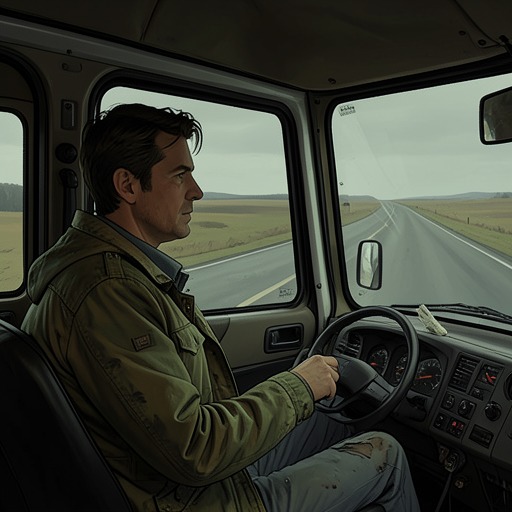
The phrase arrives in a passage about the seasonal rhythm of nomadic life. As autumn gives way to winter and seasonal jobs lay off workers, travelers pack up and move toward friends, family, or warmer places. Their journeys cross a landscape of dormant fields, shopping malls, factories, subdivisions, and open plains. When fatigue finally interrupts the drive, they pull over to sleep in Walmart parking lots, on quiet suburban streets, or at truck stops among idling vehicles. Before others notice them, they are back on the highway. The parking space is not a permanent home in this account: it is a temporary pause that makes continued movement possible.
That routine gives the expression its force. The road offers the promise of another job, town, or encounter, but movement also requires places to stop. A parking spot can provide shelter for the night without requiring a conventional dwelling, and its apparent ordinariness can make a traveler’s presence less conspicuous. The phrase calls this reprieve “free,” while the surrounding account shows how much depends on being able to keep moving and find the next place that will allow a vehicle to remain.
Permission, policy, and overnight parking
Walmart’s overnight-parking practice illustrates both the value and the limits of that permission. The company has long allowed some RV travelers to stay in its lots. The book notes competing explanations for the practice: it may reflect founder Sam Walton’s affinity for outdoor pursuits, or a strategy for attracting shoppers. Whatever its origin, travelers appreciate the invitation, while paid campgrounds and RV parks see it as competition.
The welcome is not universal. Some cities prohibit overnight stays; some stores have withdrawn permission after visitors overstayed or established more permanent-looking camps. In March 2015, a confrontation involving police and an eight-member family living in a Chevy Suburban in the Cottonwood Walmart parking lot ended in a death, after which the store began rousting overnight visitors. The episode shows how quickly a place that functions as refuge can become unavailable. A traveler cannot assume that a parking lot remains open simply because another one did.
Information services help travelers navigate that uncertainty without removing it. AllStays’ Walmart Overnight Parking Locator marks stores in the United States and Canada with a “W” icon. Red indicates a location where travelers may be rousted or towed; yellow locations include user reports about overnight stays. The map turns a dispersed, changing policy landscape into something travelers can consult, but its color-coded warnings also make clear that the parking space is not an unconditional right.
Public land and the boundaries of staying
The same tension appears in the desert near Quartzsite, where many visitors avoid paid RV parks and camp on federal land. Free sites administered by the Bureau of Land Management allow stays of up to two weeks. After that, campers must move at least twenty-five miles away or pay to stay in the La Posa Long Term Visitor Area, where a permit costs $40 for two weeks or $180 for up to seven months. The space may be open and available, but continued access is organized through time limits, distance requirements, and fees.
The permits themselves—bright stickers depicting a roadrunner and a giant snowflake—become visible signs of participation in this seasonal community. More than forty thousand RVers are estimated to stay in the desert near Quartzsite from December through February. Yet even this example of broad access to public land has boundaries: the right to camp temporarily does not amount to permission to use the land as a permanent residence. In Coconino National Forest, rangers have questioned people in vans and RVs about their addresses, and a vehicle sticker associated with Quartzsite camping can be treated as evidence of long-term presence. Campers deemed to be making residential use of the forest may be ticketed and evicted.
The cost of being allowed to stay
The expression also sits against a broader tightening of rules governing people without conventional housing. A 2016 account cited in the book reports that, by the end of 2014, 100 cities had made sitting on a sidewalk a crime, while the number banning sleeping in cars had risen to 81 from 37 in 2011. The book connects these measures to gentrification and rising housing costs. In such settings, a car may be tolerated as property while the person seeking shelter inside it is not: “Your car can stay here, but you can’t.”
Nomadic life also has to fit administrative systems designed around a fixed address. There is no clear count of how many people live nomadically in the United States, partly because travelers must maintain an official domicile for matters such as vehicle registration, licensing, taxes, voting, jury service, and insurance. Some choose Florida, South Dakota, or Texas, and use mail-forwarding services; South Dakota’s process can require only one night at a local motel and registration with a forwarding service. The practical freedom to live in many places therefore rests, on paper, on naming one place as home.
Read alongside these rules, the parking spot is less a guarantee of universal freedom than a narrow, provisional opening. It can let a traveler stop for the night and return to the road, but it can also be withdrawn by a store, restricted by a city, or curtailed on public land. The expression’s contrast between “free” and regulated space is the point: the road may be a home, but even a brief pause on it depends on permission.