Pockets of freedom
NomadlandPockets of freedom are places where limited regulation makes room for experimental building and unconventional ways of living. The phrase names a practical opening rather than complete escape: even a remote parcel, public desert, or welcoming parking lot remains subject to conditions that can enable a stay, restrict it, or bring it to an end.
The phrase and Linda May’s land
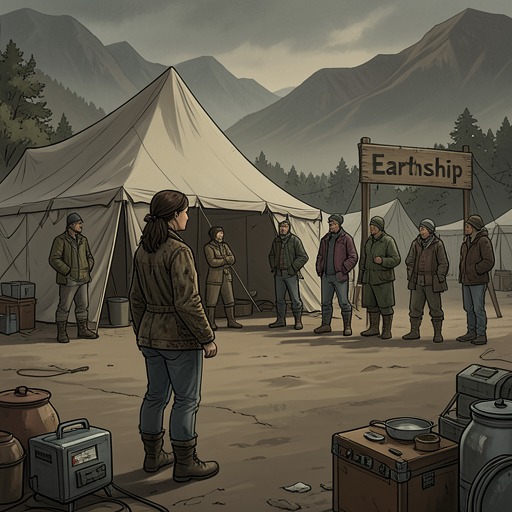
In the book, Earthship inventor Michael Reynolds’s phrase applies to rural areas where homesteaders on four or more acres are exempt from county building codes. That exemption mattered to Linda May’s plan to build a home on five acres near Douglas, Arizona. The land sat at 4,200 feet, where summers were expected to be less sweltering, and the absence of building-code requirements offered room for experimental architecture. The parcel had no electricity, well, or septic system; its access roads were overgrown with mesquite, and one crossed a dry gulch vulnerable to flash floods. The freedom lay in the possibility of building outside ordinary oversight, not in the removal of practical obstacles.
The terms of purchase made that possibility more reachable for Linda May: the seller asked $2,500, payable in installments of $200 down and $200 a month without interest. She had previously judged the area too remote, but later saw the project as time-sensitive and hoped members of her traveling community might visit and help. Her prospective homestead therefore joined regulatory latitude to affordability and social ties; none alone guaranteed that the house would be completed.
Temporary refuge on public land
The phrase also resonates with the public desert near Quartzsite, Arizona, where the Bureau of Land Management provides free camping for up to fourteen days. Campers must then move at least twenty-five miles to another patch of federal desert or pay to stay in the La Posa Long Term Visitor Area, where a permit costs $40 for two weeks or $180 for as long as seven months. Its windshield stickers, printed with a roadrunner and a snowflake, make the permitted stay visible even as they identify fellow campers across the dispersed camp.
These arrangements open land to people with very different resources: the book describes a tent beside a bicycle and dog near a custom-built motorhome worth $500,000, with both occupants sharing access to public land. But the welcome has boundaries measured in days, distance, and fees. The desert is a pocket of latitude within a system of permits and relocation rules, not unregulated space.
Parking places: welcome with conditions
For travelers moving between jobs and camps, a parking lot can offer another kind of temporary refuge. Walmart has long allowed overnight stays in many locations, although the practice is not universal: some cities prohibit it, and some stores have withdrawn permission after visitors overstayed or established semi-permanent encampments. A locator app developed by AllStays marks stores with different colors and provides user reports, turning local permission into information travelers need to check before stopping. One report from Pahrump, Nevada, records a van staying alongside two other traveling vans.
Such sites show how a small opening can depend on policy and on the conduct a property owner considers acceptable. The book’s broader account of nomadic travel returns to parking spaces as places where people can pause without paying for a conventional campsite, while stressing that those spaces may be withdrawn or policed. The roadside refuge is real, but provisional.
Mobility, regulation, and unequal access
The book sets these local openings against a wider landscape of restrictions. In 2016, reporting cited a survey in which 100 cities had criminalized sitting on a sidewalk by the end of 2014, while the number banning sleeping in cars had risen from 37 in 2011 to 81. On public land, rangers in Coconino National Forest questioned van and RV campers about their home addresses; people perceived as permanent nomads could be ticketed and evicted for residential use. The Forest Service was also developing an app for reporting suspected long-term campsites. A place that appears open, then, may still distinguish between a visitor and someone understood to be living there.
Nomadic life also relies on an official address. Travelers must maintain a state domicile for such obligations as vehicle registration, licenses, taxes, voting, and jury service, even when they have no conventional home. Some choose Florida, South Dakota, or Texas for simpler arrangements and use mail-forwarding services; South Dakota residency can be established by spending one night in a local motel and registering with a forwarding service. On the road, Linda May’s route between stops in New Mexico and Oklahoma was also shaped by an Amazon job that delayed her visit to her land until January. Movement depends on paperwork, work, and timing as well as a vehicle and somewhere to park.
Pockets of freedom therefore name neither a permanent refuge nor unrestricted autonomy. They are openings within a landscape of ownership, regulation, employment, and mobility: a rural exemption that permits a building project, a desert stay with a time limit, or an overnight space available only where local rules allow it. Their importance lies in what they make possible—and in how readily that possibility can narrow.