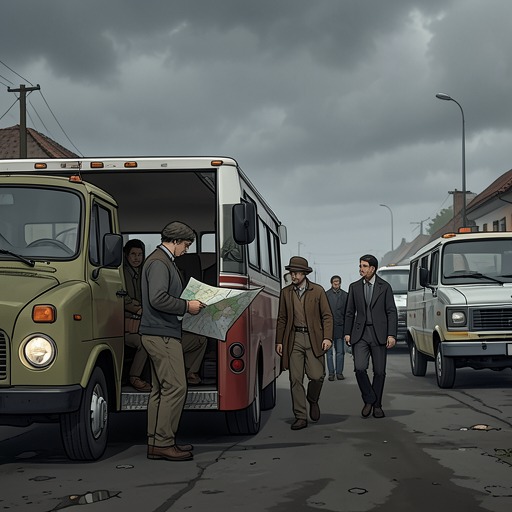
The Knock
NomadlandThe Knock is the interruption vehicle dwellers fear when a knock, a pounding on the walls, or a face at the window turns a parked vehicle into a publicly questioned home. It can come from police, security, a drunk, or passersby; its consequences range from reassurance to exposure and displacement. The expression names more than an awkward encounter. It condenses the precarious work of finding a place to sleep while trying not to attract attention, and the uncertainty of whether a person living in a vehicle will be treated as a traveler, a trespasser, or homeless.
A feared interruption
For urban vehicle dwellers, stealth parking is a practiced response to anti-camping laws and suspicion. At a seminar led by Bob Wells, advice about blending in was framed around avoiding the knock: find a safe place, arrive to sleep after dark, and leave early. He recommended separating a day camp, where ordinary tasks could be done, from a night camp used strictly for sleeping. A vehicle should be positioned with its nose toward the road so it can leave quickly if trouble starts. These procedures make the knock a kind of anticipated test: whether a sleeper can remain unnoticed, and whether a knock, if it comes, will require departure.
Concealment extended to the vehicle’s appearance and the rhythms of daily life. Bob advised keeping the vehicle clean, clearing clutter from the passenger seat, and avoiding conspicuous decorations. A cargo van could be made to resemble a work vehicle, with a safety vest visible through the windshield or a ladder rack on the roof; a white van might blend among local plumbing or catering fleets. Permanently covered windows could provoke questions, while carrying toiletries in a pocketed outdoor vest offered a discreet way to wash in a public restroom. Such details show that stealth was not simply a parking choice: it involved managing what strangers could infer from a vehicle and its occupants.
The expected visitor was not always an adversary. Bob described encounters with concerned officers who wanted to check that a person was all right, including an Ohio officer who reportedly brought a woman coffee. In places thought to be friendly, he suggested researching local attitudes, asking other vehicle dwellers, or even approaching a police station to explain a difficult situation and ask where overnight parking would be safe. Yet he cautioned that prolonged claims of merely passing through were unlikely to fool police. The tension between seeking help and avoiding scrutiny is built into the expression: a knock may be a welfare check, but it still announces that someone has noticed the sleeper.
Tactics, lots, and the limits of welcome
A national network of advice and location tools tried to make overnight parking less uncertain. AllStays marked Walmart locations in the United States and Canada with a colored icon: red indicated a risk of being rousted or towed, while yellow locations opened user reports. One report from a Pahrump, Nevada, Supercenter recorded a traveler who had slept there without trouble alongside two other vans. The locator turned local, changeable judgments about welcome into information travelers could consult, but it could not guarantee that a particular night would pass undisturbed.
Walmart’s overnight policy was uneven. Some stores were in cities that prohibited the practice; others withdrew permission after visitors overstayed, set out barbecues and lawn furniture, or established semipermanent camps. After a 2015 confrontation at a Cottonwood, Arizona, Supercenter between police and an eight-member Idaho family living in a Chevrolet Suburban ended in a traveler’s death, the store began rousting overnight visitors. Elsewhere, growing numbers of people sleeping in cars left retailers negotiating the difference between an accepted overnight guest and an unwanted encampment. The parking lot could provide temporary shelter, but the welcome remained conditional.
The same uncertainty followed nomads onto public land. Near Quartzsite, the Bureau of Land Management permitted free camping for up to two weeks at a time; campers then had to move at least twenty-five miles or pay to stay in the La Posa Long Term Visitor Area. Its bright permit stickers, bearing a roadrunner and a snowflake, identified campers to one another, but such signs could also make a nomadic presence legible to authorities. In Coconino National Forest, rangers questioned people in vans and RVs about their home addresses. A sticker indicating that a vehicle had camped in Quartzsite could be treated as evidence of permanent residence, exposing a camper to a citation or eviction for residential use. The possibility of being noticed thus extended beyond city lots: even a landscape open to camping could distinguish temporary visitors from people suspected of making it home.
LaVonne Ellis and a cover blown
LaVonne Ellis experienced the knock while stealth camping in San Diego. Officer Nunez was friendly, said he wanted to make sure she was alive, and also needed to know that she was not running a meth lab. Her vehicle, LaVanne Two, looked new and clean, and her dog was adorable; she believed that being white also contributed to her favorable treatment. Nunez did not issue a citation. But he recorded her name, license plate, and the vehicle’s make and model. The encounter ended without a ticket and still changed her situation: her cover was blown, and she would soon have to move on.
That episode gives the expression its double edge. The officer’s concern did not erase the fact that he had identified and documented her, while the absence of a citation did not restore the anonymity she needed to remain parked. The knock could therefore be mild in manner yet consequential in effect. A friendly encounter was not the same as secure permission to stay.
From a knock to a social boundary
LaVonne’s experience sits within a larger distinction between being houseless and being classified as homeless. Nomads often describe themselves as houseless because they have both shelter and transportation, and resist a label associated with having nowhere to go. Yet LaVonne later wrote that living in a city van could make others see a person as homeless, and that this perception could become difficult to separate from one’s own sense of identity. She described recognizing a connection with an older man who hid his belongings in a bush near her van. The encounter unsettled the boundary she had hoped to maintain between her situation and his.
That boundary was also enforced through law and public judgment. A 2016 account reported that, by the end of 2014, one hundred cities had made sitting on a sidewalk a crime, a 43 percent increase over 2011; the number banning sleeping in cars had risen from 37 to 81. On public land, address checks and restrictions on residential use could make long-term vehicle living grounds for removal. The knock is not itself a law, but it is a scene in which rules about who may remain become immediate: a person’s presence is questioned at the vehicle that serves as both home and transportation.
Charlene Swankie described recurring nightmares about someone knocking on her van when she was not fully comfortable with where she had parked or boondocked. In the dream, no one was usually there; sometimes police or security were present. That repetition makes the knock more than a discrete interruption. It is an anticipated intrusion, carried from one parking place to the next, and a reminder that the apparent freedom of a mobile home depends on other people’s permission—or on remaining unseen.