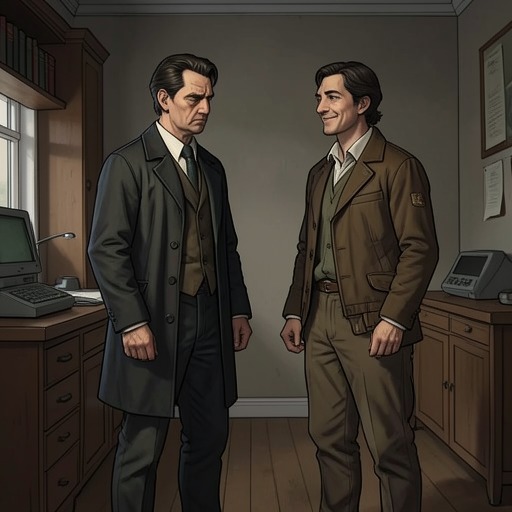
Event 1
渡边与直子在中央线重逢
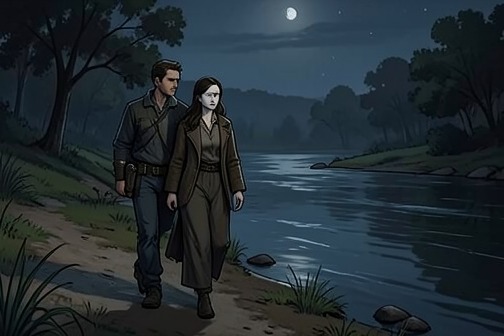
The reunion of [Naoko](entity:character-recall-character-naoko-c31d25fb4a36) and [Toru Watanabe](entity:character-recall-character-toru-watanabe-5b85a10074ad) on the Chuo commuter line reopens a fragile connection after nearly a year apart. Their unplanned walk across [Tokyo](entity:location-recall-location-2ef35aba743c) becomes an encounter marked by Naoko’s changed appearance, her struggle to find words, and her request to meet again—a tentative beginning that also exposes how difficult closeness has become for them.
## The chance encounter
Nearly a year had passed since [Watanabe](entity:character-recall-character-watanabe-aa7b56f3da37) had last seen Naoko. In that time she had lost so much weight that she seemed almost a different person: her once-plump cheeks had nearly disappeared, and her neck had become delicate and slender. The change did not make her look unhealthy; to Watanabe, she seemed serene and prettier than he remembered, though he could not find a way to tell her so.
Neither had arranged the meeting. Naoko was going to see a film alone, while Watanabe was headed to the bookshops in Kanda, with neither errand especially urgent. They happened to meet on the Chuo commuter line, and in [Yotsuya](entity:location-recall-location-f41aeb6f8c3e) Naoko suggested that they get off and walk beside the green embankment near the old castle moat. The ordinariness of their separate plans contrasts with the weight of their unexpected reunion: neither arrives with a prepared reason for seeing the other, yet Naoko chooses to extend the encounter beyond the train.
## A walk across Tokyo
Naoko set off as soon as they reached the street, and Watanabe followed several paces behind. Although he could have drawn closer, something held him back. He watched her shoulders and straight black hair, noticing the large brown hairslide she wore and, when she turned, a glimpse of her small white ear. She sometimes looked back to say something, but he could not always hear her; at other times, he did not know how to answer. She did not seem concerned by his silences and simply turned forward again.
The route made the walk more than a casual stroll. Naoko turned at Lidabashi, reached the moat, crossed the intersection at Jinbocho, climbed the hill at Ochanomizu, and came out at Hongo. From there they followed the tram tracks to Komagome. By the time they arrived, the sun was sinking into a soft spring evening. Naoko then asked where they were, seemingly only now noticing their surroundings; Watanabe told her they had made a large arc through the city. The day’s long circuit gives shape to an encounter in which conversation itself keeps circling: the two are together, but do not yet know how to speak freely to one another.
## The request to meet again
At the end of the encounter, Watanabe tried to say that he was glad they had had a chance to talk, since they had never before been alone together like that. He could not even recall what they had talked about. Naoko played with the ashtray on the table before asking, hesitantly, whether he would mind seeing her again. She said she knew she had no right to ask. Her request makes clear that the meeting has mattered to her, while her apology suggests that she regards renewed contact as something she may not be entitled to seek.
Naoko explained that for some time she had been unable to say what she meant. She would reach for words and find the wrong ones, or the exact opposite of what she intended; trying to correct herself only made matters worse until she lost track of what she had meant to say. She described the experience as being split in two, with one self chasing another around a post while the self with the right words remained just out of reach. Watanabe answered that everyone had some difficulty expressing themselves, but Naoko looked disappointed and said that was not what she meant. His effort to make her experience ordinary therefore fails to meet the particular distress she is trying to convey.
Despite this misalignment, Watanabe agreed that he would be glad to see her again. He said he was free on Sundays and that walking would be good for him. They took the Yamanote Line, and at [Shinjuku](entity:location-recall-location-3dcaa645c9c5) Naoko transferred to the Chuo Line for her tiny flat in the western suburb of [Kokubunji](entity:location-recall-location-a5311fa3eadd). As they parted, she asked whether anything had changed about the way she talked. Her question carries the difficulty of the whole meeting into their separation: she is seeking not only another meeting, but also some measure of whether she has changed and whether Watanabe can hear that change.
## Significance and aftermath
The encounter is a small but consequential turn in the relationship. Its immediate result is not a declaration or a solution, but the possibility of seeing one another again, built from Naoko’s request and Watanabe’s willingness to make Sundays available. Their closeness remains tentative: she walks ahead while he follows, they struggle to sustain conversation, and his general reassurance misses the mark when she tries to explain her experience. The promise of further meetings emerges alongside, rather than after, that distance.
The later account of Watanabe’s grief gives the reunion a further resonance without turning it into a cure for what follows. He comes to understand death not as the opposite of life but as part of it, a realization he associates first with [Kizuki’s death](entity:event-recall-event-kizuki-5b5835777ade). After Naoko’s death, however, he recognizes that no truth, sincerity, strength, or kindness can cure the sorrow of losing someone loved; grief has to be endured, and what is learned from it cannot prevent the next grief. His memories of Naoko return in vivid, particular images, and at times seem to carry him into a place where the dead remain part of life. Yet, back in Tokyo, he shuts himself away for days, his memory fixed on the dead rather than the living. In that larger arc, the spring walk remains a record of a chance to reconnect—not an answer to loss, but one of the living moments that grief will later preserve.
Event 2
Naoko and Watanabe have sex on the night of her twentieth birthday
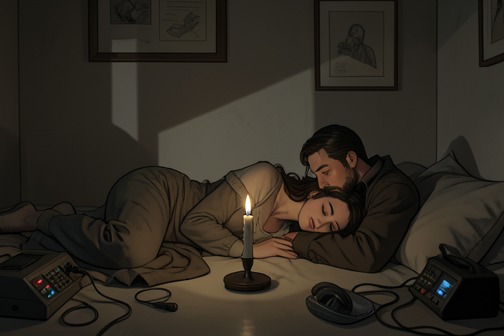
[Naoko and Watanabe have sex on the night of her twentieth birthday](entity:event-recall-event-258bbf221951), an encounter that follows a modest celebration and a long evening in which [Naoko](entity:character-recall-character-naoko-c31d25fb4a36) speaks at unusual length before breaking down. The night changes [Watanabe](entity:character-recall-character-watanabe-aa7b56f3da37)’s understanding of her past with [Kizuki](entity:character-recall-character-kizuki-1cc5bfd6aa96), but it does not resolve the distance or grief between them: by morning, Naoko has fallen silent. Remembered after her death, the scene returns as part of Watanabe’s turbulent bond with the dead and his recognition that insight cannot cure bereavement.
## Birthday and the evening’s conversation
Halfway through April, Naoko turns twenty, seven months older than Watanabe. Her birthday unsettles her; she says she is not ready and feels as though somebody is pushing her from behind. Watanabe brings a cake to her flat after lectures, wanting to mark a day she would otherwise spend alone. The packed tram has crushed the cake until it resembles the Roman Colosseum, but he sets out twenty candles, closes the curtains, and turns out the lights. They drink wine and share a simple dinner.
Afterward, as rain falls outside, Naoko tells stories about her childhood, school, and family. Watanabe is struck by the precision of her memories, yet senses something disordered in the way one story opens into another. He notices that she avoids certain subjects, including Kizuki, while lingering over trivial details. Rather than interrupt, he puts on records and lets the music cycle from Sgt. Pepper's Lonely Hearts Club Band to Bill Evans' Waltz for Debbie. Naoko speaks for more than four hours, until the late hour and Watanabe’s concern about the last train and his midnight curfew force him to intervene.
## Breakdown and sexual encounter
When Watanabe interrupts, Naoko begins to cry with an intensity he has never witnessed. He reaches for her, holds her, and waits, but the crying does not stop. The encounter that follows takes place amid her tension and confusion; Watanabe later says he could not be sure whether sleeping with her had been the right thing to do. His retrospective uncertainty remains part of the event’s meaning: the scene offers no simple assurance that intimacy has settled what is troubling Naoko.
During sex, Naoko tenses with pain. Watanabe had assumed that she and Kizuki had been sexually intimate, but discovers that this was their first time. He moves slowly and gently, and the two remain together in the darkness without words. Afterward, he asks why she had never slept with Kizuki. The question immediately brings Naoko back to silent tears, and Watanabe recognizes that he has touched a subject she cannot bear to discuss.
## Morning silence and unresolved consequences
By morning the rain has stopped, but Naoko does not answer or move. Watanabe cannot tell whether she is asleep or awake; she seems stiff, and words have left her. The room retains the traces of the birthday night: records, glasses, wine bottles, and the damaged cake. On Naoko’s desk are a dictionary and a French verb chart, while the unmarked calendar offers no sign of appointments or messages. Watanabe writes a brief note asking to talk after she has calmed down and wishing her a happy birthday, then leaves without receiving a response.
The encounter thus joins closeness to an immediate return of silence. It reveals a fact about [Naoko and Kizuki](entity:relation-recall-relation-naoko-and-kizuki-398585a88f07)’s relationship that Watanabe had misunderstood, but does not supply an explanation for it: when he asks, Naoko cannot continue the conversation. Nor does the night produce a clear new beginning between the two. Its emotional consequence is instead an unresolved mixture of tenderness, confusion, and distance.
## Recollection, death, and the living
Watanabe later remembers the crushed birthday cake and Naoko’s tears soaking his shirt among a flood of images that return after her death. As he travels along the coast, he cannot reconcile vivid memories of Naoko with the fact that she is no longer alive. In his imagination, she remains near enough to speak with and hold; when those memories recede, he is left alone with grief. The birthday scene is therefore more than an isolated recollection: its rain, cake, and intimate closeness persist as part of the life he continues to carry with the dead.
Earlier, Watanabe had come to understand death not as the opposite of life but as something contained within it. Naoko’s death teaches him the limit of that idea: no truth, sincerity, strength, or kindness can cure the sorrow of losing someone. The birthday night becomes one of the memories through which that distinction is felt. Remembering Naoko does not restore her or make the loss bearable once and for all; it binds an intimate moment of life to the continuing reality of her absence.
Event 3
Naoko leaves Tokyo and goes to a sanatorium to recuperate
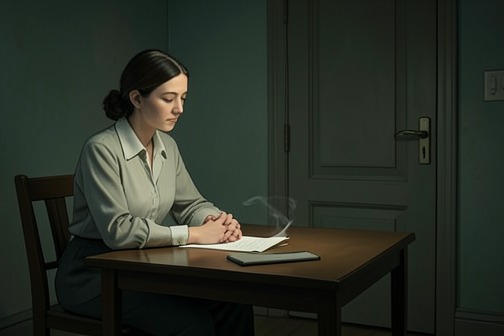
[Naoko leaves Tokyo and goes to a sanatorium to recuperate](entity:event-recall-event-b8830dc2a4c4) after withdrawing from college, returning to her family home in [Kobe](entity:location-recall-location-36b6d53677ce) and seeking treatment for her nerves. Her departure is both a deliberate retreat and a rupture in her relationship with [Toru Watanabe](entity:character-recall-character-toru-watanabe-5b85a10074ad): she needs quiet and distance, but does not reject him, and asks him to wait until she is ready to meet again. The letters that frame this separation make it a suspended interval of care, uncertainty, and attempted honesty rather than a clean parting.
## Decision and departure
After [Naoko](entity:character-recall-character-naoko-c31d25fb4a36) fails to respond to [Watanabe](entity:character-recall-character-watanabe-aa7b56f3da37)’s birthday note, he travels to [Kokubunji](entity:location-recall-location-a5311fa3eadd) and discovers that she has already left her flat. Her name has been taken off the door, the windows and storm shutters are closed, and the manager says she moved out three days earlier without leaving an address. Watanabe writes to her family home in Kobe, hoping the letter will reach her wherever she is. He tells her he wants a long conversation, but refuses to offer promises or polished assurances: he does not yet understand what has happened between them, or where he himself will stand after time has passed.
At the beginning of July, Naoko answers. She says that she has decided to take a year away from college, officially as a leave of absence, though she suspects she will not return. The decision is not a sudden response to Watanabe or to one recent encounter; she says she had been considering it for a long time and had repeatedly been unable to bring herself to say so. Her letter shifts the departure from a mystery Watanabe must solve to a choice Naoko has struggled to articulate.
Naoko asks him not to blame himself for what happened to her. She says the outcome would have been the same and describes her condition as something she must take on herself, adding that she had put off the decision for more than a year. This does not make the consequences less painful for Watanabe, but it establishes her account of the move: she recognizes the strain her silence has caused while insisting that he is not responsible for her illness or retreat.
## Treatment and separation
After leaving her flat, Naoko returns to her family home in Kobe and sees a doctor. The doctor recommends a place in the hills outside [Kyoto](entity:location-recall-location-eea1a33e8137), described not as a conventional hospital but as a sanatorium with a freer style of treatment. Naoko is considering spending time there because she needs to rest her nerves in a quiet place cut off from the world. The letter leaves the details open for a later communication, so the destination is presented through her immediate need for rest rather than through a full account of treatment.
The move therefore creates a specific boundary in the relationship. Naoko is grateful for the companionship Watanabe gave her, but says she is not prepared to see him. She distinguishes unreadiness from unwillingness: she does not say that she never wants to meet, only that she cannot meet now. She promises to write when she feels ready, and allows that they may then get to know each other better. Her departure interrupts their contact without declaring the bond finished.
Watanabe had already tried to meet this uncertainty with candor. In his letter he says the two of them knew too little about one another for him to make promises or demands, but that he would make an effort if she granted him time. He links their need for each other to their shared loss of [Kizuki](entity:character-recall-character-kizuki-1cc5bfd6aa96), the person to whom each had been able to speak honestly about feelings. He understands their relationship as having taken a major detour and become warped; Naoko’s reply does not resolve that difficulty, but confirms that she has received his appeal and values the year of companionship.
## Letters across distance
The letters make separation the condition of the pair’s communication. Watanabe writes because Naoko has disappeared from her former address; Naoko replies only after a long delay, explaining that writing itself is painful and that she has started the letter many times. Her account of the move is thus not delivered in a face-to-face scene. It reaches Watanabe as a carefully composed statement, one that gives him important facts while preserving Naoko’s need to remain apart.
Several months later, Naoko writes again from the place where she is staying, saying that nearly four months have passed since she arrived. In retrospect, she has thought about Watanabe and come to feel that she treated him unfairly and should have been a fairer person. She reflects that fairness, rather than beauty or happiness, has become a standard she can still hold onto. This later letter gives the separation a continuing emotional life: distance has not erased her concern for him, but has enabled a new way of naming it.
Her reflection does not amount to a promise of recovery or reunion. Naoko says that ideas of beauty and happiness have become difficult and convoluted for her, and that she is clinging instead to fairness, honesty, and what is universally true. The change is modest but consequential: where her first letter emphasizes unreadiness and the need to withdraw, the later one looks back at the relationship and considers its moral balance. The correspondence records thought developing across an interval whose outcome remains uncertain.
## Meaning and aftermath
For Watanabe, Naoko’s letters bring relief and pain together. When he reads a later letter, the ordinary world seems to lose its color, and he must pause to gather himself before continuing. Earlier, after reading her first explanation, sadness returns with the force of her gaze; he cannot give it a shape or find a place to hide it. The physical distance between them therefore does not contain his feelings. It makes communication possible, but each message also renews the absence it describes.
The episode belongs to the novel’s recurring tension between knowing what death means and living through loss. Watanabe comes to understand that death is part of life rather than its opposite, but that formulation does not spare him from grief. Much later, after Naoko dies, his memories of her surge back as vivid scenes and seem to draw him into a place where the dead remain part of life. Yet he also recognizes that no truth, sincerity, strength, or kindness can cure the sadness of losing someone. The departure and the later bereavement are distinct events, but the first establishes a pattern: explanation and understanding can preserve a bond without making pain disappear.
When Watanabe returns to [Tokyo](entity:location-recall-location-2ef35aba743c) after Naoko’s death, he shuts himself in his room and spends much of his time in rooms set aside in memory of her, their furniture draped in white and the windowsills dusty. His attention remains fixed on the dead rather than the living. This later withdrawal gives the earlier departure an added resonance, but does not turn Naoko’s move to the sanatorium into a foretelling or a cure. At the time of her letters, the immediate fact is narrower and more difficult: she is alive, away from Tokyo, seeking rest, and not yet ready to see him.
Event 4
University student strike and police crackdown
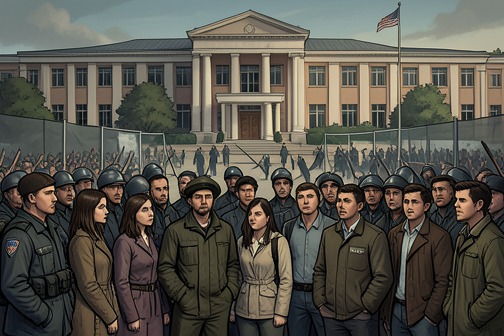
The [University student strike and police crackdown](entity:event-recall-event-863aa8019c44) turn the university’s political upheaval into a test of what its participants are actually prepared to change. The strike begins with calls to dismantle the institution, but after riot police remove the barricades, its former leaders return to class and resume taking notes. [Toru Watanabe](entity:character-recall-character-toru-watanabe-5b85a10074ad) watches the gap between the rhetoric and the conduct widen, while his own grief leaves him unable to invest in either the protest or the restored order.
## Causes and the strike’s language
At the end of May, students call for the university to be dismantled. Toru’s response is not a considered political program: he welcomes the prospect of destruction because, in his emptiness, almost any rupture seems preferable to the existing world. He says he is ready for anything and willing to help, but the intensity of the thought comes from his private desolation rather than allegiance to an organized movement.
That distinction shapes his view of the strike. Toru understands that the students who blockaded the campus were not literally trying to abolish the university. Their demand, as he sees it, was to shift the balance of power within its structure. The institution’s substantial investment and established interests also make its dissolution implausible. The slogans promise a sweeping break; the underlying political aim is narrower, and Toru remains detached from both.
The strike nevertheless changes his daily life. With the campus blockaded and lectures suspended, he takes a delivery job, loading and unloading lorries five days a week, while keeping his three-night-a-week job at the record shop. The physical work is harder than expected, but staying in motion helps him forget the emptiness inside. On nights without work, he drinks whisky and reads. The political disruption thus redirects him into labor and routine without resolving the isolation that makes the disruption momentarily attractive.
## Police intervention and the return to campus
During the summer holidays, the university calls in riot police. They break through the barricades and arrest the students inside. The crackdown is presented as a familiar outcome of the period’s campus conflicts, not as the destruction of the institution: the authorities remove the blockade, while the university itself remains standing. Toru feels nothing when the strike is crushed, a reaction that sets his personal numbness against the collective drama around him.
In September, he returns expecting to find rubble. Instead, the library’s books remain in place, the tutors’ offices have not been destroyed, and the student affairs office has not burned. The untouched campus astonishes him. The physical result makes the apparent scale of the confrontation seem at odds with what it accomplished: the barricades have fallen, but the institution has not been dismantled.
Lectures resume under police occupation. The first students to take their places are the same people who led the strike. They take notes and answer when the register is called, although, in Toru’s understanding, nobody has declared the strike over; police have simply removed the barricades. He confronts the former leaders about their return, but they cannot give him a straight answer. He suspects that attendance marks may have mattered more than continuing the protest, and reads their quick adjustment as a revealing retreat from their earlier declarations.
## Political rhetoric and the classroom
The campus conflict reappears in a lecture on Greek tragedy. A professor has been discussing the use of the [deus ex machina](entity:expression-recall-expression-deus-ex-machina-f84c6949e6f2) in Euripides when two helmeted students enter. One carries political handbills; the other tells the professor that they intend to use the second half of the lecture for political debate. He presents this as an announcement rather than a request, invoking the world’s supposedly more urgent problems. The professor doubts that these problems outrank Greek tragedy, but recognizes that his objection will not be heard and leaves the room with his cane.
The handbills call for action against a fraudulent university-president election, a new all-campus strike, and the imperial-educational-industrial complex. Toru does not object to their political positions so much as to their language: he finds the writing uninspiring and the speaker’s address merely a recycled tune. In his judgment, the students’ real enemy is not State Power but Lack of Imagination. The interruption condenses the wider contradiction of the strike: radical language claims urgency, yet its delivery seems formulaic, while the lecture displaced in its name had been engaging a different account of political and dramatic meaning.
[Midori](entity:character-recall-character-midori-56b44e3d547f) arrives late to the lecture and sits beside Toru, returning his notebook with a note apologizing for Wednesday and asking whether he is angry. When the political meeting takes over, she suggests that they leave. Toru agrees, and they walk out while the speaker is still addressing the class. Their departure is a small, immediate refusal to let the agitators dictate their attention; it also contrasts with the former strike leaders’ return to the classroom as if the confrontation had changed nothing.
## Disillusionment and consequence
Toru’s judgment of the leaders is sharpened by their reversal. He remembers them denouncing students who opposed the strike or voiced doubts, sometimes subjecting dissenters to improvised tribunals. Now they attend lectures and pursue good marks. He sees their retreat as evidence that their boldest words were not backed by a willingness to bear the ordinary costs of continuing the action. His bitter imagined address to [Kizuki](entity:character-recall-character-kizuki-1cc5bfd6aa96)—that the dead are missing nothing in this world—connects the political spectacle to his persistent grief and distrust of the society the students will help reproduce.
For a time, Toru attends lectures but refuses to answer when his name is called. He knows the gesture cannot alter the university or revive the strike; its only immediate effect is to make the room uncomfortable for a few seconds and further isolate him from his fellow students. By the second week of September, he concludes that university education is meaningless, but he does not leave. Instead, he recasts it as training in techniques for dealing with boredom, attends class, takes notes, and spends his free time reading or looking things up in the library.
The episode therefore ends not with political victory but with routines reasserting themselves: the campus is open, the former leaders are back at their desks, and Toru continues his studies without believing in their larger purpose. The crackdown exposes the strike’s limited practical reach; the classroom confrontation shows how hollow its slogans can sound to him. His silence and continued attendance do not resolve that disillusionment. They establish a private, largely ineffective way of living inside an institution whose public promises he no longer trusts.
Event 5
渡边与绿初次相识

The first meeting between [Toru Watanabe and Midori Kobayashi](entity:relation-recall-relation-toru-watanabe-and-mi-1fbf6c20411e) turns an ordinary solitary lunch into the beginning of a new connection. [Midori](entity:character-recall-character-midori-56b44e3d547f) recognizes [Watanabe](entity:character-recall-character-watanabe-aa7b56f3da37) from a university drama class, but he does not recognize her until she supplies the clue that links them; after a short, playful conversation, she proposes another meeting and offers to buy him lunch. The scene’s movement is small but decisive: an unknown student becomes someone Watanabe expects to see again.
## The encounter at lunch
At 11:30 on a Monday, after a lecture on Euripides in History of Drama, Watanabe walks ten minutes to a quiet backstreet restaurant. He has an omelette and salad by the window. The restaurant is slightly more expensive than the student dining hall, but he chooses it for its relaxed atmosphere and its good omelettes. Its owners are a married couple who rarely speak to each other, and a part-time waitress helps serve the customers. These unremarkable details establish the scene’s private, unhurried setting before anyone interrupts it.
A group of four neatly dressed students enters and takes the table near the door. As the group studies the menu and places its order, one of the women keeps glancing toward Watanabe. She has extremely short hair, dark sunglasses, and a white cotton mini-dress. Watanabe does not know who she is and continues eating; she leaves her seat, comes to his table, and asks whether he is Watanabe. He is struck by the mismatch between her certainty and his inability to place her: few people at the university know him by name, and he thinks he would remember someone so noticeable.
Midori asks if she may sit down or whether Watanabe is expecting somebody. Their initial exchange is not a formal introduction so much as a test of recognition. When Watanabe asks whether they know each other, she answers with a reference to Euripides and then to Electra, pointing back to the lecture that has just ended. The allusion supplies the missing context: she has seen him in History of Drama, while he has not yet connected the strikingly changed woman at his table with the student from class.
## Recognition and first impressions
Watanabe looks at Midori more closely and recognizes her only after she removes her sunglasses. He remembers her as a first-year student in the class, but her new hairstyle has altered his impression of her so completely that he failed to identify her. He recalls that, before the summer holidays, her hair reached several inches below her shoulder. Midori explains that she had a perm over the summer and that it turned out badly. The alteration is a concrete cause of the missed recognition, not a mystery about how they know one another.
The scene gives their first contact a gentle asymmetry. Midori has noticed Watanabe and knows his name; he needs her theatrical prompt and the removal of her sunglasses before he can place her. She is willing to cross the restaurant and initiate conversation, while he responds cautiously, trying to reconstruct the connection. Her remark about Electra makes their shared classroom the bridge between unfamiliarity and recognition, and the quick exchange lets a lecture become the unlikely pretext for a personal acquaintance.
## A conversation becomes an invitation
The two discuss the restaurant’s food. Midori orders macaroni and cheese, and Watanabe says that the restaurant makes it reasonably well. The talk then shifts from the menu to Watanabe himself. Midori comments on the smooth quality of his speech and asks whether anyone has ever mentioned it. He says no and adds that he has never noticed anything unusual about the way he talks. The exchange shows Midori attending to small, individual details, while Watanabe receives her observation without turning it into a performance.
When Midori introduces herself, she says that her name means green, though she thinks green looks terrible on her and jokes that this makes her feel cursed. She adds that her sister’s name is Momoko, or Peach girl, prompting Watanabe to ask whether her sister looks good in pink. The wordplay makes the introduction more personal than simply exchanging names: Midori offers a brief, amused account of the mismatch between her name and her sense of how the color suits her.
Before leaving, Midori asks whether Watanabe will be at lectures two days later. He says that he will. She proposes that they meet at the restaurant at noon, promising to return his notebook and buy him lunch. Her invitation is practical as well as social: she frames eating together as an easy alternative to eating alone. The conversation thus gives the meeting a clear next step, one initiated by Midori rather than left to chance.
## The missed second meeting
Midori leaves the table and returns to the other students, waving to Watanabe as he passes them. The three others barely look in his direction. That small contrast preserves the individuality of the encounter: Midori has chosen to approach him, and the invitation belongs to her rather than to the group she arrived with.
At noon on Wednesday, Watanabe returns to the restaurant, but Midori is absent. He waits, first over a beer and then through lunch, finishing at 12:35. He crosses to a small shrine and sits on its stone steps, hoping to clear his head and give her more time to arrive. At one o’clock he gives up and goes to read in the library before attending his two o’clock German lecture. The planned follow-up therefore turns into an unanswered appointment; the opening of the relationship is marked not by immediate continuity but by a promise that is briefly left hanging.
After the lecture, Watanabe goes to the student affairs office and checks the History of Drama class list. The only Midori listed is [Midori Kobayashi](entity:character-recall-character-midori-kobayashi-2b1c10b48d58). He then searches the student files for her address and telephone number, finding a record for a student who entered the university in [1969](entity:time-recall-time-1969-711fcc62f578) and lived with her family in Toshima, a north-western suburb. He slips into a telephone box and dials the number. His response to her absence extends the first meeting beyond the restaurant: a chance encounter has become important enough for him to seek her out rather than simply let the missed lunch pass.
## Significance of the first meeting
The scene establishes the beginning of Watanabe and Midori’s connection through ordinary acts of attention: a glance from across a restaurant, a walk to another person’s table, a classroom reference, a remembered hairstyle, and an invitation to share lunch. Its significance lies not in a grand declaration but in the shift from Watanabe’s solitary routine to an emerging expectation of company. Midori’s initiative opens that possibility, while Watanabe’s later wait and search show that the encounter has registered with him.
Recognition is the scene’s small reversal. Watanabe initially sees Midori as a stranger, although she knows who he is; one line about Euripides and the removal of her sunglasses redraw the scene as a reunion of classmates who had not yet become acquaintances. The missed Wednesday appointment complicates that beginning without undoing it. Instead of making their first conversation self-contained, the narrative carries its consequence forward into Watanabe’s decision to find Midori’s name and call her.
Event 6
渡边与绿在火灾现场接吻
The kiss between [Toru Watanabe and Midori Kobayashi](entity:relation-recall-relation-toru-watanabe-and-mi-1fbf6c20411e) takes place on a rooftop laundry deck while they watch a neighborhood fire. Its significance lies in the scene’s double movement: danger outside gives way to a fleeting, tender closeness, and that closeness immediately encounters the complications of their other attachments. The kiss is not a declaration or a beginning without qualification; it is a bodily recognition of intimacy, followed by an exchange that makes its limits plain.
## The Fire and the Rooftop
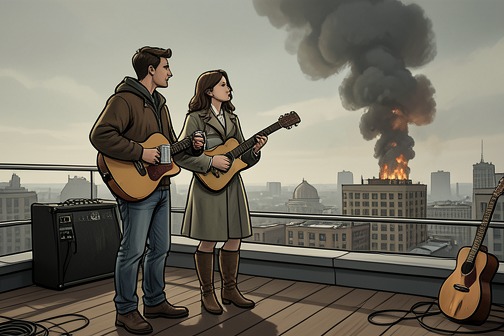
A [Sunday](entity:time-recall-time-95868a7bbce2) afternoon near [Midori](entity:character-recall-character-midori-56b44e3d547f)’s home is interrupted by sirens and a fire. Midori leaves [Watanabe](entity:character-recall-character-watanabe-aa7b56f3da37) downstairs and returns to hurry him up a steep, narrow stairway to a wooden deck above the surrounding rooftops. From there, they can see black smoke rising from a building three or four houses away. Midori identifies the burning place as Sakamoto’s, once a maker of traditional door fittings. A three-storey building blocks their direct view of the blaze, while fire engines work in and around the narrow lane.
Rather than leave the deck, Midori brings up two floor pillows, four cans of beer, and a guitar. She and Watanabe drink while watching the smoke, and she sings folk songs she used to perform with her group. Watanabe tries to join her in bass harmony, but he is so poor at it that she gives up and sings alone. The scene carries the dissonance of their activity: below them, people shout and firefighters respond; above, Midori continues her songs and Watanabe listens, keeping watch on the fire.
The emergency remains present in concrete, unsettling details. A newspaper helicopter passes overhead to photograph the blaze; a policeman shouts through a loudspeaker for bystanders to retreat; a child cries for his mother, and glass breaks somewhere nearby. The wind shifts, and white ash falls around the deck. Midori nevertheless keeps sipping and singing. Her composure does not erase the danger; it sets an oddly intimate, improvised interval against it.
## A Shared Interval
As the fire flares and subsides, Midori works through the old standards she knows and then sings an unusual song of her own. Watanabe drinks his beer and listens while watching the scene below. Their time together is neither an escape from the fire nor a conversation that directly defines their relationship. It is a shared stretch of attention, built out of music, beer, smoke, the shifting wind, and the view from the deck.
About half an hour later, the fire is out. The responders have kept it from spreading and prevented injuries; most of the fire engines leave, and the crowd disperses into conversation. One police car remains to direct traffic, its blue light turning, while two crows perch on nearby lamp-posts. Midori, by contrast, seems to have let herself go limp and spaced out. She barely speaks and stares at the sky. In the lull after the emergency, the alertness and noise of watching give way to stillness.
## The Kiss and Its Limits
Midori looks into Watanabe’s eyes, and he looks back. He puts an arm around her and kisses her. Her shoulders tense with the slightest twitch, then relax; she closes her eyes for several seconds. The kiss is soft and gentle, not intended to lead further. Its force comes from the scene that precedes it: they have spent the afternoon on the deck in the sun, drinking beer, watching the fire, and listening to songs. The narrator presents the kiss as an attempt to preserve the warmth and closeness of that shared mood, not as proof that their circumstances have been settled.
The tenderness is therefore inseparable from risk. The narration recognizes that even this restrained kiss carries danger, because each of them is attached elsewhere. The physical gesture draws them nearer before either has offered a promise; it makes a latent intimacy visible while leaving its consequences open. The scene’s turn is small in outward action but consequential in feeling: the afternoon has changed from companionship observed at a distance into contact that neither can treat as entirely casual.
## What They Tell Each Other
Midori speaks first after the kiss. Holding Watanabe’s hand, she tells him, with apparent difficulty, that she is seeing someone. He says that he had sensed as much. Her disclosure confirms that the closeness on the deck does not occur in an uncomplicated romantic space. The kiss has not removed the other relationship; instead, it makes the fact of that relationship something they must acknowledge directly.
Midori asks whether Watanabe has a girl he likes. He answers that he does. This exchange leaves both attachments in place without elaborating them in the moment. Its importance is the contrast between what their bodies have just expressed and what they say: they have shared a kiss, but neither presents the other as free to begin a relationship. The scene closes not with resolution but with mutual recognition of an obstacle.
## Place in the Relationship
The rooftop episode gives Watanabe and Midori an intimate memory formed in the midst of an ordinary neighborhood emergency. The fire provides the occasion, while the songs and their prolonged watching supply a pause in which closeness can emerge without being arranged as a formal confession. The kiss is reciprocally tender, yet its restraint matters: it remains an expression of the moment rather than a declaration of a future.
That combination of warmth and incompletion places the episode among the encounters that develop their bond while preserving its uncertainty. Midori’s admission and Watanabe’s answer prevent the kiss from being read as a clean romantic turning point. Instead, the scene holds connection and separation together: two people can share an unguarded moment, feel its danger, and still be bound by circumstances beyond it.
Event 7
Kizuki’s suicide
[Kizuki’s suicide](entity:event-recall-event-kizuki-s-suicide-d3f38c4cd509) is the novel’s initiating loss and a lasting force in the lives of [Toru Watanabe and Naoko](entity:relation-recall-relation-toru-watanabe-and-na-7a28ea1af04d). Its stark contrast between an ordinary afternoon and a death no one can explain unsettles [Watanabe](entity:character-recall-character-watanabe-aa7b56f3da37)’s understanding of life, while the absence of a note or discernible motive leaves both the characters and the narrative without a final account of why [Kizuki](entity:character-recall-character-kizuki-1cc5bfd6aa96) died. The loss returns in Watanabe’s grief, in [Naoko](entity:character-recall-character-naoko-c31d25fb4a36)’s memories of the person he did not know, and in the novel’s continuing recognition that understanding death does not make bereavement curable.
## The Last Afternoon
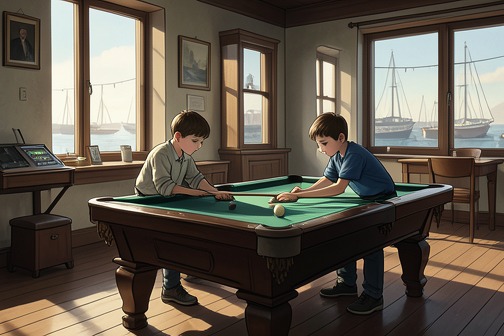
The day of [Kizuki’s death](entity:event-recall-event-kizuki-5b5835777ade) began with an unremarkable decision to skip classes. On a pleasant afternoon in May, he and Watanabe left school, walked down to a pool hall by the harbor, and played four games. Watanabe won the first, but Kizuki grew serious and took the next three. By their custom, the loser paid. Kizuki made no jokes during the games, a departure from his usual manner. When Watanabe asked why he was so serious, Kizuki said he had not wanted to lose that day, smiling with satisfaction.
That exchange gives their final meeting an ordinary closeness, but not an explanation. Nothing Watanabe observed in the afternoon prepared him for what happened later. The disjunction between the familiar friend at the pool table and the death that night becomes central to Watanabe’s retrospective account: the last encounter is vivid, yet it offers no key that would make Kizuki’s decision intelligible.
## The Death and Its Immediate Aftermath
Kizuki died by suicide in his garage that night, at seventeen. His parents had been away visiting a sick relative. When they returned to put their car away, they found him dead. The account includes a radio still playing and a petrol-station receipt beneath a windscreen wiper, details of an ordinary setting that do not clarify his motive.
He left no suicide note, and nobody could identify a reason. Because Watanabe had been the last person to see him, police questioned him. He told the investigating officer that Kizuki had shown no sign of what he was about to do and had seemed exactly as usual. The officer appeared to judge both boys through the fact that they had skipped classes to play pool, as though that behavior made suicide seem natural. A brief newspaper item brought the public account to a close; Kizuki’s parents disposed of his red N-360, while a white flower marked his desk at school for a time. The official and visible aftermath ended, but the questions did not.
## What Watanabe Could Not Forget
In the ten months between Kizuki’s death and his examinations, Watanabe could not find a place for himself in the world around him. He began a relationship with a girl at school, but it lasted less than six months and did not draw him out of his detachment. He applied to a private university in [Tokyo](entity:location-recall-location-2ef35aba743c), passed its entrance examination without exhilaration, and left [Kobe](entity:location-recall-location-36b6d53677ce) because he wanted to begin somewhere he knew no one. After moving into a dormitory, he tried to keep a proper distance from everything and to forget the pool tables, Kizuki’s car, and the flower on the school desk. The effort seemed to work at first, but an indistinct knot remained inside him.
As Watanabe recalls it, that knot gradually formed into the recognition that death was not separate from life. Before Kizuki died, he had imagined death as an eventual force that remained elsewhere until it reached a person. The loss broke down that distinction: death was already within the life of the living, and no effort to forget could make it absent. Watanabe came to understand that Kizuki’s death had taken part of him as well. He carried this conviction into the following spring, even as he resisted becoming serious and struggled with the contradiction between treating death as an unalterable fact and fearing that seriousness itself might not bring him closer to truth.
## What Naoko Knew
Naoko’s memories complicate Watanabe’s picture of his friend. Kizuki had shown Watanabe his best side, working to conceal his weaknesses because he was fond of him. With Naoko, his lifelong companion, he let his guard down. She remembered him as changeable from childhood: sometimes talkative, sometimes depressed, and often frustrated by his attempts to improve himself. She described his efforts to change as a source of anger and sadness, despite the qualities she considered fine and beautiful in him. Her account does not provide a definitive motive for his suicide; it reveals instead how differently the same person could appear within different relationships.
Naoko also described their closeness as an inseparable childhood bond. They had grown up together with an unusual openness and little sense of distance between them. She believed that, had Kizuki lived, they would have stayed together, loving one another and gradually becoming unhappy. This imagined future is not a claim that their relationship caused his death. It underscores the limits of what a surviving person can know: Naoko can describe the relationship they shared and the vulnerabilities she witnessed, but neither she nor Watanabe can turn those facts into a conclusive explanation.
## Recurrence and Significance
The absence of an explanation becomes a painful pattern in the novel, not a puzzle solved by repetition. When Naoko tells Watanabe that her older sister also died by suicide at seventeen and left no note, she sees the deaths as exactly alike. The parallel deepens her grief and her sense of recurrence, but it does not establish a shared cause. Later, Kizuki’s death remains part of how Watanabe understands Naoko’s death, and subsequent losses reinforce the distance between the living person’s desire for reasons and the silence left by the dead.
Watanabe’s eventual formulation—that death exists as part of life—does not release him from grief. After Naoko dies, he reflects that living also means nurturing death, but that this truth cannot cure the sorrow of losing someone loved. In that later reckoning, Kizuki’s suicide is both an early lesson and an unresolved beginning: it changes how Watanabe understands mortality, yet it cannot prepare him to meet the next bereavement. The event’s significance lies not in a recovered motive, but in the way an unexplained death continues to shape memory, intimacy, and the difficult work of remaining among the living.
Event 8
Naoko’s sister’s suicide and Naoko’s discovery of her body
[Naoko’s sister’s suicide and Naoko’s discovery of her body](entity:event-recall-event-naoko-naoko-abeace93dc39) are inseparable events: an unexplained death becomes a formative trauma for the younger sister who finds her. [Naoko](entity:character-recall-character-naoko-c31d25fb4a36) recounts the discovery to [Toru Watanabe](entity:character-recall-character-toru-watanabe-5b85a10074ad), describing how the sudden loss, her paralysis in the moment, and her silence afterward marked a crisis whose effects reached into her later illness and her relationship with [Watanabe](entity:character-recall-character-watanabe-aa7b56f3da37). The account also draws an explicit parallel with [Kizuki’s death](entity:event-recall-event-kizuki-5b5835777ade), establishing a pattern of losses that those left behind cannot make intelligible through a clear motive or explanation.
## Background and the Unexplained Death
Naoko remembers her older sister as exceptionally capable and popular, while describing herself as the younger, “sweet little girl” who was dressed up, taught piano and ballet, and treated with loving attention by her sister. The contrast in their childhood roles shaped how Naoko understood herself alongside her sister, but her account does not offer that contrast as an explanation for the suicide. She says that nobody knew why her sister killed herself; the sister was seventeen, gave no warning, and left no note. Naoko immediately compares this to [Kizuki](entity:character-recall-character-kizuki-1cc5bfd6aa96), who also died at seventeen without an apparent sign or explanation.
That parallel does not resolve either death. It instead places the sister’s suicide within the book’s repeated experience of deaths whose causes remain obscure to those who survive them. Naoko’s sister had been known as intelligent and an avid reader, and after her death Naoko encountered her marginal comments, pressed flowers, and letters from boyfriends in her books. These traces prompted Naoko to cry, but they did not supply a reason for the death. What remains central is the disjunction between the life her family thought it knew and the unexplained fact of her suicide.
## The Discovery
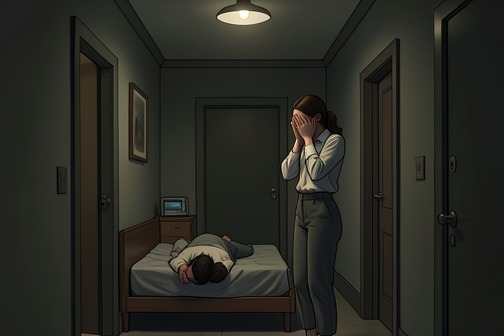
Naoko was in her first year of school when she found her sister, who was in sixth form. On a dark, rainy day in November, she returned from a piano lesson at 6:30. Their mother was making dinner and asked her to tell her sister that the meal was ready. Naoko went upstairs, called through the bedroom door, and, hearing no answer, opened it to look inside.
At first, she could not understand what she was seeing in the dark room. Her sister stood by the window, and Naoko noticed that she seemed taller than usual. As she moved closer, she saw the rope above her sister. She recalls taking in the details, then becoming unable to act according to her conscious intention: she wanted to run downstairs and call her mother, while her body seemed to move separately as she tried to lower her sister. She did not have the strength to do so. For five or six minutes she remained in a blank, disoriented state with her sister, until their mother came upstairs.
## Immediate Aftermath and Lasting Effects
For three days after the discovery, Naoko could not speak. She lay in bed staring into space, unable to understand what was happening to her. When she later tells Watanabe about those days, she connects them to the depth of her illness: she says that it has deeper roots than he realizes, and that she is more flawed than he understands. Her disclosure gives the earlier loss a continuing place in the present; it is not simply a past tragedy, but part of the history through which Naoko understands her own vulnerability.
Naoko asks Watanabe not to put his life on hold for her. She tells him to go on ahead, not to let thoughts of her hold him back, and to visit sometimes and remember her. She fears that she may draw him into her suffering and says she does not want to interfere with his life or anyone else’s. Watanabe resists her attempt to reduce their bond to occasional visits and remembrance. The conversation therefore links the sister’s death to a present conflict about love, responsibility, and whether Watanabe can remain close to Naoko without being consumed by the losses that shape her life.
## Repetition, Grief, and the Meaning of Death
The comparison with Kizuki recurs beyond Naoko’s account. Watanabe, who was the last person to see Kizuki before his death, describes being questioned by police and unable to find his place in the world during the months that followed. The deaths of [Kizuki and Naoko](entity:relation-recall-relation-fc4e04933774)’s sister are not given a shared cause, but their resemblance—the same age and the same absence of a discernible warning or note—makes the survivors’ search for an explanation feel persistently unanswered.
Watanabe later gives that experience a formulation: death exists not as life’s opposite but as part of life. The idea first takes shape after Kizuki’s death, and the parallel with Naoko’s sister is among the losses that give it weight. Yet Watanabe’s later reflection on Naoko’s death adds a limit to philosophical understanding: no truth, sincerity, strength, or kindness can cure the sadness of losing someone loved. The two insights work together without cancelling each other. Death is bound up with the lives of the living, but recognizing that fact does not make grief disappear.
## Narrative Significance
Naoko’s account reaches Watanabe as an act of disclosure: she recounts the sister’s death and its immediate aftermath while explaining why she believes her illness is deeply rooted and why she urges him not to wait for her. The remembered scene thus connects childhood loss with present intimacy, while its unanswered cause resists a neat psychological explanation. Its significance lies not in revealing a motive, but in showing what the absence of one leaves behind: a traumatic memory, a silence that lasts three days, and a lasting fear that closeness may expose another person to the same darkness.
The episode also anticipates the novel’s broader movement between remembering the dead and trying to remain among the living. Watanabe’s later grief for Naoko returns him to the lesson he first formed after Kizuki’s death, but it also exposes the lesson’s limits. The sister’s suicide helps establish the pattern of inexplicable loss; Naoko’s memory of finding her shows how that pattern is lived from within, and Watanabe’s reflections show that naming death cannot complete the work of mourning.
Event 9
Reiko’s first mental breakdown
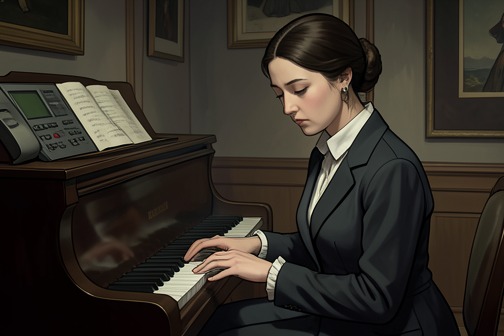
[Reiko’s first mental breakdown](entity:event-recall-event-reiko-9fae3cf649b1) began when the left little finger she depended on as a pianist abruptly stopped moving. No physical cause could be found, yet the failure shattered the future she had been raised to expect: after piano had shaped her life since childhood, its threatened loss left her without a stable sense of what remained. Her account connects that private collapse to the sanatorium’s later ethic of accepting, rather than forcibly correcting, human differences.
## The finger that stopped
[Reiko](entity:character-recall-character-reiko-50478f17e09b) recalls that she was in her final year at the conservatoire, preparing intensively for an important competition. Her prospects appeared assured: she had won competitions, received top marks, and expected to study in Germany after graduation. Then her left little finger stopped moving. Massage, hot water, and time away from practice made no difference.
The doctors found nothing wrong with the finger or its nerves, and could identify no physical reason for the loss of movement. A psychiatrist suggested pre-competition stress and advised her to leave the piano for a while. The mismatch between the clear bodily failure and the absence of a medical explanation intensified the uncertainty: piano was both her vocation and the frame through which she understood her life, while the cause of its sudden interruption remained obscure.
## A life organized around piano
Reiko went to her grandmother’s home on the coast in [Izu](entity:location-recall-location-6e70ebb92804) to recuperate, intending to spend a few weeks away from practice. Instead, she found herself unable to stop thinking about the piano or the possibility that her finger would never move again. She had begun playing at four, had built her days around music, and had even avoided housework so as not to injure her fingers. She understood that people had valued her for her talent, and feared that without piano she would have nothing to offer.
The crisis became a mental collapse she describes as a complete jumble and total darkness. Her dream of becoming a concert pianist ended. After two months in hospital, the finger began moving again, allowing her to return to the conservatoire and graduate. But physical recovery did not restore what had been lost: Reiko says that some inner energy had vanished, and a doctor advised her that she lacked the mental strength to become a professional pianist.
She taught piano pupils at home after graduating, but the work did not resolve her grief over the career she had imagined. Hearing of less talented musicians winning competitions or giving recitals brought the loss back into focus. The breakdown therefore outlasted the period when her finger was immobile: the immediate bodily symptom receded, but the collapse of her former future remained a source of pain.
## From crisis to the sanatorium
Years later, Reiko describes herself as a music teacher and office helper at the sanatorium, where she has lived for seven years. Other residents sometimes call her “The Music Doctor” or “Doctor Ishida,” but she clarifies that she is a patient, not a doctor. The ambiguity of her daily role reflects the community’s less sharply divided arrangement of care: patients and staff can work and take part in activities together, even though their positions are not identical.
Reiko explains that the place is not an ordinary hospital. It has doctors who check residents’ conditions, but its purpose is more convalescence than intensive treatment; there are no bars on the windows, its gate remains open, and people enter and leave voluntarily. Admission depends on being suited to that form of recovery. People needing specialized therapy may instead be sent to a specialized hospital. The distinction matters to Reiko’s story: the sanatorium provides a setting for living with vulnerability, but it is not presented as a substitute for every kind of treatment.
## Acceptance rather than correction
The sanatorium’s doctor tells Reiko that residents are not there simply to have their deformities corrected, but to become accustomed to them. Differences in how people think, feel, and see the world cannot necessarily be altered on command; trying to force a correction may create other problems. The explanation does not deny the pain these differences cause. Rather, it describes the community as a place to get away from some of that suffering and make room for it.
Reiko links this idea to the way residents live together. They know themselves to be “deformed,” she says, whereas people outside may go through life unaware of their own differences. The residents wear their deformities openly and live quietly so as not to hurt one another. Her history makes that principle concrete: the return of finger movement did not make her former ambition recoverable, and simply telling her to resume her old life could not undo the devastation attached to its loss.
## Care, its limits, and Reiko’s later role
The novel later shows the boundary of this mutual-support model through Reiko’s account of [Naoko](entity:character-recall-character-naoko-c31d25fb4a36)’s condition. Reiko writes that Naoko is usually well, but can become so emotionally unstable that the residents must watch her constantly; during intense episodes of hearing voices, she shuts down and withdraws inside herself. After a long discussion involving Naoko’s mother, the doctor, and Reiko, they conclude that Naoko should move to a proper hospital for intensive treatment, with the possibility of returning to the sanatorium depending on the results.
This later decision does not erase the sanatorium’s value; it clarifies its limits. Reiko’s account of her first breakdown is set against a form of care based on patience and accommodation, while Naoko’s worsening condition requires a different level of treatment. Reiko’s own experience—from a finger that began moving again to a future in music that did not return—keeps recovery from meaning a simple restoration of the past. In her history, learning to live with a changed life is distinct from being cured of what caused the change.
Event 10
Reiko’s second mental breakdown
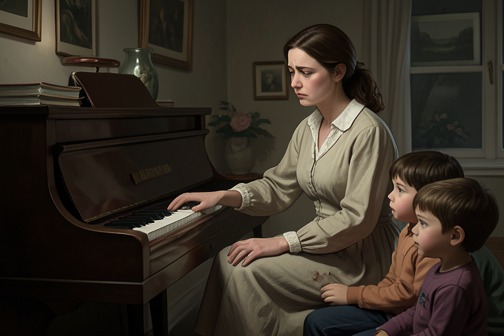
[Reiko’s second mental breakdown](entity:event-recall-event-reiko-0f4dbdf129e2), recalled in her account to [Toru Watanabe](entity:character-recall-character-toru-watanabe-5b85a10074ad), is the return of a crisis she had struggled to outrun: after losing her hoped-for future as a concert pianist, she again descended into what she calls “the jumble, the darkness.” The episode marks the distance between outward recovery and inward loss, and helps explain why her later life at [Ami Hostel](entity:location-recall-location-ami-hostel-a16d1036cfbe) is organized around patience and accommodation rather than a simple promise of cure.
## Causes and Circumstances
After an earlier hospitalization, movement returned to [Reiko](entity:character-recall-character-reiko-50478f17e09b)’s finger, allowing her to resume conservatoire studies and graduate. But the physical recovery did not restore the inner energy she associated with becoming a professional pianist. A doctor told her she lacked the mental strength for that career and advised her to give up the ambition. The loss was not merely a change of occupation: Reiko felt that a jewel of energy had evaporated from her, leaving the life she had imagined inaccessible.
She began teaching piano pupils at home, including neighborhood children working through Beyer exercises and sonatinas. The everyday routine sharpened rather than softened her sense of deprivation. Hearing of less talented musicians winning competition places or giving recitals brought her to tears; each report measured the public recognition she believed she had lost against the smallness of her new life.
The crisis also unfolded within her family and neighborhood. Reiko felt her parents moving carefully around her for fear of causing pain, yet believed she could sense their disappointment that their once-prized daughter had become a former mental patient. She feared that neighbors were talking about her and became afraid to go outside. The pressure of living among people whose feelings she thought she could read fed the isolation from which the second breakdown emerged.
## Breakdown and Hospitalization
Reiko locates the return of the crisis in a brief, abrupt phrase: “So then, snap!” At twenty-four, the jumble and darkness came back. The contrast with her first hospitalization is explicit: this time she spent seven months in a different institution, a conventional asylum with high walls and locked gates, rather than the open convalescent community where she later lived.
She describes that asylum as filthy and without pianos. With no instrument and little sense of what to do, her overriding aim was to get out as soon as possible, and she struggled desperately to recover. Seven months felt long; Reiko also remembers that this period was when her wrinkles began. The details make the institution not an abstract stage of treatment but a restrictive setting sharply unlike the later life she would describe at Ami Hostel.
## Aftermath and Later Context
The breakdown did not end Reiko’s connection to music, but it changed its place in her life. After leaving the hospital, she taught pupils at home; later, at Ami Hostel, she taught music as a form of therapy and helped in the office. She had lived there for seven years by the time Toru visited. Though residents sometimes called her “Doctor Ishida,” she explained that she was another patient, and that the blurred distinction between helping and being helped was part of her daily role.
Reiko describes Ami Hostel as a place for convalescence rather than ordinary hospital treatment: residents enter and leave voluntarily, and people who need specialized therapy may be transferred to a specialist hospital. Its quiet, open setting and shared activities do not erase distress. Instead, the community’s account of recovery emphasizes learning to recognize and accept personal differences rather than trying to correct them by force. Against the locked gates of the asylum in Reiko’s memory, this approach gives her second breakdown a lasting context: it is part of a history in which recovery has limits, may require different institutions, and depends on patience rather than a single decisive cure.
Event 11
Reiko’s third mental breakdown and suicide attempt
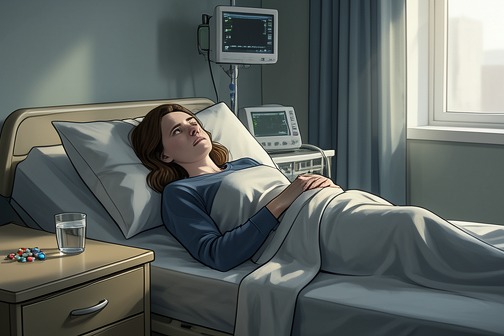
[Reiko’s third mental breakdown and suicide attempt](entity:event-recall-event-reiko-a3badae7bd0e) marks the point at which a renewed crisis overwhelmed the life she had tried to preserve with her husband and daughter. She had recognized that the pressure of staying in her neighborhood was making her mind falter again; when her husband asked her to hold on for a month while he arranged a move, she could not wait. She took sleeping pills and turned on the gas, then woke in a hospital. The attempt led not to a shared new beginning but to divorce, and [Reiko](entity:character-recall-character-reiko-50478f17e09b)’s later fear of the outside world reveals how the crisis continued to govern what she felt able to risk.
## Causes and the decision to leave
Reiko recounts the crisis while explaining the circumstances surrounding her separation from her husband. She believed that the girl at the center of the earlier conflict had manipulated the adults around her, and that others would believe what they wanted regardless of what Reiko and her husband said. Continuing to struggle in the same neighborhood, she feared, would make her vulnerable to another breakdown. Her conclusion was practical and urgent: they had to move somewhere far away where nobody knew her.
The proposed move collided with her husband’s circumstances. He loved his work, they had only recently settled into their own small prefab house, and their daughter was comfortable at kindergarten. He thought the arrangements would take at least two months. Reiko said she could not endure that long: her ears were already ringing, she was hearing things, and she could not sleep. Her husband suggested that she leave first on her own while he managed the practical details, but she refused. She needed him with her and feared that, without him, she would fall apart.
Her husband then asked for just one month, promising to leave his job, sell the house, arrange a new kindergarten, and find work elsewhere; he mentioned a possible position in Australia. Reiko understood that objecting might isolate her further, but the promised interval did not feel survivable. The breakdown came before the month was over. In the sequence she tells, the request to wait is not merely a logistical delay: it is the interval in which her already returning symptoms become an immediate emergency.
## The attempt and its aftermath
Reiko describes the moment of collapse as happening again, with the abruptness of a snap. She took sleeping pills and turned on the gas. She woke in a hospital bed; the account does not describe the mechanics of her rescue or the medical treatment, but makes clear that she survived and needed months before she had calmed enough to think through what had happened.
Afterward, Reiko asked her husband for a divorce, saying it would be better for him and their daughter. He refused at first, proposing that the three of them move somewhere new and begin again. Reiko answered that, for her, the decisive break had already occurred when he asked her to wait a month. She feared that moving would not erase the pattern: she might again ask him for help, and make him suffer again. She therefore rejected the prospect of another attempt at family life, however far away they went.
## Marriage, care, and separation
Reiko does not present the divorce as the result of a loveless marriage. She describes her husband as faithful, strong, patient, and someone she trusted completely. He had done everything he could to help her recover, while she had tried to recover for his sake and their daughter’s. She recalls being happy for six years after their marriage and believed she was recovering. In her image, her husband brought her 99 percent of the way there, but the remaining one percent went crazy. That contrast makes the breakdown more than a rejection of his care: his devotion was real, yet it could not guarantee her safety from another crisis.
Reiko says that she ended the marriage because she believed she would remain ill and did not want to drag others down or make them live in constant fear that she might lose her mind. She later learned that her former husband had remarried, and says she was still glad she had made him leave her. Her decision is narrated as an attempt to spare her family the continuing consequences of a condition she did not believe she could control, not as proof that recovery had been wholly absent or that her husband had failed to care for her.
## Continuing fear and the significance of the recollection
The crisis remains present in Reiko’s later life as fear of renewed involvement. She tells [Watanabe](entity:character-recall-character-watanabe-aa7b56f3da37) that she cannot leave the sanatorium because she is afraid of the outside world, of meeting new people, and of feeling new feelings. Her fear gives the earlier crisis a continuing consequence: the attempt did not only end her marriage but also shaped her sense of whether ordinary contact and emotional attachment were safe. When Watanabe tells her he thinks she can go outside and make it, she smiles without answering; the exchange offers encouragement, not evidence that the fear has already disappeared.
Set against the book’s wider account of death, the episode also complicates any simple idea that understanding a crisis can resolve its pain. Watanabe comes to believe that death is part of life, yet later recognizes that no truth, sincerity, strength, or kindness can cure the sorrow of losing someone. Reiko’s account presents a related limit in the realm of illness and care: her husband’s love and her own efforts to recover carried her far, but they could not prevent the one percent she describes as going crazy. The recollection matters because it preserves both sides of that limit—the seriousness of her collapse and the genuine care that preceded it—without turning survival into a complete or certain recovery.
Event 12
渡边首次探访阿美寮

[Toru Watanabe](entity:character-recall-character-toru-watanabe-5b85a10074ad)’s first visit to [Ami Hostel](entity:location-recall-location-ami-hostel-a16d1036cfbe) is a journey toward [Naoko](entity:character-recall-character-naoko-c31d25fb4a36) and an encounter with the fragile terms on which they can remain close. Prompted by her letter, he crosses from [Tokyo](entity:location-recall-location-2ef35aba743c) into the mountains, where Naoko’s insistence on honesty gives their reunion its warmth and its limit: she welcomes him, but warns him not to let the visit become a burden or allow his life to be held back by hers. The visit ends not with resolution, but with a promise to return and write—a modest routine that later gains the weight of a lifeline.
## The letter and the journey
After reading Naoko’s seven-page letter, [Watanabe](entity:character-recall-character-watanabe-aa7b56f3da37) fears that he will keep rereading it if he stays beside it. He puts it away in his desk, spends [Sunday](entity:time-recall-time-95868a7bbce2) walking aimlessly through Tokyo while turning its sentences over in his mind, then calls Ami Hostel to ask whether he can visit her the following afternoon. The receptionist first asks him to call back; after dinner, she confirms that the visit is possible. Watanabe packs a change of clothes and toiletries, but sleep still eludes him until after one in the morning.
On Monday he rises at seven, goes to the dormitory Head to say he will be away for two days hiking, and leaves without breakfast. He catches a crowded commuter train to Tokyo Station, buys a bullet-train ticket to [Kyoto](entity:location-recall-location-eea1a33e8137), and jumps onto the first Hikari express. After coffee and a sandwich, he dozes during the journey. In Kyoto, Naoko’s directions take him by city bus to a northern-suburbs terminal. The next bus will not leave until 11.35 and will take more than an hour, so he buys a map from a bookshop across the street while he waits.
The map makes clear how far into the mountains Ami Hostel lies. The bus route crosses several hills, follows a canyon road to its dead end, then turns back toward the city; Watanabe’s stop is just before the end of the line. From there, Naoko has told him, a footpath leads to the hostel in about twenty minutes. The journey’s remoteness is not incidental: before he can see Naoko, Watanabe must pass from his familiar urban life into a place set apart from it.
At the gate, a sign declares the grounds private and off-limits to trespassers. The guardhouse appears recently occupied: an ashtray holds three cigarette ends, a teacup is half full, a transistor radio rests on a shelf, and a clock ticks in the quiet. After waiting and trying what may be a bell, Watanabe sees only three vehicles in a car park built to hold thirty. A gatekeeper arrives on a yellow bicycle, apologizes for keeping him waiting without sounding especially sorry, and calls ahead after Watanabe gives his name. The white number 32 on the bicycle’s mudguard and the gatekeeper’s precise directions make the entrance feel like a threshold governed by its own procedures. He sends Watanabe through trees and a roundabout toward the main building, telling him to ask for Doctor Ishida.
## Reunion and the hostel’s terms
In the room where he waits, Watanabe lies down and becomes absorbed in memories he has rarely recalled. They arrive like a torrent, until Naoko quietly opens the door. For a moment he takes her for an image created by his own recollection; then he recognizes that she is really there. The scene folds memory into the present before the two have exchanged more than a few words: he has been thinking of the past, and Naoko enters it as a living person.
Naoko touches her hairslide and says that she has to go when their time is up. Before leaving, she thanks him for coming and tells him that his presence makes her happy. But Ami Hostel, she explains, is a special place with a special system, and not everyone can enter into it. If being there is a burden for him, she wants him to tell her; she will not be crushed. She describes the residents’ practice as telling one another all kinds of things with complete honesty. Watanabe promises to be honest with her.
The promise is followed by a gesture rather than a further explanation. Naoko sits beside him on the sofa and leans against him; when he puts an arm around her, she rests her head on his shoulder and presses her face to his neck, staying there as if taking his temperature. Watanabe feels warmth in his chest. She soon rises and leaves as quietly as she came. The embrace offers closeness without pretending that closeness has cured her illness or settled their future.
## Walking together and confronting illness
During the visit, Watanabe and Naoko walk along a level road beside a pasture fence. A dog wakes and follows them briefly before losing interest and returning to the porch. As they stroll, Naoko sometimes takes Watanabe’s hand or slips her arm beneath his. She calls the moment something like the old days; he gently corrects her, saying the spring they mean was only earlier that year. Their exchange measures how quickly shared experience can feel distant when illness and separation have altered the present.
Naoko also tells Watanabe how deeply her sickness is rooted. Recalling the shock of discovering her sister’s body, she says that for three days afterward she could not speak and lay in bed staring into space. She calls herself more flawed than Watanabe understands and insists that her illness is worse than he thinks. Her request is stark: he should go ahead with his life, not wait for her, and sleep with other women if he wishes. She fears that otherwise she may take him with her, and says she does not want to interfere with his life or anyone else’s. She asks instead that he visit from time to time and always remember her. Watanabe objects that this is not all she wants, but she tells him that he is wasting his life by being involved with her. The visit therefore makes their attachment inseparable from Naoko’s effort to release him from it.
## A promise to return
As the visit continues, practical promises give the relationship a form that distance can preserve. Naoko asks whether Watanabe will come again; he says he will. She asks whether he will write, and he promises to write every week. [Reiko](entity:character-recall-character-reiko-50478f17e09b), present with them, asks him to add a few lines for her as well, and he agrees. Their exchange turns affection into a repeated obligation: visits and letters are not a cure, but they are actions Watanabe can undertake when he is away.
After cleaning the aviary, Watanabe packs while [Naoko and Reiko](entity:relation-recall-relation-naoko-and-reiko-ed03a905755b) put on their farm clothes. They leave together and part just beyond the tennis court: the women turn right, while Watanabe continues straight ahead. He calls goodbye and promises to return; Naoko gives him a little smile and disappears around a corner. On his way to the gate, he passes other residents in yellow raincapes, carrying farm tools, baskets, and sacks. The scene makes the hostel’s daily life visible even as Watanabe leaves it, moving from the shared routine back toward the world outside.
The transition is painful. On the path beside a stream, fog drifts toward the steep sides of a nearby mountain, and Watanabe stops repeatedly to sigh. He feels as though he has arrived on a planet with slightly different gravity and recognizes that he is back in the outside world. By 4.30 he is at the dormitory; later he works at a record shop in [Shinjuku](entity:location-recall-location-3dcaa645c9c5), sitting dazed as people stream past. The return does not erase the visit. Instead, its promise of continued contact has to coexist with the distance between Naoko’s sheltered life and his own.
## Memory and the afterlife of the visit
The first visit becomes part of the memories through which Watanabe later experiences Naoko’s death. On a month-long journey down the coast, perhaps in Tottori or on the hidden side of Hyogo, he sleeps on sand, makes fires from driftwood, roasts dried fish bought from a fisherman, and listens to the waves while thinking of her. The fact of Naoko’s death remains impossible for him to absorb, even after he has heard the nails being driven into her coffin. Memories of her return in vivid, bodily detail, including the rainy morning at Ami Hostel when she wears a yellow raincape, cleans the aviary, and carries the feed bag.
Those recollections do not simply console him. They bring Naoko back, in imagination, to a place where he can speak with her and hold her, before the tide of memory recedes and leaves him alone with grief. The visit thus survives in two opposed forms: as a promise of future visits and letters made in Naoko’s presence, and as a sharply particular scene that Watanabe can recover after there can be no further meeting. His earlier understanding that death is part of life does not remove the sorrow of losing her. He concludes that no truth, sincerity, strength, or kindness can cure that grief; it must be lived through, and what a person learns from one loss cannot prepare them for the next.
Back in Tokyo after the journey, Watanabe shuts himself in his room for days, his attention fixed on the dead rather than the living. He imagines the rooms he had set aside within himself for Naoko as shuttered, their furniture covered in white and their windowsills dusty. The promise made at Ami Hostel—to visit, write, and remember—therefore reaches beyond an ordinary episode of travel. It points both toward the continuing work of attachment while Naoko is alive and toward the persistence of memory when that work can no longer bring her back.
Event 13
Kizuki’s death

[Kizuki’s death](entity:event-recall-event-kizuki-5b5835777ade) is the loss that first unsettles [Toru Watanabe](entity:character-recall-character-toru-watanabe-5b85a10074ad)’s belief that life and death occupy separate worlds. Its significance unfolds through recurring memories: a perfectly made pool shot, the cue [Watanabe](entity:character-recall-character-watanabe-aa7b56f3da37) does not pick up for nearly two and a half years, and the later recognition that remembering the dead cannot prevent life from changing. The death becomes the starting point for Watanabe’s philosophy of mortality, but not a truth capable of ending grief.
## The Last Game
Watanabe recalls that he and [Kizuki](entity:character-recall-character-kizuki-1cc5bfd6aa96) played pool on the day Kizuki died. Kizuki’s final shot was a difficult cushion shot that Watanabe did not expect him to make. It landed perfectly; the white and red balls barely made a sound as they brushed across the green baize for the game’s last score. The beauty and precision of the shot persist in Watanabe’s memory, bound to the day’s fatal outcome.
For nearly two and a half years afterward, Watanabe never touched a cue. When he later plays pool with [Hatsumi](entity:character-recall-character-hatsumi-34a69bdd1e16), he is startled that Kizuki does not come to mind during the game. The memory returns only after the first game, as Watanabe buys a Pepsi from a vending machine. The pool hall is the one where he and Kizuki used to play, often betting drinks on the outcome. An ordinary pause after play therefore becomes the occasion for belated remembrance.
Watanabe feels guilty that he did not think of Kizuki immediately, as if the lapse meant he had abandoned him. Yet he also recognizes that memory has not simply faded. Kizuki remains seventeen, while Watanabe is approaching twenty; what the two shared at sixteen and seventeen has partly disappeared because Watanabe has continued to grow. The dead friend’s age is fixed, but the living friend’s relation to the past changes.
## From Loss to a View of Death
After beginning a new life in the dorm, Watanabe tries to create distance from everything and forget the objects and scenes associated with loss. At first the effort seems to work, but a vague inner knot remains. Over time it takes a clear form: “Death exists, not as the opposite but as a part of life.” He comes to understand that death is not a separate force that leaves the living untouched until the moment it claims them. It is already present in the world of the living, like fine dust breathed into the lungs.
That understanding does not make Kizuki’s death abstract. Watanabe later tells someone he has not played pool for two years and five months, explaining that his friend died the night after their last game together. The interval itself measures how the loss has entered ordinary experience: not through a declared act of mourning, but through the absence of a familiar activity.
## Grief’s Return
The death’s meaning recurs after [Naoko](entity:character-recall-character-naoko-c31d25fb4a36) dies. During a month of travel far from [Tokyo](entity:location-recall-location-2ef35aba743c), Watanabe walks down the coast, sleeps on the sand, makes fires from driftwood, and listens to the waves while thinking about her. Memories of Naoko arrive with vivid physical detail, and he imagines a place where he can speak with and hold the dead. In that inward landscape, death is one element of life rather than its decisive end. The idea echoes the lesson he had drawn from Kizuki, now returned in a more intimate and painful form.
But the imagined nearness cannot last. The tide of memory withdraws, leaving Watanabe alone on the beach, unable to escape his sadness. He concludes that what Kizuki’s death taught him—that living also means nurturing death—is only one truth among others. Naoko’s death teaches him that no truth, sincerity, strength, or kindness can cure the sorrow of losing someone loved. Grief has to be lived through; what is learned from one loss cannot protect the bereaved from the next.
## Lasting Consequences
When Watanabe returns to Tokyo, he shuts himself in his room for days, his memory fixed on the dead rather than the living. He spends much of his time in rooms set aside in his mind for Naoko, with their imagined furniture draped in white and their windowsills dusty. There he thinks of Kizuki too, addressing him as if Naoko has finally returned to the person to whom she belonged. He recognizes that Kizuki had already drawn part of him into the world of the dead, and that Naoko has drawn another part after her.
The novel thus presents Kizuki’s death not as a grief Watanabe completes and leaves behind, but as the first loss through which later losses become legible. Its memory changes with the living: the last shot remains bright, the shared adolescence recedes, and the long absence from the pool ends without erasing the friend. The distinction between remembering and being able to keep living remains unresolved; Watanabe’s understanding of death grows, but it does not spare him the recurring force of grief.
Event 14
Mr. Kobayashi’s death
[Mr. Kobayashi’s death](entity:event-recall-event-f607e88ce123) is a quiet but consequential loss in [Midori](entity:character-recall-character-midori-56b44e3d547f)’s family and in [Toru Watanabe](entity:character-recall-character-toru-watanabe-5b85a10074ad)’s experience of grief. Its emotional center is not a dramatic final scene but a cucumber eaten in a hospital room: a frail man sees [Watanabe](entity:character-recall-character-watanabe-aa7b56f3da37) eating, asks for one, and joins him in the same small, audible act. After the father dies, Watanabe remembers that crunch as an irreducibly particular trace of a life, linking an ordinary moment of care to the novel’s larger meditation on how the dead persist in the living.
## The Hospital Visit
Midori brings Watanabe to the hospital because it is her turn to stay with her father all day. She reveals that her earlier claim that he was in Uruguay was a lie: he had long talked of going there, but had never been able to do so. The correction makes the visit a meeting with the real circumstances of her family life, rather than the distant possibility Midori had described.
When Midori leaves to attend to business, she tells her father that Watanabe will watch him. He lies on his back, staring at the ceiling, scarcely moving or responding. His bloodshot eyes and flaring nostrils as he breathes are among the few visible signs of life; Watanabe cannot tell what is happening in the murky depths of his consciousness. Unsure how to speak to him, Watanabe keeps quiet. The scene establishes the distance and helplessness surrounding the sick man, but it does not make him merely an object of observation.
With the father asleep, Watanabe and Midori drink coffee from a vending machine in the television room. Watanabe later reports the small sequence that occurred while Midori was away: her father slept, woke, ate some of his leftover lunch, then noticed Watanabe eating a cucumber and asked for one himself. He ate the whole cucumber and urinated. The plain, bodily details resist any grand account of a final encounter; a meal, a request, and a shared crunch are what Watanabe can carry forward.
## Death and the Cucumber Memory
Midori praises Watanabe for getting her father to eat. Her family had been struggling to persuade him to take food, while his appetite arose here from seeing Watanabe enjoy his cucumber. The moment creates a small connection without requiring a conversation: Watanabe’s ordinary act prompts the father’s request, and eating briefly becomes something they share.
Watanabe does not return to the hospital the following [Sunday](entity:time-recall-time-95868a7bbce2). Midori’s father has died on Friday morning, and she calls Watanabe at 6:30 to tell him. He runs to the lobby in a cardigan thrown over his pajamas as cold rain falls. Midori speaks in a small, quiet voice. When Watanabe asks whether there is anything he can do, she says there is nothing; her family is used to funerals, and she wanted only to let him know. A sigh escapes her. The call gives the death no elaborate explanation or consoling resolution: it registers as news passed between two people, with the practical limits of help plainly acknowledged.
A week later, Watanabe writes to [Naoko](entity:character-recall-character-naoko-c31d25fb4a36) and includes the hospital visit in his letter. He recalls that the father died five days after eating with him, and that the tiny crunching sound remains vivid. His conclusion is that people leave strange, little memories of themselves behind when they die. The cucumber is therefore more than a detail of the visit: it is the surviving form in which this particular man returns to Watanabe’s attention. The memory is modest, sensory, and involuntary, rather than a complete account of the person who has been lost.
## Grief, Memory, and the Living
The episode resonates with Watanabe’s earlier understanding that death is not separate from life. He had once tried to put distance between himself and painful reminders, but came to feel that death existed within ordinary things and was breathed in like fine dust. Mr. Kobayashi’s final days give that idea an intimate, domestic scale: life continues through eating, sleeping, breathing, and the brief recognition of another person’s food, even as death approaches.
The loss also has a limit that philosophy cannot overcome. In reflecting later on Naoko’s death, Watanabe distinguishes the idea that people nurture death by living from the actual sorrow of losing someone. No truth, sincerity, strength, or kindness can cure that sadness; it must be lived through, and what is learned does not protect the bereaved from the next loss. Mr. Kobayashi’s death belongs to this pattern without being interchangeable with Naoko’s: Watanabe’s remembered cucumber preserves the father’s distinct, small presence, while the larger truth about mortality cannot make bereavement painless.
The event’s narrative force lies in its scale and recurrence. Watanabe first encounters the father as a nearly motionless patient whose thoughts he cannot read, then remembers him through a simple request and the sound of chewing. The later letter turns that sound into a compact act of remembrance. Death closes the father’s life, but not the afterlife of the encounter in Watanabe’s memory; what remains is neither a consoling answer nor an abstract symbol alone, but one vivid, ordinary moment that grief has made impossible to forget.
Event 15
渡边探望并照料Midori的父亲
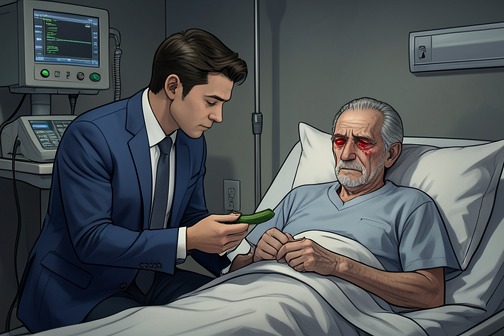
[Watanabe](entity:character-recall-character-watanabe-aa7b56f3da37)’s visit to [Midori](entity:character-recall-character-midori-56b44e3d547f)’s hospitalized father turns a brief offer of help into an act of hands-on care, and a cucumber into a lasting memory. Midori has been spending the day at the hospital, taking her turn staying with her father; when Watanabe offers to watch him so she can leave for a couple of hours, the father’s silence and frailty make the work seem at once practical and emotionally uncertain. The visit later acquires its deepest significance when Watanabe learns that the man died five days afterward: what remains with him is the tiny crunch of the cucumber they shared, a modest sound that bears the weight of a life’s ending.
## The visit and its purpose
Midori tells Watanabe that they are going to the hospital because her father is there and it is her turn to stay with him all day. Watanabe is surprised: he thought the father had gone to Uruguay. Midori matter-of-factly admits that this was a lie. Her father had talked for years about going, but could never do it. The explanation places the visit within the difficult, ongoing reality of Midori’s family life, rather than the imagined departure she had described.
At the hospital, Watanabe suggests that Midori go out for a walk and clear her mind while he takes over. She hesitates over whether he knows how to care for her father. Watanabe says he has been watching and has learned the routine: check the intravenous drip, give him water, wipe away sweat, help him spit phlegm, use the bedpan, and offer the remainder of his lunch if he is hungry. Anything he cannot manage, he will ask a nurse about. The offer is not abstract sympathy; he has noticed the ordinary tasks and is willing to perform them.
Midori also warns him that her father is beginning to act strangely and may say things that make no sense. When she tells her father that she has business to attend to and Watanabe will stay with him, the man gives no discernible reply. He lies on his back looking at the ceiling, almost motionless; his eyes are bloodshot, and his nostrils flare with each deep breath. Watanabe cannot tell what he is thinking or feeling. The gap between the visible demands of care and the inaccessible inner life of the patient shapes the quiet tension of the scene.
## Care through food and attention
Once Midori has left, Watanabe does not know what to say to her father, so he keeps quiet. Later, hungry himself, he finds little in the room beyond a can of nori, cough drops, soy sauce, and the cucumbers and grapefruit Midori had brought. He washes three cucumbers, wraps one in nori, dips it in soy sauce, and eats. He praises their fresh, simple taste, then eats another as the sickroom fills with the sound of his chewing.
The father responds to that ordinary display of appetite. When Watanabe asks whether he would like something to drink, the man answers with a request for cucumber. Watanabe raises the bed, cuts a small piece, wraps it in nori, dips it in soy sauce, and feeds it to him with a toothpick. The father chews and swallows with little change in expression. When Watanabe asks whether he would like nori with it, the father gives a small nod. The exchange is spare, but it marks a shift: a man who had not replied to Midori now communicates a preference and accepts food.
Watanabe tells him that food tasting good is like proof of being alive. The father eats the entire cucumber, asks for water, and later needs to urinate. Watanabe gets the urine jar from under the bed, helps him use it, empties it into the toilet, and washes it. He then returns to his tea. This sequence makes the visit a full act of intimate physical assistance, from feeding to bodily care, without turning the father’s condition into a dramatic recovery. The immediate change is smaller and more tangible: he eats, drinks, and makes his needs known.
## Midori’s respite and Watanabe’s role
When the father falls asleep, Watanabe and Midori buy coffee from a vending machine and sit in the television room. He reports what happened while she was away: her father slept, woke to eat some of his leftover lunch, noticed Watanabe eating a cucumber, asked for one, ate it all, and urinated. Midori tells Watanabe that the family had been struggling to get her father to eat anything, and is astonished that he finished a whole cucumber. Watanabe credits the father with seeing him enjoy his own food; Midori suggests that Watanabe has a knack for putting people at ease.
The episode gives Midori a short break from the responsibility she has been carrying at the hospital. Her relief is bodily as well as emotional: afterward she says she feels much better, though still tired, and that her body feels lighter than before. Watanabe’s offer allows her to leave without abandoning her father’s care, while his willingness to learn the routine makes him useful in a way that conversation alone could not. Their closeness is expressed through shared responsibility and trust rather than a declaration.
## The memory after death
Five days after the visit, Midori’s father dies. Watanabe later recalls the hospital scene in a letter to [Naoko](entity:character-recall-character-naoko-c31d25fb4a36): he had gone to visit the father of a girl in one of his lectures, eaten cucumbers in the room, and heard the man ask for some after listening to him crunch. The father made the same small crunching sound as he ate. Watanabe says he still remembers it vividly, and reflects that people leave strange, little memories of themselves behind when they die.
That recollection gives the cucumber its force beyond the immediate scene. During the visit, it is simple food that prompts a response from a nearly silent patient and provides a moment of shared, ordinary life. In retrospect, the sound of chewing becomes a specific remnant of someone who is gone. The event’s emotional weight rests not on a grand farewell or a final revelation, but on the contrast between the father’s near-immobility and the small acts he could still perform: asking, chewing, swallowing, and asking for water.
## Place in the novel’s treatment of loss
The episode is a compact instance of care in a novel where death remains close to the lives of the living. Watanabe has learned that death is part of life, but that understanding does not make individual losses abstract or painless. Here, the approach of death is encountered through the concrete work of looking after someone: watching his breathing, offering food, handling a urine jar, and reporting his appetite to Midori. The ordinary details do not resolve grief; they give it a particular shape that can be remembered.
The scene also connects Watanabe and Midori through an act that neither of them can treat as merely symbolic. Midori must take her turn at the hospital; Watanabe steps in, watches carefully, and gives her time away. Her father’s response to the cucumber is no cure and no reversal of his decline, but it creates a brief, shared exchange in a room otherwise marked by silence. After his death, Watanabe carries that exchange forward as a memory of the man—not as a complete account of him, but as one small, unmistakable trace.
Event 16
Midori童年两次离家出走
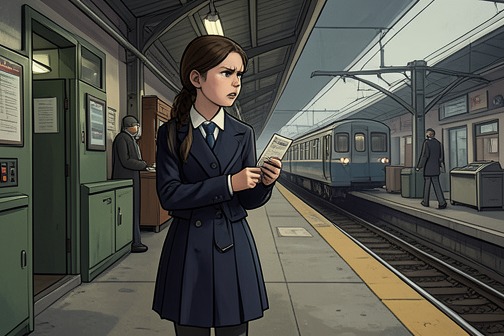
[Midori](entity:character-recall-character-midori-56b44e3d547f)’s two childhood runaways, at ages eight and ten, were acts of anger and defiance that also led to unusually close conversations with her father. Both times she took a train from [Ueno Station](entity:location-recall-location-ueno-station-518512ec2f76) to [Fukushima](entity:location-recall-location-fukushima-f4320af9f81c), where an aunt she liked lived; her father came to bring her home, turning the return journeys into the only occasions she could recall having a long, good talk with him.
## The Two Runaways
Midori explains the episodes while trying to interpret a muddled message from her father, in which the words “Please take care of Midori” and “Ueno Station” prompt her to search her memory for what the station might mean. She recalls that somebody at home had made her angry, and that she ran away to get even. On each occasion she took money from the till to buy her ticket, then travelled from Ueno to Fukushima to stay with her aunt.
The repeated route makes the episodes more than two isolated acts of escape. Midori went to a relative she liked, but it was her father who travelled the hundred miles to retrieve her. The journey home together—not the destination alone—became the important part of the memory.
## Conversations on the Journey Home
As they rode from Fukushima back to Ueno, Midori’s father told her stories in fragments, with long pauses between them. He spoke about the 1923 earthquake, the war, and the time of her birth—subjects he did not usually discuss. Midori remembers those train rides as the only times she and her father had something like a good, extended conversation, giving the runaway journeys an unexpected intimacy alongside their original anger.
His account of the earthquake stood out for its comic incongruity. He had been riding through Koishikawa with a cart attached to his bicycle and failed to notice the major earthquake happening around him. Only after returning home to find roof tiles fallen and his family clinging to pillars did he realize anything was wrong. Midori also recalls his detached way of telling stories about major historical events, as if little of importance had happened in Japan for decades.
At the end of the train rides, her father would tell her, “So that goes to show you, Midori, it's the same wherever you go.” She says she was young enough to be impressed. In adulthood, the phrase remains attached to her memory of those trips: her father’s halting stories, the shared train ride, and the rare experience of sustained conversation.
## Memory and Meaning
Midori identifies Ueno Station not through an abstract association but through these two returns from Fukushima. When asked whether she had ever run away, [Watanabe](entity:character-recall-character-watanabe-aa7b56f3da37) says he had not. The contrast leaves her childhood account as a distinct piece of family history: anger initiated the journeys, but the remembered conversations with her father gave them a lasting, more complicated meaning.
Event 17
The Great Kantō Earthquake of 1923
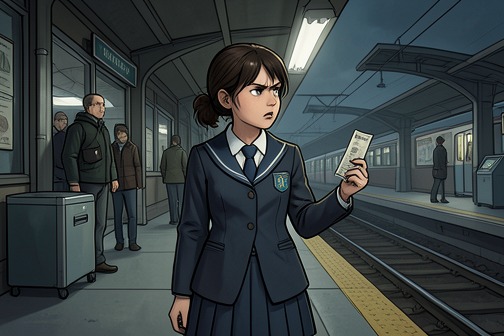
[The Great Kantō Earthquake of 1923](entity:event-recall-event-61e5d47748ee) appears in [Midori](entity:character-recall-character-midori-56b44e3d547f)’s account not as a narrated disaster scene but as an offbeat family recollection. Her father, who had been in [Tokyo](entity:location-recall-location-2ef35aba743c) during the earthquake, later told her about riding through the city without realizing that anything extraordinary had happened; the story’s force lies in the mismatch between a historic catastrophe and his matter-of-fact, belated recognition of it.
## The memory’s setting
Midori associates the story with two childhood runaways, when she was eight and ten. Each time she took money from the till, bought a train ticket from Ueno to [Fukushima](entity:location-recall-location-fukushima-f4320af9f81c), and went to stay with an aunt she liked. Her father came all the way to retrieve her. On the return journey to Ueno, they ate boxed lunches and talked—an unusual stretch of conversation between them.
Those journeys give the earthquake story its personal frame. Her father shared fragments about the past, including the earthquake, the war, and the time of Midori’s birth, subjects he did not usually discuss. Midori remembers these trips as the only occasions when the two of them had something like a good, long talk. The catastrophe enters the narrative through the rare intimacy of a parent bringing a runaway child home.
## Her father’s account
Her father said he had been riding through Koishikawa with a cart attached to his bicycle and had not felt the earthquake. Only after he arrived home did he see that roof tiles had fallen throughout the neighborhood and find his family clinging to pillars in fear. Even then, he did not understand what had happened; in his recollection, he asked what was going on.
The account’s comedy depends on the distance between the devastation visible around him and his uncomprehending passage through it. Midori laughs at the story and calls it her father’s “fond recollection” of the earthquake. His other stories of the past, she says, are similarly undramatic and slightly off-center: even the 1936 uprising by young officers and the Pacific War appear in his telling as events he remembers only when prompted.
## Historical catastrophe and family speech
The earthquake is one item in a string of remembered historical events, but Midori’s father does not arrange them into a grand account of national history. He relates them in bits and pieces during the train ride, and his recurring lesson to his daughter is that things are the same wherever one goes. As a child, she was impressed by this simple conclusion.
In the novel, the episode establishes how a large historical event can survive in family memory as an intimate, eccentric anecdote rather than a solemn public narrative. Its emotional significance is inseparable from the circumstances in which it was told: two otherwise unusual companions, traveling home after Midori’s acts of escape, sharing a conversation neither usually had. The earthquake becomes part of the small store of stories through which she remembers her father and their limited moments of closeness.
Event 18
Nagasawa通过外务省考试

[Nagasawa](entity:character-recall-character-nagasawa-87c3bac299fd)’s success in the Foreign Ministry examination makes his planned career official and gives concrete direction to the future he has been pursuing. Announced casually over tea and beer, the result is at once a personal milestone and a turning point in the circumstances surrounding his relationship with [Hatsumi](entity:character-recall-character-hatsumi-34a69bdd1e16): training and overseas service lie ahead, while he has no intention of marrying her.
## The result and its significance
Nagasawa tells [Toru Watanabe](entity:character-recall-character-toru-watanabe-5b85a10074ad) that the examination results have been posted and that he passed. The conversation makes clear that this is not a surprise to him. [Watanabe](entity:character-recall-character-watanabe-aa7b56f3da37) says he had expected Nagasawa to succeed, and Nagasawa agrees, laughing that he is not surprised either; what pleases him is having the result made official. The scene therefore distinguishes confidence from confirmation: Nagasawa had already treated success as likely, but the posted result turns expectation into a recognized fact.
The examination is formally named the Foreign Affairs Public Service Personnel First Class Service Examination. Nagasawa calls that official title a joke, puncturing its bureaucratic grandness with his characteristic ease. Yet the credential carries practical weight. His immediate path is structured by the result: first a year of training, then a period overseas. The achievement does not merely decorate his self-image; it opens a sequence of institutional steps that will remove him from Japan for a time.
## Career and departure
When Watanabe asks whether he will go abroad after entering the Foreign Ministry, Nagasawa explains that the year of training comes first and that an overseas posting follows. The order matters: departure is not an immediate improvisation but part of the career route he has passed into. His matter-of-fact answer presents the future as already legible, with the exam, training, and foreign service forming a progression he expects to follow.
The scene gives that prospect an ordinary physical setting. Watanabe sips tea while Nagasawa drinks beer with obvious satisfaction; after discussing the result, Nagasawa even offers Watanabe his refrigerator for when he leaves the dormitory, joking that it is excellent for beer. The small domestic detail places the large career change alongside the practical business of moving on. Nagasawa can discuss departure without hesitation because, for him, the next stage is an anticipated transition rather than a crisis.
## Hatsumi and the cost of his certainty
Nagasawa proposes a proper dinner with Watanabe and Hatsumi to celebrate his new job, explicitly distinguishing it from going out to pick up women. His father will pay, and he wants the meal at an expensive restaurant. He says that Watanabe’s presence would make both him and Hatsumi more comfortable. The invitation folds his private relationship into the celebration of professional success, but it also exposes the imbalance between the futures the two of them imagine.
During a later conversation, Watanabe points out the consequence of Nagasawa’s plan: after entering the Foreign Ministry and completing a year of training, Nagasawa will go abroad, while he has no intention of marrying anyone. Hatsumi confirms that she knows this. The exam thus acquires a relational meaning beyond career advancement. Its success makes the separation foreseeable, and the prospect of overseas service intensifies the question of what Hatsumi is expected to do while Nagasawa pursues a life organized around his own ambitions.
## Narrative role
The episode’s calm, congratulatory tone contrasts with the pressure embedded in its implications. Nagasawa can treat his success as confirmation and speak of training and foreign service as the next steps; Watanabe’s later challenge makes visible what this confidence leaves unresolved for Hatsumi. The examination is therefore both an achievement and a marker of incompatible expectations: it advances Nagasawa’s chosen system of life while making clearer that his career plans offer no corresponding promise of marriage.
The result is reported in conversation rather than staged as an examination ordeal. That compressed presentation suits Nagasawa’s assurance: the suspense is not whether he will pass, but what his success makes possible and whom that future leaves waiting. By linking the official result to the training year, overseas posting, celebratory dinner, and Hatsumi’s acknowledged uncertainty, the episode turns a career announcement into a measure of the distance between professional certainty and emotional commitment.
Event 19
Nagasawa、Hatsumi与渡边的晚餐冲突
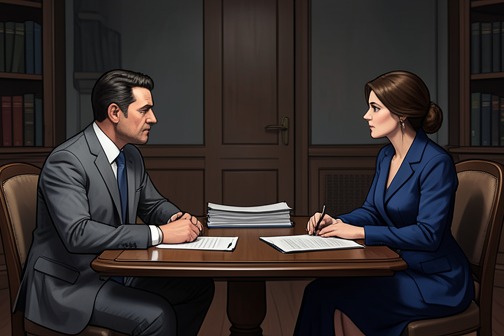
The dinner between [Nagasawa](entity:character-recall-character-nagasawa-87c3bac299fd), [Hatsumi](entity:character-recall-character-hatsumi-34a69bdd1e16), and [Toru Watanabe](entity:character-recall-character-toru-watanabe-5b85a10074ad) turns an elegant meal into a confrontation over what Nagasawa calls his way of living and what Hatsumi names as injury. In a private room in Azabu, talk of literature and the Foreign Ministry exam gives way to the revelation that Nagasawa and Toru once exchanged sexual partners; Hatsumi’s defense of Toru’s sincerity then makes Nagasawa’s own conduct impossible to keep at a distance. By the end, Hatsumi refuses Nagasawa’s offer to take her home and chooses Toru instead, while Nagasawa warns that Toru is no less detached than he is.
## Setting and Uneasy Civility
Nagasawa chooses a fashionable French restaurant on a quiet Azabu backstreet and books a secluded private room. About fifteen prints hang on its walls. The details establish a carefully controlled setting for an evening that will expose the instability beneath its polished manners: Nagasawa arrives in an expensive-looking grey suit, while Toru wears an ordinary blue blazer. Hatsumi arrives fifteen minutes later, carefully made up in gold earrings, a deep blue dress she calls midnight blue, and red court shoes.
As they wait, Nagasawa and Toru drink wine and talk about Joseph Conrad. The conversation appears companionable, but its social ease depends on what remains unspoken. When Nagasawa mentions that his father brings his mistress to the restaurant, Hatsumi asks about it; Toru drinks his wine as if he has heard nothing. The meal’s refined surroundings thus provide no protection from the personal arrangements and ethical indifference that will surface at the table.
## The Conversation Turns Personal
Over hors d'oeuvres and soup, Nagasawa talks about the Foreign Ministry exam. He describes most examinees with contempt, allowing that a few may be decent, and presents the proportion of good people to bad as an immutable feature of society. Toru questions whether the ratio differs from society at large; Nagasawa says it is the same everywhere. He orders a second bottle of wine and a double Scotch, and the discussion’s broad cynicism soon narrows to his own behavior.
Nagasawa reminds Toru, in Hatsumi’s presence, that they once swapped women. He delivers the disclosure casually, then drains his whisky and orders another. Hatsumi turns to Toru and asks whether it happened. Unable to answer, Toru says nothing at first; when pressed, he says only that they were drunk. The past incident, which Toru might have left unexamined, becomes a public test of his judgment and of the sincerity Hatsumi has attributed to him.
Nagasawa grows nasty as the mood sours. The hostility is directed at Hatsumi rather than Toru, which makes Toru find it harder to remain seated and silent. When the food arrives, Nagasawa eats roast duck and continues drinking; Toru takes a forkful of spinach, while Hatsumi leaves her sea bass untouched. Her stillness contrasts with the men’s different evasions: Nagasawa maintains his swagger, and Toru has yet to make a clear response to what has been exposed.
## Hatsumi Names the Harm
Hatsumi tells Toru that, whatever makes his situation complicated, the conduct he has described does not suit him. She calls him sincere and caring and says he is not that kind of person. Her defense is not an absolution: she looks him in the eye and asks what he thinks, and Toru admits that he has sometimes felt the same way about himself. Her assessment makes his discomfort explicit while also revealing that she has tried to arrange a better future for him.
Nagasawa answers by turning the argument into a dispute about male sexual needs. He says that, during his three years with Hatsumi, he has slept with many women, each only once, and claims not to remember their names or faces. He calls it a game in which nobody gets hurt. Hatsumi rejects the premise rather than simply condemning his infidelity: she says she has never really been angry about his sleeping with others, but cannot stand his arrogance. Then she gives the consequence he has erased from his account: she is hurt, and wants to know why she is not enough for him.
Nagasawa pauses and swirls his whisky. He says that Hatsumi’s not being enough is not the issue; he describes his behavior as an inner hunger he can only live with, and as what makes him himself. His explanation converts a choice into an apparently unchangeable identity. Hatsumi’s response exposes the gap between his claim that nobody is harmed and the person directly telling him she is.
## The Break and Its Aftermath
Hatsumi asks whether it is wrong to want to be understood by him. Nagasawa says it is not, and suggests that most people would call such a desire love, but immediately sets that desire against his different “system for living.” When Hatsumi asks whether he is saying he is not in love with her, he begins to answer in terms of that system. She shouts, “To hell with your fucking system!” Toru has never heard her shout before, making this first and last outburst a decisive rupture in the evening’s restrained manner.
Nagasawa calls for the bill and says he will see Hatsumi home, apologizing to Toru and telling him to return to the dorm alone. Hatsumi refuses: she does not want to spend more time with Nagasawa that day and thanks him for dinner. Then she asks Toru to see her home. The choice briefly aligns her with the man she has just defended, but Nagasawa immediately tries to undo the distinction. He says Toru is practically the same as he is: nice on the surface, yet incapable of loving anyone, with a detached part that stays awake and an enduring hunger.
The dinner establishes no reconciliation or resolution; it ends with Hatsumi rejecting Nagasawa’s escort and turning to Toru. Her choice brings Toru’s own compromised past into the open even as she distinguishes him from Nagasawa. Nagasawa’s accusation complicates that distinction: whether it is insight or self-serving provocation, the scene leaves Toru implicated in the emotional distance he has not managed to answer for. The private meal’s central reversal is therefore not a change in Nagasawa’s creed, but the moment Hatsumi makes its human cost audible—and refuses to let his language settle the matter.
Event 20
Hatsumi’s suicide
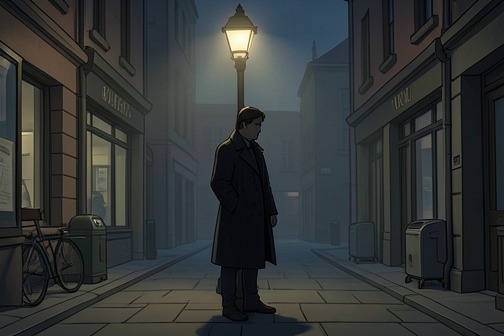
[Hatsumi’s suicide](entity:event-recall-event-hatsumi-0b4d610432bb), disclosed years after her death, turns an early, subdued encounter into a lasting measure of what [Toru Watanabe](entity:character-recall-character-toru-watanabe-5b85a10074ad) could not understand or save. The novel offers no explanation for her decision: after marrying two years after [Nagasawa](entity:character-recall-character-nagasawa-87c3bac299fd) left for Germany, [Hatsumi](entity:character-recall-character-hatsumi-34a69bdd1e16) died by suicide two years later. Her death belongs to the book’s recurring pattern of losses without clear causes, but its delayed narration gives it a further force. Only when [Watanabe](entity:character-recall-character-watanabe-aa7b56f3da37) remembers her in a sunset many years later does he recognize what she had awakened in him—and how permanently that possibility had gone unfulfilled.
## The Encounter and Its Delayed Meaning
Watanabe’s memory of Hatsumi begins with a quiet evening rather than with her death. After the two share drinks at a small bar, they walk through the night; they speak little, and Watanabe finds the silence reminiscent of walking with [Naoko](entity:character-recall-character-naoko-c31d25fb4a36). He notices Hatsumi’s subtle emotional effect on him but cannot name it. The recognition arrives only some dozen years later, while he is in Santa Fe interviewing a painter. As he sits in a pizza parlour watching the sunset, the image of Hatsumi returns, and he understands that what she stirred was a childhood longing that had remained unfulfilled. The vividness of this later realization makes the suicide more than a biographical endpoint: Watanabe recognizes the depth of a connection only after it is irretrievably past.
The recognition is accompanied by sorrow rather than resolution. Watanabe understands Hatsumi as a special woman and feels that something in himself had lain dormant until she brought it back into view. The memory does not offer a way to repair what happened. Instead, it makes the distance between belated understanding and effective action unmistakable: he can now name what her presence meant to him, but he could not have used that knowledge to change her fate.
## Marriage, Death, and the Limits of Explanation
The chronology Watanabe recalls is spare. Two years after Nagasawa left for Germany, Hatsumi married; two years after her marriage, she died by suicide. The narrative identifies the means, but gives no account of a motive or of events leading to her decision. It does not establish that her marriage, Nagasawa’s departure, or any other specific circumstance caused her death. The absence of an explanation is part of the event’s meaning, not a gap the reader is invited to fill with certainty.
Watanabe’s response is a stark counterfactual wish: someone should have done something, anything, to save her. Yet he immediately acknowledges that neither he nor Nagasawa could have managed it. The contrast between the wish to intervene and the recognition of helplessness keeps the narration from turning grief into a claim of blame or an account of preventable cause. Hatsumi’s decision remains singular and unexplained, even as its consequences reach beyond her death into the lives and memories of those who knew her.
## Nagasawa’s Letter and Watanabe’s Severance
Watanabe learns what happened from Nagasawa, who writes from Bonn. In his letter, Nagasawa says that Hatsumi’s death has extinguished something and that the loss is unbearably sad and painful even for him. The message is a rare direct measure of Nagasawa’s grief, but it does not explain Hatsumi’s decision. It records the devastation left behind rather than offering a cause.
Watanabe tears the letter to shreds and throws it away, then never writes to Nagasawa again. The action marks a break in their relationship at the point when news of Hatsumi’s death reaches him. The narrative does not spell out a single motive for Watanabe’s response; it presents the destruction of the letter and the end of correspondence as concrete consequences of the news. The letter cannot make the loss intelligible or undo it, and Watanabe’s refusal of further contact leaves his reaction unresolved.
## A Recurring Pattern of Unexplained Death
Hatsumi’s death echoes losses elsewhere in the story without making their circumstances identical. Watanabe recalls that [Kizuki](entity:character-recall-character-kizuki-1cc5bfd6aa96), like Hatsumi, died at seventeen, left no note, and gave no apparent warning; Naoko’s sister also died by suicide without anyone knowing why. These parallels sharpen the recurrence of deaths whose motives remain inaccessible, rather than forming a reliable explanation for any one person’s decision. The novel presents the pattern as an unsettling limit on what the living can know.
That limit is connected to Watanabe’s understanding of death as part of life. After [Kizuki’s death](entity:event-recall-event-kizuki-5b5835777ade), he comes to feel that death is not wholly separate from the lives of those who remain. After Naoko dies, he learns a different and harsher truth: no principle, sincerity, strength, or kindness can cure the sorrow of losing someone. Hatsumi’s suicide belongs to this widening knowledge of bereavement. It gives Watanabe another death to remember, but no formula that would make the next loss comprehensible or easier to bear.
## Belated Grief and the Living
The later memory of Hatsumi sits beside Watanabe’s extended mourning for Naoko, whose death leaves him travelling far from [Tokyo](entity:location-recall-location-2ef35aba743c) and unable to return at once to ordinary life. On the coast, memories of Naoko repeatedly draw him into an imagined nearness to the dead, before the tide of memory recedes and leaves him alone with grief. The novel does not equate Watanabe’s response to Naoko with his response to Hatsumi; rather, the two recollections show how death continues to shape the living in different forms and at different times.
After returning to Tokyo, Watanabe shuts himself in his room, his memory fixed on the dead rather than the living. He recognizes the contradiction between Naoko’s death and [Midori](entity:character-recall-character-midori-56b44e3d547f)’s continued presence, but recognition alone does not immediately restore his capacity to turn toward life. In this broader arc, Hatsumi’s suicide stands as a belatedly understood loss: Watanabe can finally identify the longing her presence awakened, yet his insight arrives as mourning, not rescue. The event thus intensifies the novel’s distinction between learning something from grief and being able to use that knowledge to prevent another grief.
Event 21
渡边在小林书店过夜陪伴Midori
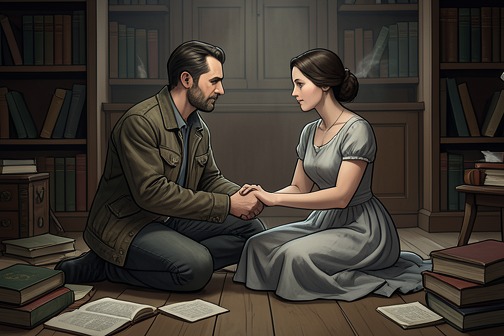
[Toru Watanabe](entity:character-recall-character-toru-watanabe-5b85a10074ad)’s night at the shuttered [Kobayashi Bookshop](entity:location-recall-location-97b2f377ff31) becomes a quiet scene of intimacy between him and [Midori Kobayashi](entity:character-recall-character-midori-kobayashi-2b1c10b48d58): she asks him to stay beside her and hold her until sleep, and he answers with affection and a promise to care for her. The encounter joins a closed family business, a memorial to [Midori](entity:character-recall-character-midori-56b44e3d547f)’s father, and a makeshift bed in the altar room to a small but consequential gesture of comfort. Its warmth is real, though the later narrative of [Watanabe](entity:character-recall-character-watanabe-aa7b56f3da37)’s mourning makes clear how difficult it is for him to turn from the dead toward the living.
## The Closed Shop and a Changed Household
After deciding against a love hotel, Watanabe and Midori travel on the Yamanote Line to [Otsuka](entity:location-recall-location-otsuka-3e6235edb961) and raise the metal shutter of the Kobayashi Bookshop. The paper sign announces that it is temporarily closed. Inside, the old-paper smell hangs over empty shelves and bundled magazines awaiting return; what had felt hollow on Watanabe’s first visit now seems like an abandoned hulk. The depleted shop is not just a place to sleep but evidence of a household at a turning point.
Midori tells Watanabe that the family intends to sell the shop and divide the proceeds, allowing her and her sister to live independently rather than under anyone’s protection. Her sister plans to marry the next year, while Midori still has three years of university ahead. The decision gives the overnight visit a practical backdrop: the shop and home are about to change, and Midori is preparing for a less protected life. Her invitation to Watanabe unfolds inside that unsettled domestic space.
## The Altar and Her Father’s Presence
Upstairs, Midori sends Watanabe to the kitchen table while she warms the bath. He puts the kettle on, and the two drink tea as midnight approaches, with only the clock and refrigerator audible. The stillness gives their conversation room to deepen. Midori asks him to burn incense for her father; Watanabe follows her to the Buddhist altar, lights a stick before her father’s photograph, and brings his hands together.
The memorial setting is intimate rather than solemnly distant. Midori tells Watanabe that she had recently undressed in front of her father’s photograph and posed for him, describing the act with deliberately blunt, irreverent language. The disclosure places grief, the body, and the awkwardness of family affection in the same room. Watanabe does not turn the moment into a judgment; the scene moves from the altar back toward the practical care of preparing for bed.
## A Request for Comfort
After they bathe and change into pyjamas, Midori spreads a mattress for Watanabe on the floor of the altar room. He borrows a nearly new pair of her father’s pyjamas, a little too small but usable. Then Midori asks him to stay with her and hold her until she falls asleep. He agrees, and the arrangement places them close together on her small bed, his arm around her back and his other hand gripping the bed frame so he will not fall.
The bodily closeness is affectionate, but the awkward position is explicitly not conducive to sexual excitement. Watanabe’s nose rests against Midori’s short hair as she presses her face to his chest and places her hands on his hips. The scene’s emphasis is not seduction but the precise, unglamorous work of staying beside someone: their comfort is cramped, improvised, and physical.
Midori asks him to say something nicer. Watanabe tells her he likes her a lot and compares the feeling to a [spring bear](entity:expression-recall-expression-spring-bear-419209eabc76). She calls it the best thing she has ever heard, then asks whether he would do anything she told him to do, would avoid getting angry, and would take care of her always. He answers that he will, stroking her short, soft hair and reassuring her that everything will be fine. Her fear remains audible even as she settles against him; soon her breathing becomes regular and she falls asleep.
## Before Dawn
Watanabe does not sleep beside Midori for the rest of the night. He slips away to the kitchen, drinks a beer, and, unable to find anything nearby to read, eventually reads *Beneath the Wheel* by the light of the quiet bookshop. A bottle of brandy stands in the kitchen; he pours some into a coffee cup. Shortly before three he checks on Midori. She remains asleep, her stillness and breathing reminding him of her father. Her suitcase, white coat, neatly arranged desk, and Snoopy calendar make the room feel lived-in even as the surrounding shops lie closed beneath their shutters.
When the sky begins to lighten, Watanabe makes instant coffee and writes Midori a note on notepaper. He says he drank some of her brandy, bought a copy of the book, and is going home because it is light outside. After hesitating, he adds that she looks cute when she is asleep. He washes the cup, turns off the kitchen light, lifts the shutter quietly, and steps into the street at about 5:50 in the morning. He worries a neighbor might find him suspicious, but the street is empty; he walks to the tram stop and returns to his dorm after breakfast.
## A Brief Opening Toward the Living
The encounter gives Watanabe and Midori a form of closeness built out of ordinary acts: tea, incense, bathing, borrowed pyjamas, a promise, and a handwritten note. Midori asks for reassurance directly, and Watanabe responds with tenderness rather than evasion. Yet his departure before dawn preserves the scene’s limits. He has offered presence for one night, not resolved what his attachment to Midori will become.
That uncertainty acquires force in the later account of Watanabe’s grief for [Naoko](entity:character-recall-character-naoko-c31d25fb4a36). After her death, memories return in vivid detail, and he describes being swept into a place where the dead seem to remain part of life. He concludes that no truth, sincerity, strength, or kindness can cure the sorrow of losing someone; grief must be lived through, and a later loss cannot be met with the lesson learned from an earlier one. When he returns to [Tokyo](entity:location-recall-location-2ef35aba743c), he shuts himself away for days, his memory fixed on the dead rather than the living. Against that withdrawal, the night with Midori stands as a brief, concrete instance of care and contact—not a cure for grief, but a fragile connection that the larger story places under pressure.
Event 22
Midori与男友分手
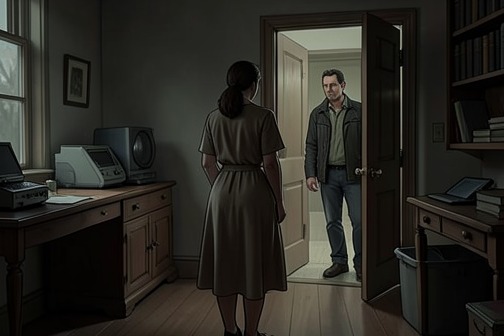
[Midori](entity:character-recall-character-midori-56b44e3d547f)’s breakup with her boyfriend is the moment she turns a confused attachment to [Watanabe](entity:character-recall-character-watanabe-aa7b56f3da37) into a decision: when her boyfriend makes continued contact with Watanabe incompatible with their relationship, she chooses Watanabe and ends the romance. Her frank declaration of love makes the choice explicit, but it does not produce an easy beginning. Watanabe remains absorbed in [Naoko](entity:character-recall-character-naoko-c31d25fb4a36)’s death, and Midori acknowledges that he is in love with someone else even as she asks him to respond to her after two difficult months.
## The Distance Behind the Decision
Midori explains that her anger at Watanabe was only part of why she had stayed away. During their absence from one another, he had seemed so lost in thoughts of Naoko that he scarcely looked at her when they met again. She had wanted to reprimand him, but she had also concluded that she needed distance to understand her own feelings. The separation was therefore both a response to feeling neglected and an attempt to clarify what the relationship with Watanabe meant to her.
That clarification brought an uncomfortable comparison into focus. Midori says she had reached the point where she enjoyed being with Watanabe more than being with her boyfriend. She still liked her boyfriend and regarded him as her first serious romantic attachment; she describes him as self-centred, narrow-minded, and somewhat fascist, while also recognizing his good qualities. Her feelings for Watanabe were different: she considered him special, said she felt that something was right when they were together, and told him she believed in him and did not want to let him go. The breakup grows out of that conflict rather than from a simple claim that she had ceased to care for her boyfriend.
## The Ultimatum and Breakup
Unable to settle the question alone, Midori asked her boyfriend what she should do. He told her to stop seeing Watanabe, or to break up with him if she intended to keep seeing Watanabe. His answer turned her private uncertainty into a direct choice between the relationship she already had and the connection she wanted to preserve. Midori says she broke up with him, presenting the decision as immediate rather than as the outcome of a protracted negotiation.
As she explains what she has done, she puts a Marlboro to her mouth, shields it with her hand while lighting it, and inhales. The small, controlled gesture accompanies an unusually exposed conversation. When Watanabe asks why she chose to break up, Midori reacts with disbelief: to her, the answer should be obvious from what she has already said. She tells him that she likes him more than her boyfriend and that she has fallen in love with him. Her admission converts the breakup from a reported change in status into an explicit declaration of what she hopes the choice means.
## The Declaration and Its Limits
Midori’s confession does not erase the circumstances that make Watanabe unavailable. She knows that he is in love with someone else, and she tells him she is not expecting anything from him. At the same time, she asks him not to make her spell out her feelings and asks for a hug, saying that the preceding two months have been difficult. Her request makes the scene intimate without implying that the relationship has been settled: she has made her choice, but she cannot decide for Watanabe.
The contrast becomes especially stark against the loss shaping Watanabe’s life. In his account of the months after Naoko’s death, he reflects that death is part of life, but that no truth, sincerity, strength, or kindness can cure the sorrow of losing a loved one. He describes memories returning with the force of a tide, carrying him into an inner world where Naoko seems present, before the tide recedes and leaves him alone with grief. Midori’s decision takes place within this unresolved mourning, not after it has ended.
## Significance in the Larger Arc
The breakup is a change in the terms of Midori and Watanabe’s relationship: she has chosen him over a boyfriend she still values, and has directly named her love. Yet the scene withholds the reciprocal answer. Watanabe struggles to speak when she confesses, and later, after returning to [Tokyo](entity:location-recall-location-2ef35aba743c), shuts himself away for days, his memory fixed on the dead rather than the living. The decision therefore establishes both a possibility of renewed connection and the grief that obstructs it.
In this episode, love is not presented as a feeling that automatically resolves competing loyalties or makes sorrow disappear. Midori acts on what she has come to understand about her feelings, even though Watanabe cannot immediately meet her choice. Her clarity stands beside his inability to turn from the dead toward the living: the breakup opens a path between them, but it cannot compel him to walk it.
Event 23
Naoko’s transfer to a specialist hospital for treatment
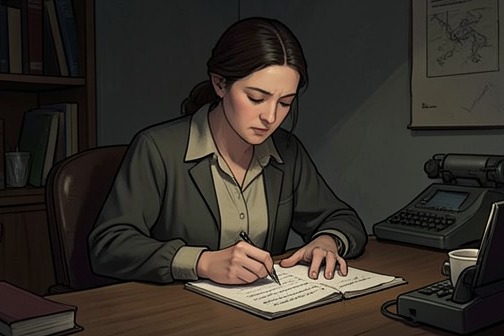
[Naoko’s transfer to a specialist hospital for treatment](entity:event-recall-event-naoko-424866c1d19d) is the point at which [Ami Hostel](entity:location-recall-location-ami-hostel-a16d1036cfbe)’s quiet, voluntary convalescent life can no longer meet the severity of her worsening condition. Told through [Reiko](entity:character-recall-character-reiko-50478f17e09b)’s letters to [Toru Watanabe](entity:character-recall-character-toru-watanabe-5b85a10074ad), the decision is not a sudden rejection of the Hostel’s mutual-support approach but a recognition of its limits: [Naoko](entity:character-recall-character-naoko-c31d25fb4a36) needs intensive treatment, and the community cannot safely provide it. For [Watanabe](entity:character-recall-character-watanabe-aa7b56f3da37), the news makes the letters that hold his scattered life together more urgent, even as Naoko’s illness is making communication increasingly difficult.
## The crisis revealed through letters
Reiko explains that Naoko had been trying to write to Watanabe but could not finish a letter. Reiko had offered to answer for her, yet Naoko insisted that writing to him was too personal to delegate. The delay was therefore not indifference: it was itself an early sign of the struggle she was facing. Reiko asks Watanabe to understand that the month of waiting has been difficult for Naoko too, and admits plainly that her condition is not good.
Looking back, Reiko identifies the first symptom as Naoko’s loss of the ability to write, beginning around the end of November or the beginning of December. Voices then began to interrupt her attempts to compose a letter, interfering with her choice of words. At first the symptoms did not seem severe, and Reiko understood that such difficulties could come in cycles. After Watanabe’s second visit, however, the episode intensified: Naoko struggled even to hold an ordinary conversation, could not find the words she wanted, and became confused and frightened. The voices grew worse alongside that loss of speech.
The crisis is thus conveyed through a change in a familiar means of connection. Letters had allowed Naoko to address Watanabe across distance, but the effort to write became precisely where the voices intruded. Her silence is not presented as a settled choice to withdraw from him; Reiko describes a person trying to communicate while increasingly unable to control the words through which communication depends.
## Ami Hostel and the limits of convalescence
Reiko’s account places the decision within the distinct character of Ami Hostel. She is not Naoko’s doctor: though residents sometimes call her the Music Doctor, she is a patient who has lived there for seven years, teaches music as therapy, and helps in the office. The blurred line between resident and staff reflects the Hostel’s shared daily life, but it does not make it an ordinary hospital.
The Hostel is described as a place for convalescence rather than conventional treatment. Its gate remains open, its windows have no bars, and people enter and leave voluntarily. Doctors check on residents, but the institution’s central purpose is to create an environment in which people can work toward helping themselves; it is not designed to supply concentrated therapy. Reiko had earlier explained that people who need specialized treatment may have to go elsewhere. Naoko’s transfer follows that boundary rather than contradicting the care she has received there.
That boundary matters because Ami Hostel’s recovery model depends on quiet coexistence, shared activity, and learning to live with one another’s differences. The community is small in relation to its wide, nature-filled grounds: about seventy residents and just over twenty staff. Residents play sports alongside staff, grow vegetables, and live by the understanding that each person has their own ways of thinking and feeling. The doctor in charge describes the work not as correcting every difference, but as becoming accustomed to it and finding a place for the pain it can cause. When Naoko’s episodes become more intense, however, the Hostel’s openness and mutual support cannot substitute for the intensive care she needs.
## The decision to transfer
The transfer takes shape through discussion among Naoko, her mother, the doctor, and Reiko. Naoko’s mother has come from [Kobe](entity:location-recall-location-36b6d53677ce), and the four reach the conclusion that Naoko should move to a proper hospital for a period of intensive treatment, with a possible return to the Hostel depending on the results. Naoko herself would prefer to stay and become well there. Reiko knows she will miss her and worry about her, but describes the practical reason for agreeing: it is becoming harder to keep Naoko safe at the Hostel.
For much of the time Naoko is fine, but her emotions can become extremely unstable. During intense episodes of hearing voices, she shuts down completely and burrows into herself; the people caring for her cannot take their eyes off her, because they cannot predict what she might do. Reiko’s conclusion that specialist treatment is best is therefore grounded in the changing demands of care, not in a claim that Naoko has stopped trying. She stresses that Naoko and the people around her are doing everything they can.
The decision happens quickly. Reiko says that Naoko should already have moved to the new hospital by the time Watanabe receives the letter. She apologizes for waiting to tell him until the decision was settled, gives him the new address, and asks him to continue writing there. The hospital has good doctors, and Reiko expects to be kept informed about Naoko’s progress. A return to the Hostel remains possible, but it is conditional on how treatment goes; for now, the transfer separates Naoko from the place and people with whom she had hoped to recover.
## Watanabe, Reiko, and the work of waiting
The letter makes the transfer a change in Watanabe’s role as well as Naoko’s place of care. He cannot join one of the daily sessions with a specialist: Reiko had suggested adding him, and the doctor agreed, but Naoko opposed it. She wanted her body to be clean of all this when she met him. Reiko argues that getting well should matter more than that wish, but Naoko does not change her mind. Her refusal shows that even amid serious illness she has a particular hope for how she will meet Watanabe, while also keeping him outside the immediate work of treatment.
Reiko asks Watanabe to keep hoping for Naoko’s recovery and to keep sending letters. She had already told him that patience mattered: the people at the Hostel must try to unravel the jumbled threads one at a time, without abandoning hope. In the darkness, she says, they can only sit tight until their eyes adjust. That image offers no promise of a quick cure. It frames care as patient attention to a condition whose course cannot yet be seen clearly.
Watanabe answers the separation with an outpouring of correspondence. That spring he writes weekly to Naoko, several times to Reiko, and several times to [Midori Kobayashi](entity:character-recall-character-midori-kobayashi-2b1c10b48d58), composing letters in lecture halls, at home, and during breaks at an Italian restaurant. He describes writing as a way of holding together the pieces of his crumbling life. The transfer therefore sharpens the importance of letters even as Naoko’s illness has made writing difficult for her: the medium that fails her remains one of the few ways Watanabe can continue to address her.
## Significance and aftermath
The transfer exposes a tension in the novel’s account of recovery. At Ami Hostel, people are not simply defined as patients to be corrected: residents and staff share activities, and the stated aim is to live quietly without hurting one another. Yet a community organized around voluntary convalescence cannot answer every need. Naoko’s worsening voices and episodes of instability require a level of specialized treatment the Hostel is not equipped to provide. The move recognizes that care must change when the circumstances change.
The decision also begins a separation without resolving what will follow it. Naoko wants to remain at the Hostel, Reiko fears losing her daily companionship, and Watanabe must continue at a distance, writing to a new address and waiting for news. A possible return is left open, but not guaranteed. The letters record the decision before its outcome is known, preserving both Reiko’s hope and her honest account of the risk.
Later, Watanabe’s response to Naoko’s death makes clear that continued understanding cannot spare him grief. He remembers her with a vividness that brings her close, then confronts the fact that she is gone; he concludes that no truth, sincerity, strength, or kindness can cure the sorrow of losing someone loved. Against that later recognition, the transfer stands as an earlier moment when patience and treatment still leave room for hope, though neither Reiko nor Watanabe can control the course of Naoko’s illness.
Event 24
Watanabe and Midori reunite in the rain and confess their feelings

[Watanabe and Midori reunite in the rain and confess their feelings](entity:event-recall-event-midori-a5bd9ff86ddc) after two months apart, turning a period of silence and misunderstanding into an explicit declaration of love. The scene brings them physically close and makes their attachment unmistakable, yet [Watanabe](entity:character-recall-character-watanabe-aa7b56f3da37)’s continuing sense of responsibility toward [Naoko](entity:character-recall-character-naoko-c31d25fb4a36) prevents the reunion from becoming a simple romantic resolution: [Midori](entity:character-recall-character-midori-56b44e3d547f) agrees to wait, but insists that if he chooses her, he must choose her fully.
## The Reunion After Two Months
The conversation takes place on the roof of a department store on a rainy day. The place is nearly deserted: the kiosks and children’s rides are shut, and rain covers the wooden horses and garden chairs. After lunch, Watanabe and Midori wander beneath their umbrellas; she looks through a telescope while he holds the umbrella over her. They sit beside the rides and watch the rain, a pause that gives way to Midori’s direct invitation for him to say what he has come to say.
Before reaching the rooftop, the two have eaten together from lacquered lunch boxes. Midori smokes after the meal, then stands and takes her umbrella without speaking. The quiet movement into the rain precedes the directness of the conversation: the encounter begins not with a declaration but with an empty, wet public space and a silence both of them have to break.
Watanabe explains that he had been deeply depressed and unable to register much around him. Only after he could no longer see Midori did he recognize that having her in his life had been essential to his ability to survive. He tells her that losing her brought home the pain and loneliness he had been avoiding. Midori answers that she, too, has been lonely during the two months apart, and points out that she had already told him about it in her letters.
## The Separation and Midori’s Choice
The separation had not meant that Midori stopped caring for Watanabe. She had wanted to see him, but became angry when, during their time together, he was so absorbed in thoughts of another woman that he did not even look at her. At the same time, she had been trying to understand her own relationship with her boyfriend. She explains that being with Watanabe had begun to give her more pleasure than being with him, a situation she found emotionally confusing.
Midori had asked her boyfriend what she should do. He told her to stop seeing Watanabe, or to break up with him if she wanted to keep seeing Watanabe. She chose to end the relationship. When Watanabe asks why, she responds that she loves Watanabe more, even while acknowledging that she might have wished to fall for someone more handsome. Her confession is deliberately plain: her feelings, rather than a tidy comparison of the two men, are the reason for her decision.
That choice gives the reunion a consequential reversal. Midori has already acted on her attachment before Watanabe can promise her a shared future. She tells him she is not expecting him to reciprocate while he loves someone else, but asks him at least to embrace her; the two months have been difficult for her. She throws her cigarette into a puddle, and they move behind the game area, where they hold each other and kiss beneath Watanabe’s umbrella.
## Love and Responsibility
The embrace does not remove the conflict. Watanabe tells Midori that he loves her from the bottom of his heart and does not want to lose her again, but says he cannot make a move. When she asks whether the obstacle is the other woman, he confirms it. He describes his connection to Naoko as complicated and long-standing, and says he feels a human responsibility that he cannot simply abandon, even though he does not know whether she loves him.
Midori answers from the immediacy of the present. Pressing her cheek against Watanabe’s neck, she stresses that she is a living person in his arms, offering affection, honesty, hard work, and a willingness to do what he asks. Her self-description mixes emotional insistence with a deliberately comic inventory of practical and physical attractions. Beneath the humor is a serious demand: she will not be treated as an abstraction or kept indefinitely as a possibility while Watanabe remains turned toward someone absent.
Watanabe asks for time to think and make decisions. Midori accepts the request because she believes him and says she will wait, but sets a condition for whatever may follow: when he chooses her, he must choose only her, and when he holds her, he must think only about her. The exchange gives the reunion a provisional ending rather than a resolution. Mutual love is spoken aloud, but Watanabe’s divided loyalties remain in place.
## The Rain as Physical Reconciliation
After Midori agrees to wait, she tells Watanabe to drop the umbrella and hold her with both arms. She has been waiting two months for this closeness and does not want him to keep thinking instead of embracing her. Watanabe sets the umbrella down; the two are soaked as traffic rushes along the highway. Rain darkens Midori’s denim jacket and Watanabe’s yellow nylon windcheater and runs down their faces like tears.
The scene’s physical contact answers, without settling, the distance created by Watanabe’s withdrawal. Their earlier kiss makes the reunion bodily as well as verbal, while the later rain-soaked embrace extends that contact and makes Midori’s request for presence concrete. Watanabe asks whether they should return under the roof, but Midori suggests going to her home, where no one is there. The encounter thus moves toward private intimacy even as its central decision remains deferred.
## Place in the Novel’s Emotional Arc
The reunion stages a clash between the living relationship Watanabe can reach for and his sense that he remains accountable to Naoko. Midori makes that contrast explicit by insisting on her reality as a living woman, while Watanabe’s declaration of love is immediately qualified by his inability to choose. The scene gives Midori agency: she names her feelings, ends her existing relationship, challenges Watanabe’s assumptions about her anger, and sets terms for the future rather than waiting passively for him to decide.
The storm also places the confession within the novel’s larger pattern of grief and continuing attachment to the dead. Watanabe has previously come to understand death as part of life, but that insight does not erase the sorrow or responsibility associated with losing someone. Here, the emotional force of Midori’s presence does not cure or replace that grief. Instead, the rain-soaked embrace holds two truths together: Watanabe loves Midori, and he remains unable to act as if his bond with Naoko has ended. The scene is therefore a major opening toward renewed intimacy, not the end of his conflict.
Event 25
Watanabe and Midori’s reunion in the rain

[Watanabe and Midori’s reunion in the rain](entity:event-recall-event-7c82121a2530) marks a decisive turn in their relationship: the closeness they had avoided naming becomes an acknowledged love, and [Watanabe](entity:character-recall-character-watanabe-aa7b56f3da37) recognizes that he wants a future with her. Yet the reunion does not erase his attachment to [Naoko](entity:character-recall-character-naoko-c31d25fb4a36). Instead, its force comes from the coexistence of two truths—[Midori](entity:character-recall-character-midori-56b44e3d547f) is alive and drawing him forward, while his love for Naoko remains quietly preserved—and from his inability to make that conflict disappear by acting sincerely.
## The Reunion and Its Intimacy
After the rain, Watanabe and Midori go to her flat in [Myogadani](entity:location-recall-location-606814a48ae2). They buy a towel at a linen department, take turns drying their hair, and then shower separately while their clothes dry. Wearing a bathrobe Midori lends him, Watanabe sits with her at the kitchen table over coffee. These ordinary acts of shelter and care follow the rain-soaked reunion, shifting its intensity into a private domestic setting where the two can speak directly about how they see one another.
Midori describes the objections her former boyfriend had raised to her clothes, smoking, drinking, speech, and criticism of his friends. She asks Watanabe to tell her if there is anything about her he dislikes and says she will change it if she can. His response rejects the premise that she must be corrected to be loved: he tells her he likes how she dresses, acts, speaks, walks, and drinks, and cannot think of anything he wants her to change. Her question about whether she is all right as she is makes the exchange an affirmation of her whole character, not merely an expression of attraction.
The conversation becomes openly affectionate when Midori asks how much Watanabe loves her. He answers with the image of loving her enough to melt all the tigers in the world to butter. Satisfied, she asks him to hold her again. They lie together, kiss as rain sounds outside, and talk about subjects ranging from the formation of the universe to how hard boiled eggs should be. Their intimacy is thus presented not only as physical closeness but as ease in conversation and a willingness to remain together in the ordinary aftermath of an emotionally charged encounter.
## Acknowledging Love and Its Complication
After leaving Midori, Watanabe finds that he cannot read the newspaper on the train. He is preoccupied with what the day means and with what may change. He has no regret about their closeness: he knows he would choose the same day again, including holding Midori on the roof in the rain and going home with her. He recognizes that he loves her and is glad she has returned to him; the certainty of that feeling contrasts with his uncertainty about what to do next.
Watanabe’s realization is not that his love for Naoko has ended. He believes he has loved Naoko all along and still does, describing that love as quiet, gentle, and transparent. What he feels for Midori is different: it has a force that seems to carry him into the future. He also acknowledges that he had been avoiding this conclusion for a long time. The reunion therefore changes his understanding of his own feelings without simplifying them into a choice already settled or a past attachment fully overcome.
That division is sharpened by his concern for Naoko’s condition. Watanabe thinks he cannot tell her that he has fallen in love with someone else, particularly while she is unwell. He holds open an inner space for Naoko even as his relationship with Midori has acquired what he calls decisive finality. The two relationships are not interchangeable: one remains a tender, enduring bond, while the other is active and oriented toward the life ahead. The event’s emotional change lies in his recognition of both, not in the removal of one by the other.
## The Letter to [Reiko](entity:character-recall-character-reiko-50478f17e09b)
Unable to explain the new situation to Naoko, Watanabe decides to write to Reiko with complete honesty. At home, he sits on the veranda watching rain fall over the garden and puts phrases together before going to his desk to write. He summarizes his relationship with Midori and what happened that day, then sends the letter by special delivery. Reiko’s reply arrives five days later, dated 17 June. The correspondence gives his confusion a direct recipient and makes the reunion’s consequences extend beyond the couple’s private encounter.
In the letter, Watanabe insists that he has not stopped loving Naoko, but says that what exists between him and Midori has a decisive finality and an irresistible pull toward the future. He describes his feelings for Midori as a different kind of emotion, one that affects him profoundly, and asks Reiko for advice because he does not know what to do. His appeal is not a claim that sincerity will resolve the problem: he says he has tried not to lie or hurt others, yet finds himself caught in a situation he cannot explain. The letter preserves the tension that the reunion creates rather than supplying an immediate answer.
## Significance and Limits of the Turning Point
The scene’s movement is from uncertainty toward acknowledgment. Midori asks whether she can be accepted as she is; Watanabe answers that he likes her as she is, and then recognizes the depth of his love. Their reunion gives him a living, reciprocal relationship that points toward the future. At the same time, the rain-soaked closeness does not make Naoko’s place in his feelings vanish, and his subsequent letter makes clear that moving toward Midori entails a painful moral and emotional conflict.
The novel’s earlier formulation that death exists as part of life gives this divided attachment a larger context. Watanabe has learned that death is woven into living, but that understanding cannot cure the sorrow of losing someone he loves. The reunion does not offer an escape from that grief or a neat resolution between past and future. It shows him choosing, without regret, the closeness Midori offers while still carrying Naoko within him. Its significance rests in that imperfect beginning: love becomes unmistakable, but the cost and consequences of living on remain unresolved.
Event 26
Naoko’s suicide
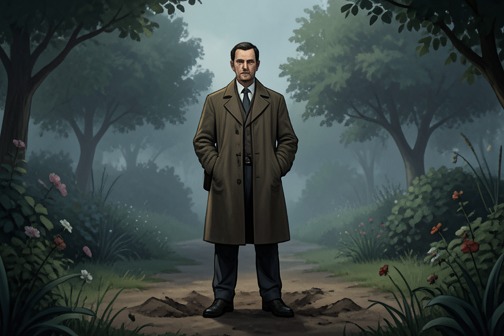
[Naoko’s suicide](entity:event-recall-event-8758433d2a8d) is the loss that deepens [Toru Watanabe](entity:character-recall-character-toru-watanabe-5b85a10074ad)’s grief into prolonged withdrawal and wandering, while exposing the limits of the philosophy he formed after [Kizuki’s death](entity:event-recall-event-kizuki-5b5835777ade). The novel does not provide a motive; instead, it follows the discovery of her absence, the search through the sanatorium grounds, and the ways her death continues to occupy the living.
## Background and the Unanswered Question
[Naoko](entity:character-recall-character-naoko-c31d25fb4a36)’s death echoes [Kizuki](entity:character-recall-character-kizuki-1cc5bfd6aa96)’s: both died by suicide at seventeen, without leaving a note or giving an apparent warning. Earlier, [Watanabe](entity:character-recall-character-watanabe-aa7b56f3da37) had been unable to find a reason for Kizuki’s death, and he carried the fact that he was the last person to see his friend before being questioned by police. The repetition does not solve either death. It establishes a pattern of loss whose circumstances can be recounted, but whose cause remains beyond the survivors’ knowledge.
Naoko herself had described her sister’s suicide in the same terms. Her sister, also seventeen, had given no indication of what she intended and left no note. Naoko recalled that people offered explanations about her sister’s intelligence and reading, but those explanations did not settle the mystery for her. The parallel among Kizuki, Naoko’s sister, and Naoko makes the absence of an explanation part of the event’s significance, without establishing a shared motive or a definite cause.
## Discovery at the Sanatorium
The account of Naoko’s final night reaches Watanabe through [Reiko](entity:character-recall-character-reiko-50478f17e09b)’s later recollection. Naoko had asked Reiko to hold her, and Reiko stayed with her until she settled and appeared to be asleep. In the morning, Naoko was gone. Her nightdress remained, but she had taken her clothes, trainers, and a torch kept by Watanabe’s pillow. Reiko understood from the torch that Naoko had left in darkness.
A note on Naoko’s desk asked that her clothes be given to Reiko. The residents searched the dormitories and surrounding woods, taking different paths; the search lasted five hours. Reiko then disclosed that Naoko had brought a rope. An ambulance took Naoko away, and police questioned Reiko. Because a note was present and the circumstances were treated as clear, the questioning was formal rather than an inquiry into an unknown outcome. Reiko telegraphed Watanabe as soon as the police had left.
## Funeral and Immediate Aftermath
Watanabe describes Naoko’s funeral in [Kobe](entity:location-recall-location-36b6d53677ce) as quiet and deeply painful. He believed her family was troubled that he knew she had died and suspected they did not want the suicide made public. His sense that he perhaps should not have attended intensified his distress. After returning, he went back on the road rather than resuming his life in [Tokyo](entity:location-recall-location-2ef35aba743c).
Reiko later wrote to him several times, insisting that Naoko’s death was not his fault and was nobody’s fault. Watanabe did not answer. He could not see what a reply might accomplish: Naoko was gone, and reassurance could not restore her. The silence leaves Reiko’s attempt at consolation unanswered, showing how even compassionate contact fails to bridge the distance created by the death.
## Watanabe’s Grief and the Limits of Philosophy
During his travels, Watanabe moved along the coast, sleeping on the sand, making fires from driftwood, and listening to the waves while thinking about Naoko. He could not absorb that she was dead. Memories returned with such force that, in his imagination, he entered a place where Naoko remained present and death was one element of life rather than a final boundary. Those moments of imagined closeness brought temporary ease, but the feeling receded; he was left alone with grief.
Kizuki’s death had led Watanabe to understand death as part of life, a realization that had once seemed to give shape to his experience. Naoko’s death does not simply disprove that thought; it shows that recognizing death’s place in life cannot make bereavement bearable. Watanabe concludes that no truth, sincerity, strength, or kindness can cure the sorrow of losing a loved one. Grief must be lived through, and what is learned from one loss offers no protection against the next.
## Withdrawal and Continuing Significance
After returning to Tokyo, Watanabe shut himself in his room for days. His attention remained with the dead rather than the living, and he spent much of his time in rooms he had set aside for Naoko, kept shuttered with the furniture covered and the windowsills dusty. Inwardly, he addressed Kizuki and imagined surrendering Naoko to him, as though the two deaths had drawn them together beyond the world of the living. This imagined exchange expresses Watanabe’s inability to reconcile his attachment to Naoko with her absence; it is not a resolution of his grief.
The event’s consequences therefore extend well beyond the discovery and funeral. Naoko’s death renews Watanabe’s earlier bereavement, interrupts his capacity to rejoin everyday life, and leaves his relationships with the dead more immediate than his connection to the living. The narrative gives no final explanation that would make the loss comprehensible. Its emphasis falls instead on the difference between accepting that death belongs to life and finding any consolation in that knowledge.
## Narrative Frame
Naoko’s final departure is presented retrospectively within Watanabe’s first-person account, through what Reiko tells him after leaving the sanatorium. The search, note, and police questioning are thus relayed as remembered testimony rather than shown directly as an uninterrupted scene. This framing places the reader alongside Watanabe in learning what happened, while preserving the same central uncertainty: the details of Naoko’s disappearance and death are known, but her motive is not.
Event 27
Watanabe’s wanderings after Naoko’s death

[Watanabe’s wanderings after Naoko’s death](entity:event-recall-event-c65d9cfb0a2b) are a month-long flight from ordinary life that fails to soften his loss. He leaves [Tokyo](entity:location-recall-location-2ef35aba743c) after [Naoko](entity:character-recall-character-naoko-c31d25fb4a36)’s funeral, moves west without a destination, and eventually returns on [2 October 1970](entity:time-recall-time-1970-10-2-0c554661448b). The journey’s defining contradiction is that physical distance cannot loosen his bond with the dead: memory keeps bringing Naoko close, while grief makes contact with the living difficult.
## Departure and aimless movement
At the end of August, a quiet funeral for Naoko is held in [Kobe](entity:location-recall-location-36b6d53677ce). [Watanabe](entity:character-recall-character-watanabe-aa7b56f3da37) returns to Tokyo, tells his landlord he will be away and his employer at the Italian restaurant that he will not come to work, and sends [Midori](entity:character-recall-character-midori-56b44e3d547f) a short note asking her to wait because he cannot yet explain himself. After spending three days in cinemas, he packs a rucksack, withdraws his savings, goes to [Shinjuku](entity:location-recall-location-3dcaa645c9c5) Station, and takes the first express train out of town. The sequence carries him from a private farewell into a deliberately unstructured departure: he leaves obligations behind, but does not know what he is going toward.
His recollection of the route is fractured. He remembers sights, sounds, and smells, but not the towns’ names or the order in which he passed through them. Trains, buses, and lifts in lorries take him from place to place; he sleeps in empty car parks, stations, parks, riverbanks, and on the seashore. Once he persuades people to let him sleep in a local police station, and another time he beds down beside a graveyard. He wants a place where he can stay inside his sleeping bag as long as he likes, out of other people’s way. The changing locations matter less than the repeated act of moving on.
The road is sustained by improvised work and bare necessities. When his money runs low, Watanabe works as a labourer for a few days, then continues once he has enough to travel. He sleeps in his bag, sometimes drinks cheap whisky before falling asleep, and accepts the difference between towns where people offer food and mosquito coils and those where residents call the police to chase him from parks. Neither welcome nor rejection alters his purpose: he wants to fall asleep in places he does not know. His wandering is not a tour or a search with a clear destination, but a suspension of ordinary attachments and plans.
## Naoko’s persistence in memory
As he travels down the coast, perhaps in Tottori or on the hidden side of Hyogo, the landscape gives Watanabe a temporary routine rather than relief. Walking beside the sea is easy; he finds sand to sleep on, makes fires from driftwood, roasts dried fish bought from a local fisherman, drinks whisky, and listens to the waves while thinking of Naoko. The simple repetition of fire, food, drink, and surf sets the bodily rhythm of the journey against the fact he cannot absorb: Naoko is dead and no longer part of the world.
At night, memories arrive not as a controlled act of remembrance but as a flood. Watanabe recalls Naoko in her yellow raincape cleaning the aviary with a feed bag, the birthday cake that caved in and her tears soaking his shirt, her camel-hair coat on a winter walk, the hairslide she touched, her clear eyes, and her blue nightdress as she sat with her knees drawn up on a sofa. The specificity of these scenes makes absence more palpable: the memories preserve gestures and appearances, but cannot restore Naoko’s living body.
In the inward place created by these memories, Naoko seems present. Watanabe imagines speaking to and holding her, and experiences death there not as the force that ends life but as one of the elements within it. In that imagined encounter, Naoko tells him, "Don't worry, it's only death. Don't let it bother you." Her familiar gestures soothe him, and for a moment he feels no sadness. But this reprieve depends on the memory-world in which she can still answer him; when it recedes, he is left alone on the beach, overcome by darkness and tears. The return of grief reveals the limit of consolation: vivid remembrance sustains a bond, yet cannot undo the loss.
## Grief, other people, and the limits of consolation
The journey sharpens a distinction Watanabe had formed after [Kizuki’s death](entity:event-recall-event-kizuki-5b5835777ade): death exists not as life’s opposite but as part of life. Naoko’s death teaches him a different, harder lesson. No truth, sincerity, strength, or kindness can cure the sadness of losing someone loved. Grief must be lived through to its end, but what is learned from one loss offers no protection against the next. The thought accompanies him as he walks farther west with sand in his hair and a knapsack on his back, surviving on whisky, bread, and water. The philosophy does not resolve his mourning; it names what mourning cannot be made to surrender.
One windy evening beside an abandoned hulk, a young fisherman finds Watanabe weeping in his sleeping bag and offers him a cigarette. Watanabe has not smoked for more than a year. When asked why he is crying, he almost reflexively says that his mother has died and that he is on the road because he cannot bear the sadness. The fisherman offers sympathy, brings sake and two glasses, and tells him about losing his own mother at sixteen, after she wore herself out working despite her poor health. Watanabe can barely listen. His private anguish makes another person’s account seem intolerably remote, and his unspoken rage at the comparison shows how grief has narrowed his capacity to meet another person’s sorrow.
After the fisherman leaves, Watanabe thinks of an old girlfriend from his last year of school and recognizes that he had taken her sweetness for granted, scarcely considering her feelings or the pain he caused. This recollection turns his attention, however briefly, from what has been done to him toward harm he may have done to someone else. Then nausea, a headache, and guilt over lying to the fisherman and taking his money converge. He decides that he cannot continue this way forever and walks to a railway station to find a route home. His departure from the road follows not a cure but an encounter with the costs of remaining shut inside his own grief.
## Return without recovery
At the ticket office, Watanabe learns that he can reach [Osaka](entity:location-recall-location-e97c45ac2ea1) by morning by changing night trains, then take the bullet train to Tokyo. He buys his ticket with the 5,000-yen note the fisherman gave him and checks a newspaper while waiting: it is 2 October 1970, and he has been travelling for a full month. He understands that he has to return to the real world. The date gives a precise endpoint to a journey whose towns and sequence he cannot recall, but the passage of time has not made its central loss more bearable.
The month away neither lifts Watanabe’s spirits nor softens the blow of Naoko’s death. Back in Tokyo, he cannot bring himself to telephone Midori. He cannot tell her that it is all over and that they can be happy together; Naoko is dead, while Midori remains alive, and that difference makes an easy transition into a new relationship feel impossible. Instead, he shuts himself in his room for days, overcome by a sense of defilement, his attention still fixed on the dead rather than the living. The journey ends geographically, but not in restored participation in ordinary life.
The rooms he had set aside for Naoko remain shuttered, their furniture draped in white and their windowsills dusty. Watanabe spends much of each day in them, thinking of [Kizuki](entity:character-recall-character-kizuki-1cc5bfd6aa96) and imagining that he has finally given Naoko back to him: she had been Kizuki’s to begin with, Watanabe reflects, and in the imperfect world of the living he had tried to establish a new life for the two of them. He now feels that Kizuki drew part of him into the world of the dead and that Naoko has drawn another part there. This ending gives the wanderings their full measure: they take Watanabe away from Tokyo, but do not free him from the dead or return him ready to join the living. The trip records a passage through grief, not its completion.
Event 28
Reiko leaves the sanatorium and travels to Tokyo
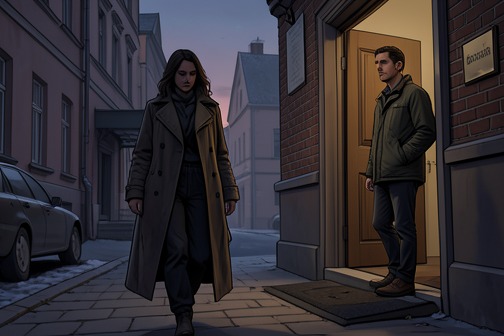
[Reiko leaves the sanatorium and travels to Tokyo](entity:event-recall-event-40ba83c114db) at a moment when grief has divided the living from the dead. After [Naoko](entity:character-recall-character-naoko-c31d25fb4a36)’s death, [Reiko](entity:character-recall-character-reiko-50478f17e09b)’s arrival gives her and [Toru Watanabe](entity:character-recall-character-toru-watanabe-5b85a10074ad) a chance to speak face to face, but it is no simple return to ordinary life: she has spent eight years in the sanatorium, has lost the companion who made it a home, and is frightened by the freedom she is choosing. Their meeting joins a farewell to the institution with a tentative movement toward what comes next.
## The decision to leave
On the fourth day after [Watanabe](entity:character-recall-character-watanabe-aa7b56f3da37) returns to [Tokyo](entity:location-recall-location-2ef35aba743c), a special-delivery letter from Reiko asks him to call her. She has been unable to reach him for weeks and says she will be waiting by the telephone at nine in the morning and nine at night. Their call leads to the news that she intends to leave the sanatorium and visit him. Her reason is immediate and personal: coming to Tokyo is the way she can see Watanabe, and she believes it is time to leave after eight years there. She jokes that if the institution keeps her longer, she will start to rot, but beneath the joke is the scale of the transition. The place has been her home for years; departure is not merely a change of address but a step out of the life and routines that have held her.
The journey is arranged with precision. Reiko tells Watanabe she will arrive on the 3:20 bullet train two days later and asks him to meet her at Tokyo Station. Her question about whether he still remembers what she looks like, or has lost interest now that Naoko is dead, brings the new absence directly into the practical arrangements. Watanabe answers that he will be there. The appointment makes their reunion possible, but its terms are shaped by Naoko’s death: Reiko is coming because she cannot remain at the sanatorium without her, and because she wants to speak with Watanabe, who also knew and lost her.
## A recognizable arrival
At Tokyo Station, Watanabe finds Reiko easily in the crowd. Her appearance is distinctive and specific: a man’s tweed jacket, white trousers, red trainers, very short hair with its familiar tufts, a brown leather suitcase in one hand and a black guitar case in the other. She greets him with a broad, wrinkled smile; he grins back, takes her suitcase, and walks beside her toward a train for the western suburbs. These details give the departure a material shape. Reiko has left the sanatorium carrying both the necessities of travel and her guitar, while Watanabe meets her not as an abstract figure from Naoko’s letters but as a familiar person returned to his presence.
Their first exchange also registers what has happened to Watanabe during his absence. Reiko teases him about the terrible look on his face, and he explains that he has been travelling and eating badly. The joke makes room for recognition without pretending that he has recovered. His journey and her arrival meet at the station, but they have not made his grief disappear. Their reunion offers company and conversation, not a cure.
## Fear after the refuge
The emotional difficulty of leaving emerges plainly in Reiko’s confession that she is scared—so scared she feels she could go crazy—and does not know what she is supposed to do, flung out by herself. The fear is not resolved simply because she has made the journey. Watanabe takes her hand and tells her that her own strength has brought her this far. His gesture and reassurance acknowledge both her vulnerability and the effort already involved in reaching this threshold.
Reiko explains that she had to come to Tokyo because she could not bear to remain at the sanatorium without Naoko; if nothing had happened, she might have spent the rest of her life there. This retrospectively clarifies the departure’s cause. The sanatorium had offered a quiet, nature-filled community organized around convalescence and mutual accommodation, but its boundaries mattered: when Naoko’s condition worsened, Reiko and the others concluded that she needed intensive treatment in a specialized hospital. Reiko’s life there had also blurred the categories of patient and staff. She had lived there seven years when she introduced herself as a music teacher who helped in the office, and explained that the residents entered and left voluntarily. By the time she leaves, she says she has been there eight years. The institution was neither an ordinary hospital nor a permanent answer; it provided a particular form of shared life, and Reiko now has to find her way beyond it.
## A destination beyond Tokyo
When Watanabe asks what she plans to do, Reiko says she is going to [Asahikawa](entity:location-recall-location-60de83264010), far north in [Hokkaido](entity:location-recall-location-39a138d5986a). An old college friend who runs a music school has been asking her for two or three years to help there. Reiko admits she had resisted because she thought it would be too cold; now that she has her freedom back, the prospect still does not excite her, and she calls the town a hole in the ground. Her hesitation keeps the future uncertain: leaving the sanatorium has not instantly turned into confidence or enthusiasm.
Watanabe answers that he has been to Asahikawa and that it is not a bad little town, with an atmosphere of its own. Reiko asks if he is sure. The exchange is modest, but its direction matters. She has come to Tokyo to see Watanabe, not to settle there; her next stated plan takes her toward work at a music school and a friend who has been waiting for her. The scene therefore closes not with a grand resolution but with a destination, a practical possibility, and the continuing fear of beginning again.
## Grief, memory, and renewed movement
Reiko’s journey crosses the aftermath of Watanabe’s own attempt to comprehend Naoko’s death. During his travels along the coast, he had struggled to believe that she was gone, carrying vivid memories of her as if she were still beside him. At times, memory created a place where Naoko lived with death inside her; when that inward refuge receded, he was left alone with sadness. He concludes that no truth, sincerity, strength, or kindness can cure the sorrow of losing someone loved: grief must be lived through, and what is learned from one loss cannot protect anyone from the next.
That understanding gives Reiko’s arrival its particular weight. She too has lost Naoko, and she says directly that the loss made it impossible for her to stay where they had lived together. Watanabe, meanwhile, has returned to Tokyo and shut himself away, his memory fixed on the dead rather than the living. Reiko’s letter and visit interrupt that isolation without erasing it. The movement is small but consequential: a call is answered, a train is met, a hand is taken, and a future route is named. In a novel where death remains woven into the lives of those who survive, this departure and reunion do not solve grief; they create a fragile occasion for the living to move again.
Event 29
Watanabe and Reiko’s private funeral for Naoko
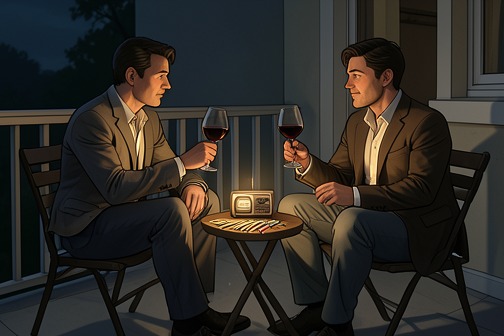
[Watanabe and Reiko’s private funeral for Naoko](entity:event-recall-event-cab90c4a6ba5) is an improvised memorial in which music, drink, and a counted row of matches transform mourning into a shared ritual. Held after [Naoko](entity:character-recall-character-naoko-c31d25fb4a36)’s death, it gives [Watanabe](entity:character-recall-character-watanabe-aa7b56f3da37) a vivid alternative to the funeral he found unbearably sad: [Reiko](entity:character-recall-character-reiko-50478f17e09b) asks him to remember their ceremony instead, and the two mark Naoko’s life through songs she loved and songs that speak to the sadness of living.
## Circumstances and Purpose
After walking with Reiko to the local public baths, Watanabe returns with her to the house, refreshed, and they sit drinking wine on the veranda. Reiko proposes that they hold a funeral for Naoko themselves, just the two of them, and specifies that it should not be so sad as the funeral Watanabe has already witnessed. The proposal is not a denial of death or an attempt to replace the earlier ceremony with a formal one. It makes room for a different kind of remembrance, shaped by the two people who knew Naoko through their lives together.
Reiko’s suggestion answers Watanabe’s difficulty in accepting the funeral he has seen. He says that he is not prepared to follow through on what she is telling him because it had been such a sad little funeral, and that no one should have to die like that. Reiko strokes his head and reminds him that everyone will die like that sometime. Their private rite follows this exchange: rather than argue away the sadness, it gives the two survivors a way to sit with death and remember Naoko together.
## The Ceremony and Its Music
Reiko asks Watanabe for another glass, fills it to the brim, and sets it on the garden’s stone lantern. Sitting against a veranda pillar with her guitar and a cigarette, she asks for the largest box of matches he can find. The procedure is simple and deliberate: Watanabe is to lay down one match each time she plays a song. The accumulating line turns the length of the memorial into something visible, measured one performance at a time.
Reiko begins with Henry Mancini’s “[Dear Heart](entity:expression-recall-expression-dear-heart-3b4bba1be523),” a song Watanabe had given Naoko for Christmas the year before last. He confirms that Naoko liked it. Reiko says she likes it too, calling it sweet and beautiful, and plays a few bars again. The choice makes the memorial personal rather than generic: a piece associated with Naoko’s pleasure becomes part of the ceremony, shared by the two people who remember her.
She then plays Beatles songs including “[Norwegian Wood](entity:expression-recall-expression-norwegian-wood-fea1a49a7118),” “Yesterday,” “Michelle,” and “Something,” sings and plays “Here Comes the Sun,” and follows it with “The Fool on the Hill.” Watanabe lays seven matches in a row. Reiko reflects that the Beatles understood something about the sadness of life and gentleness. The sequence connects Naoko’s remembrance to a wider repertoire of songs without losing its intimate focus: each piece is played and counted by the two people gathered in her memory.
After a short pause, Reiko continues through “Penny Lane,” “Blackbird,” “Julia,” “When I’m 64,” “Nowhere Man,” “And I Love Her,” and “Hey Jude.” She later moves among bossa novas, songs by Rogers and Hart, Gershwin, Bob Dylan, Ray Charles, Carole King, The Beach Boys, and Stevie Wonder, as well as Kyu Sakamoto’s “Sukiyaki Song,” “Blue Velvet,” and “Green Fields.” Sometimes she closes her eyes, nods, or hums. The memorial unfolds through a succession of familiar melodies rather than speeches: Reiko plays, Watanabe listens and counts, and the evening gathers duration through the music.
## Counting and Remembrance
When the wine runs out, Watanabe pours it from the garden glass over the stone lantern and replaces it with whisky. Reiko asks how many songs they have reached; Watanabe answers that the count is forty-eight. Reiko plays “Eleanor Rigby” as number forty-nine and performs “Norwegian Wood” again as number fifty. After resting and drinking whisky, she says that may be enough. The repeated song gives the ceremony a return rather than a straight line: “Norwegian Wood,” heard earlier in the Beatles sequence, comes back at the threshold of its ending.
Reiko looks Watanabe in the eye and asks him to forget the sad little funeral he saw and remember this marvelous one instead. Her request defines the ceremony’s purpose. It does not claim that one memorial cancels the other or that music can resolve grief; it asks Watanabe to retain this evening as another, more sustaining memory of Naoko. He nods, accepting Reiko’s invitation to remember the shared rite alongside the earlier funeral.
For one more piece, Reiko plays her favorite Bach fugue, bringing the count to fifty-one. When she finishes, she asks Watanabe whether he would like to have sex with her. He says he had been thinking the same thing. They go inside, draw the curtains, and seek each other’s bodies in the dark. The sexual encounter follows the memorial’s intimate, private character, but it is distinct from the songs themselves: the scene moves from shared remembrance toward a physical encounter between the two living participants.
## Significance
The funeral’s central contrast is between public, conventional mourning and a private ceremony made from remembered attachments. Its objects are modest and specific: a full glass on a stone lantern, a guitar, cigarettes, wine replaced by whisky, a large box of matches, and a row that reaches fifty-one. These details make the ritual countable without making grief manageable. The matches register the passage of the songs; the songs, in turn, keep the ceremony anchored in Naoko’s tastes and in the survivors’ memories of her.
The event also answers the novel’s continuing tension between death as part of life and sorrow that cannot be reasoned away. Watanabe has understood death as something inseparable from living, yet Naoko’s death leaves him unable to absorb her absence. Reiko does not offer a comforting explanation or declare the loss overcome. Instead, she creates a shared act of remembrance and asks him to carry it forward. The private funeral’s significance lies in this limited but consequential gesture: it does not end mourning, but gives the living a memory of Naoko that they have made together.
Event 30
渡边给绿子的最后一通电话
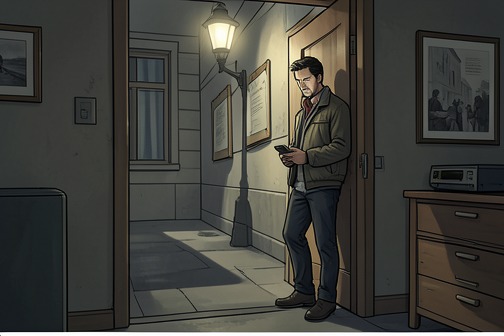
[Watanabe’s final call to Midori](entity:action-recall-action-watanabe-s-final-call-1f7dc373f691) is an attempted return to the living after [Naoko](entity:character-recall-character-naoko-c31d25fb4a36)’s death, but it ends not with reunion or reassurance: [Midori](entity:character-recall-character-midori-56b44e3d547f) asks where he is, and he cannot answer. The telephone conversation gathers the novel’s central tension between remembering the dead and choosing life into one unresolved image—a man calling out from a place he cannot name.
## Background: Grief and Withdrawal
After Naoko’s death, [Watanabe](entity:character-recall-character-watanabe-aa7b56f3da37) travels west along the coast, as far from [Tokyo](entity:location-recall-location-2ef35aba743c) as he can get. He sleeps on the sand, makes fires from driftwood, roasts fish bought from a local fisherman, and drinks whisky while thinking about Naoko. Her death remains almost impossible for him to absorb; memories of her return with such force that he feels she is still beside him, even as he knows that her body no longer exists in the world.
These memories do not offer a stable refuge. Watanabe imagines a place in which he can speak with Naoko and hold her, where death is one element of life rather than its decisive opposite. But the imagined closeness gives way: the tide withdraws, leaving him alone and overwhelmed by sadness. He understands that the philosophy he had formed after [Kizuki’s death](entity:event-recall-event-kizuki-5b5835777ade)—that death exists as part of life—cannot cure the sorrow of losing someone he loves. No truth, sincerity, strength, or kindness can remove it; grief has to be lived through, and what he learns cannot protect him from the next loss.
When Watanabe returns to Tokyo, he is still unable to turn toward the living. He shuts himself in his room for days, his memory fixed on the dead. In his imagination, the rooms reserved for Naoko are shuttered, their furniture covered in white and their windowsills dusty. He thinks of [Kizuki](entity:character-recall-character-kizuki-1cc5bfd6aa96) and speaks inwardly of giving Naoko back to him, as though the dead still claim a part of the living. This withdrawal is the immediate emotional background to the call: Watanabe’s words to Midori express a desire to begin again, but they come from someone who has not yet found his way back to the present.
## The Call and Its Appeal
Before the telephone conversation, Watanabe and [Reiko](entity:character-recall-character-reiko-50478f17e09b) part at a station. He tells her he will remember her and Naoko wherever he goes, and, seeing Reiko cry, kisses her. The kiss is framed by a recognition of their shared condition: they are alive, and must continue living. Reiko’s farewell turns that recognition into an appeal, urging him to be happy and to combine her share and Naoko’s with his own. Her counsel does not erase either woman’s place in his life; it asks him to carry their presence forward by living.
Watanabe then phones Midori. He says he has a million things to talk about and wants to see her; more decisively, he tells her that all he wants in the world is her and that he wants them to begin everything from the beginning. His language makes the call both a confession and a proposal to resume their relationship. It also sets the living Midori against the dead Naoko without treating the two as interchangeable: Naoko remains the focus of his mourning, while Midori is the person to whom he now tries to reach out.
## Midori’s Question and the Unresolved Ending
Midori does not answer at once. Her long silence is described through an image of misty rain falling on newly mown lawns. Watanabe presses his forehead against the glass and shuts his eyes as he waits. The pause stretches the call beyond a simple exchange of confession and reply: after his urgent declaration, he has no control over whether or how Midori will respond.
At last, Midori asks, “Where are you now?” The question has an immediate physical meaning, but Watanabe cannot supply even that. Still gripping the receiver, he raises his head and looks beyond the phone box. He sees countless people walking past, apparently going nowhere, and recognizes that he has no idea where he is. He calls out for Midori again and again from what he describes as the dead centre of a place that is no place. The book ends at this moment, before Midori gives any further answer and before the pair’s proposed new beginning can be confirmed.
## Significance: Choosing Life Without Resolution
The call brings Watanabe to the threshold of renewed connection, not to a completed recovery. Reiko’s parting words and his own declaration to Midori affirm that the living must go on, yet his disorientation shows that accepting this principle is not the same as knowing how to live. The novel refuses to make grief yield neatly to insight: Watanabe can recognize that he wants Midori and still be unable to locate himself in the world to which he is trying to return.
That unresolved ending also gives Midori’s question its full force. It asks for a location, but the answer exposes Watanabe’s emotional and existential displacement. His call is a real movement toward another person, while his inability to say where he is shows how much remains unsettled. The final scene holds those facts together: he is reaching for life, but the reach does not yet tell him where he stands.