Lennie's hallucination of Aunt Clara
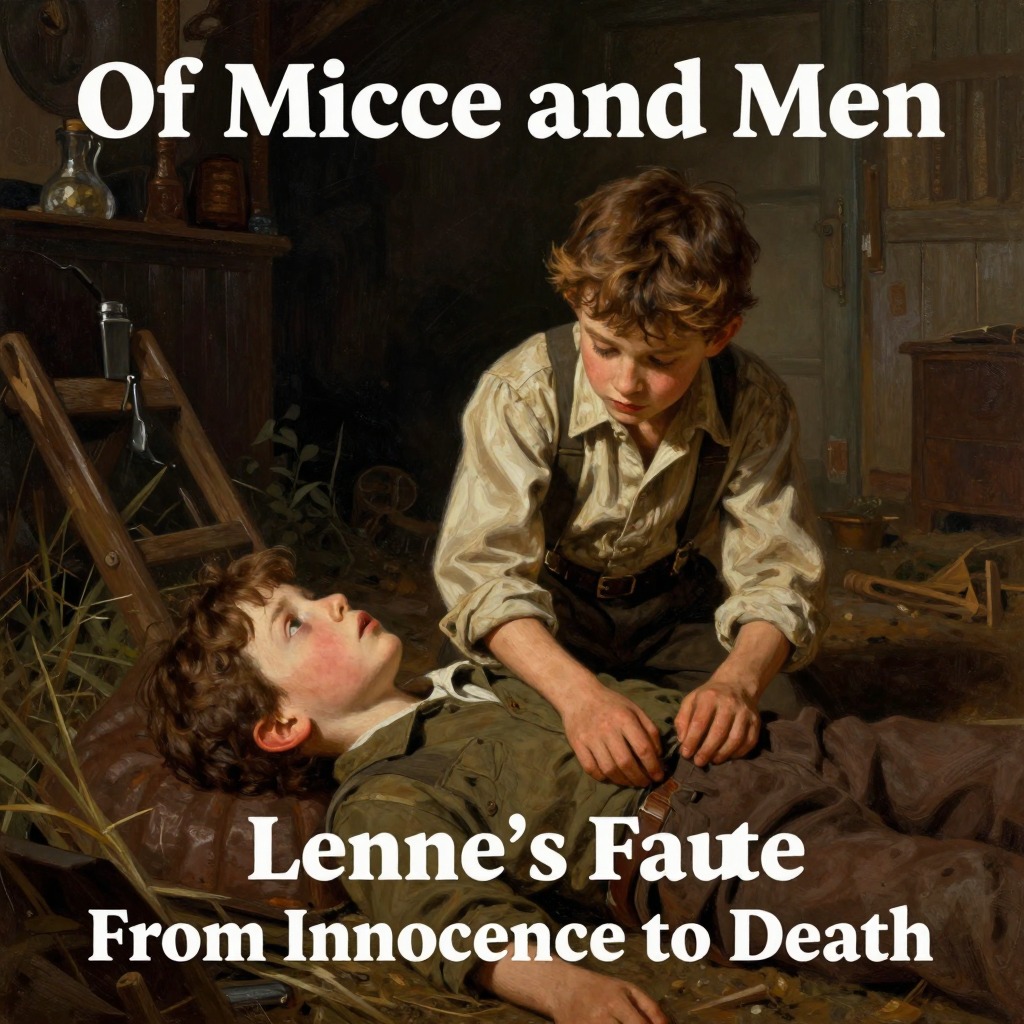
Lennie Small, alone at the Salinas River pool in the late afternoon after fleeing the ranch where he has accidentally killed Curley's wife, experiences a hallucination of his deceased Aunt Clara. The vision is not a ghostly visitation but a projection from Lennie's own mind, a manifestation of his profound guilt and terror of having failed George Milton. Speaking in Lennie's own voice, Aunt Clara materializes as a little fat old woman in thick bull's-eye glasses and a starched, clean gingham apron, standing before him with her hands on her hips, frowning disapprovingly. This internal confrontation lays bare the core emotional conflict driving Lennie's final moments: his desperate love for George and his crushing sense of his own destructive inadequacy.
The Accusation of Failure
Aunt Clara's rebuke is a catalog of Lennie's failures, delivered in the very voice he uses to speak to himself. She reminds him that she had told him to "Min' George because he's such a nice fella an' good to you," but that he never takes care and does "bad things." Lennie's response is a plea of helplessness: "I tried, Aunt Clara, ma'am. I tried and tried. I couldn' help it." The hallucination then shifts to a detailed indictment of the burden Lennie places on George. She points out that George has always given Lennie half or more than half of any pie, and all the ketchup if there was any. More painfully, she articulates the life George could have had without Lennie: he could have taken his pay and "raised hell in a whore house," played snooker in a pool room, but instead he has to take care of Lennie. This is not merely a memory of past scoldings; it is Lennie's own mind rehearsing the very arguments he fears George might use against him, the same arguments George himself has recited in their ritual complaint.
The Threat of Abandonment
The hallucination directly confronts Lennie's recurring solution to his troubles: running away. When Lennie moans that he will go off into the hills and find a cave so he won't be any more trouble to George, Aunt Clara dismisses the promise with sharp contempt. "You jus' say that," she says. "You're always sayin' that, an' you know sonofabitching well you ain't never gonna do it. You'll jus' stick around an' stew the b'Jesus outa George all the time." This accusation strips away Lennie's last defense—the fantasy of self-removal—and forces him to confront his own helpless dependency. The vision then vanishes, replaced by the even more terrifying hallucination of the giant rabbit, which directly threatens that George will leave him. The rabbit's repeated taunt—"He gonna leave you, ya crazy bastard. He gonna leave ya all alone"—drives Lennie to cover his ears and cry out for George, a cry that brings George himself out of the brush and into the clearing.
The Dream as Counterpoint
Aunt Clara's hallucination is structurally and thematically opposed to the dream of the little farm that George and Lennie share. Where the dream is a vision of future security, belonging, and the tending of rabbits, the hallucination is a vision of past failure and present guilt. The dream is a collaborative creation, spoken aloud between the two men; the hallucination is a solitary, internal torment. The dream promises a place where Lennie can be safe and useful; the hallucination insists he is a danger and a burden. The dream's climax is the promise that Lennie will get to "tend the rabbits"; the hallucination's climax is the rabbit itself, which scorns Lennie as unfit to "lick the boots of no rabbit" and predicts George will beat him with a stick. This hallucination thus serves as the psychological counterweight to the dream, the voice of Lennie's own doubt and self-loathing that the dream is meant to silence.
The Voice of the Other
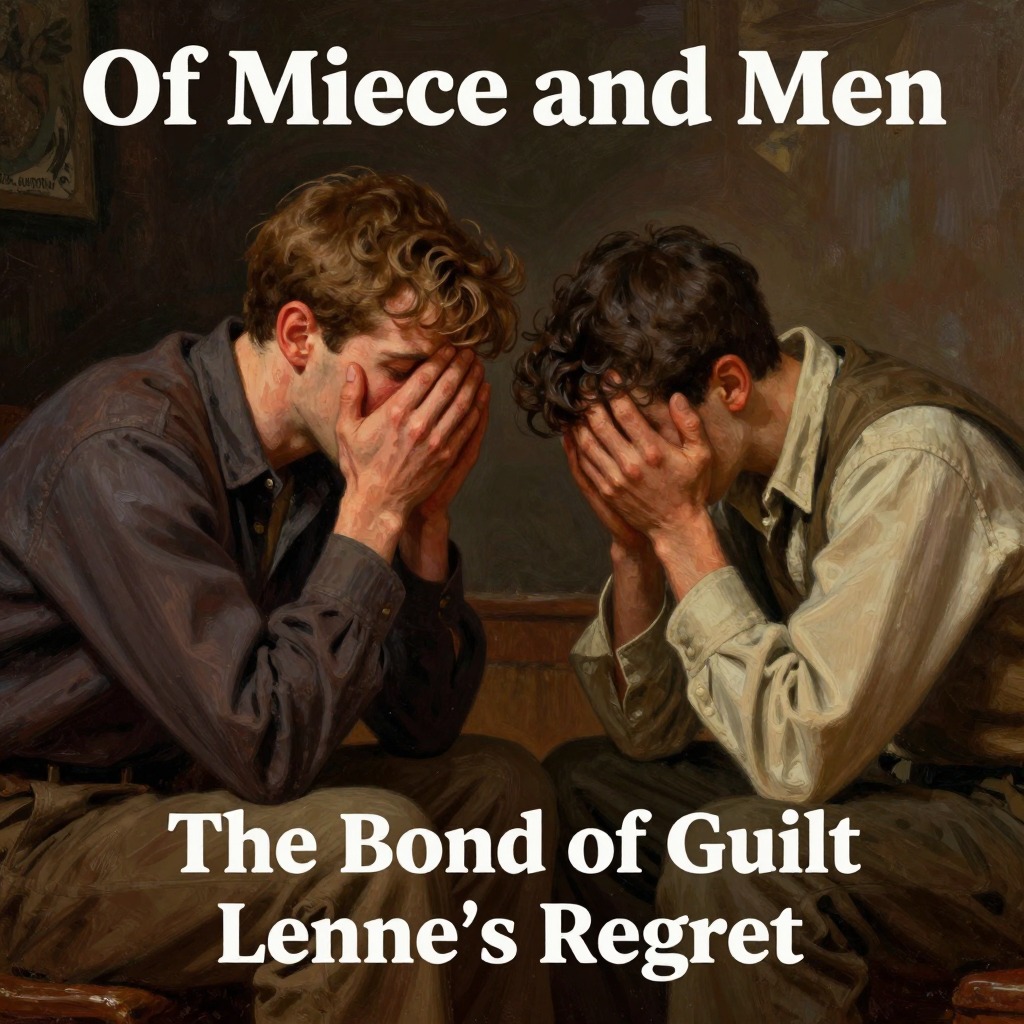
Crucially, both Aunt Clara and the rabbit speak in Lennie's own voice. This is not a supernatural visitation but a symptom of Lennie's fractured psyche. The hallucination is Lennie's own guilt and fear externalized into figures of authority—the maternal figure who raised him and the animal he most desires to care for. The fact that they speak in his voice underscores that the accusations are self-generated; no one else is present to condemn him. The hallucination is a form of internalized judgment, a mirror in which Lennie sees himself as George must see him: a hopeless, destructive burden. This self-condemnation is so powerful that it drives Lennie to the brink of despair, making George's final act of mercy—the shooting that ends Lennie's life while reciting the dream—both a release from this internal torment and a tragic fulfillment of the hallucination's prophecy of abandonment.
Thematic Significance
Lennie's hallucination of Aunt Clara is a pivotal moment in the novella's exploration of loneliness, guilt, and the impossibility of the American Dream for the dispossessed. It reveals that Lennie, despite his limited mental capacity, is fully aware of his own destructive nature and the burden he places on George. The hallucination is the story's most direct expression of Lennie's inner life, showing that his simplicity does not exempt him from the anguish of self-knowledge. It also prefigures the novella's final, devastating irony: that the only way George can protect Lennie from the world's cruelty is to become the agent of the very abandonment Lennie most fears. The hallucination, by forcing Lennie to confront his guilt, makes him a willing participant in his own death, as he turns his head toward the river and listens to George recite the dream one last time, a dream that the hallucination has already shown him he is unworthy of.