Description de l'Égypte
OrientalismDescription de l'Égypte was the monumental scholarly record of Napoleon's occupation of Egypt and, in Edward Said's analysis, a founding instrument of modern Orientalism. Produced through the machinery of a military occupation, it presented the country as an object that European experts could survey, classify, and narrate. Its importance lies not simply in the knowledge it collected, but in the way that knowledge made Egypt legible to Europe while displacing Egyptians' own historical agency and understanding of their country.
Origin and scholarly machinery
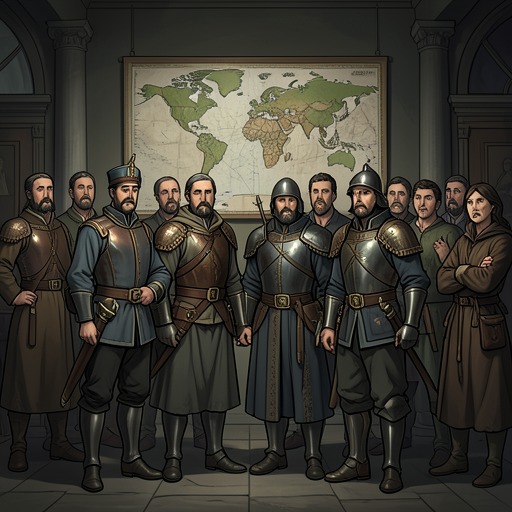
The work emerged from Napoleon's invasion of Egypt in 1798, which Said presents as a model of one culture's scientific appropriation by another, apparently stronger one. The expedition did not bring scholarship along as a neutral supplement to conquest. Its full-scale academy embodied a textual attitude: the conviction that prior books and scholarly accounts could prepare the way for an intervention, and that systematic study could render a place open to European scrutiny. Egypt was to become not merely a territory occupied by France, but a department of French learning.
The Institut, the expedition's learned division, assembled chemists, historians, biologists, archaeologists, surgeons, and antiquarians. It began meetings and experiments almost from the first moments of the occupation, undertaking what Said calls a fact-finding mission. Its task was to put Egypt into modern French through coordinated observation and record-making. The ambition was more comprehensive than the earlier 1735 Description de l'Égypte by the Abbé Le Mascrier: this would be a universal undertaking, with everything said, seen, and studied collected into a single scholarly project.
That program produced a work on an extraordinary scale: twenty-three enormous volumes, published between 1809 and 1828. The scale mattered, but Said stresses that the defining feature was the project's attitude toward its subject, not merely the size of the publication or the intelligence of its contributors. The enterprise converted the observations of an occupying expedition into a lasting body of organized authority.
Egypt as object and imperial setting
The Description's preface historique, written by the Institut's secretary Jean-Baptiste-Joseph Fourier, represents Egypt as a place of concentrated historical significance. Positioned between Africa and Asia and in communication with Europe, it is described as the center of the ancient continent, a homeland of arts and monuments. Fourier's account gathers Greek sages, Alexander, and Roman rulers into a history that culminates in the country's attraction for princes who direct the fate of nations. Egypt appears, in this framing, as a prize and pivot of world history, naturally drawing the ambitions of powers in both Europe and Asia.
Said reads this framing as a conversion of Egyptian history into a European account of Egypt. The country is valued for its memories, monuments, and strategic position, but its past is made to support the authority of the scholars and rulers who describe it. In the Description's logic, recording an event rescues it from oblivion; yet that rescue also turns Egypt into a theater for European representations. The work identifies its own record with world history, while world history functions as a euphemism for European history. Egypt's histories and meanings are thus not simply added to a neutral archive: they are displaced by a narrative whose authority comes from the occupying power's ability to describe.
The project joined scholarship to an explicit civilizing rationale. Napoleon's ambitions, as represented in the material Said discusses, included restoring Egypt from present barbarism to former classical greatness, instructing it in the modern West's ways for its own supposed benefit, and presenting European administration and knowledge as a source of prosperity. The country was assigned a supposedly natural role as Europe's appendage. Egyptians were not consulted or treated as partners in the production of this knowledge; instead, they became pretexts for a text whose usefulness was directed elsewhere. Political domination could consequently be recast as a contribution to modern learning.
Classification, display, and authority
The Description exemplifies a method that divides, deploys, schematizes, tabulates, indexes, and records. Details observed in Egypt could be turned into generalizations, and generalizations into supposedly immutable laws about an Oriental nature, temperament, mentality, custom, or type. In Said's account, this was more than the collection of facts: it was a way of making the Orient available to European categories and of treating those categories as authoritative descriptions of reality.
The same logic appears in the work's scientific uses of Egypt. Said notes that the Description could make the country confirm laws of zoological specialization associated with Buffon, or serve as a striking contrast to European habits, with representations of supposedly bizarre Oriental pleasures underscoring Western sobriety and rationality. Even Egyptian techniques of embalming could be turned toward European purposes: comparable physiological characteristics were sought in European bodies so that knights fallen in battle might be preserved as lifelike relics of Napoleon's campaign. In each instance, Egypt's observed particularities were made to serve questions and values established elsewhere.
Said connects this procedure to a broader Orientalist scholarly form. Renan's linguistic work, for example, arranged languages and hypothetical linguistic ancestors in structures comparable to the displays of comparative anatomy. A page of scholarship or a museum case, in this analogy, does not simply reproduce nature; it selects and arranges an object to exhibit the relationship between scientist and subject. The Description's ambition to record Egypt comprehensively belongs to this same transformation of living actuality into an ordered, European-readable field of knowledge.
Such arrangements could outlast the original expedition because Orientalism developed institutions for acquiring and circulating material. Learned societies, professorships, periodicals, dictionaries, and museums expanded the reach of specialized knowledge. Sacy's envisioned museum, with its objects, drawings, original books, maps, and travel accounts, would let students feel transported among the peoples they studied, while also filtering that experience through scholarly collections and classifications. The Description stands as a particularly imposing instance of the same process: the conversion of accounts gathered through travel, commissions, armies, and occupation into an impersonal system of definitions and textual representations.
Failure, legacy, and reception
Napoleon's occupation of Egypt ended in military failure, but Said argues that this defeat did not undo the intellectual projection it had set in motion. The occupation helped establish a modern experience of the Orient interpreted within a discourse whose agencies included the Institut and the Description. Egypt was represented as a region that, regenerated through enlightened administration, might radiate civilization to neighboring lands. Other European powers, especially Britain, could compete over the mission, but the premise that the Orient was an object for Western knowledge and direction persisted beyond the French campaign.
In this sense, the Description's enduring consequence was not simply the preservation of information about Egypt. It offered a reproducible model in which occupation generated observations, institutions organized them, and publication conferred the authority of modern knowledge on a representation produced under unequal political conditions. The volume of material and its scholarly organization helped make this model persuasive: a vast record could appear to be the country itself, even while Egyptians' own historical coherence and claims to interpretation were pushed aside.
The book Orientalism, which later analyzed this history, itself acquired a many-sided afterlife through translation and debate. Its Arabic translation by Kamal Abu Deeb sought to render technical concepts through the resources of classical Arabic rhetoric rather than simply Arabizing Western terminology, placing Said's critique within an Arabic intellectual tradition capable of addressing another on terms of cultural adequacy and equality. Yet Said regretted that some Arabic responses emphasized confrontation between an Arab world and a Western world, missing his intention to critique systems of domination rather than affirm antagonistic identities. This reception echoes the larger stakes of the Description: who has the authority to represent a culture, in what intellectual language, and for whose benefit that representation circulates.
Said also records that Orientalism's influence extended into Africanist and Indological studies, subaltern history, postcolonial anthropology and political science, art history, literary criticism, musicology, and feminist and minority discourses. That wider critical use does not erase the asymmetry he identifies in the Description. Rather, it makes the work's central problem newly visible: a record may be learned, detailed, and institutionally durable while still converting the people and place it describes into objects of knowledge for an external power.