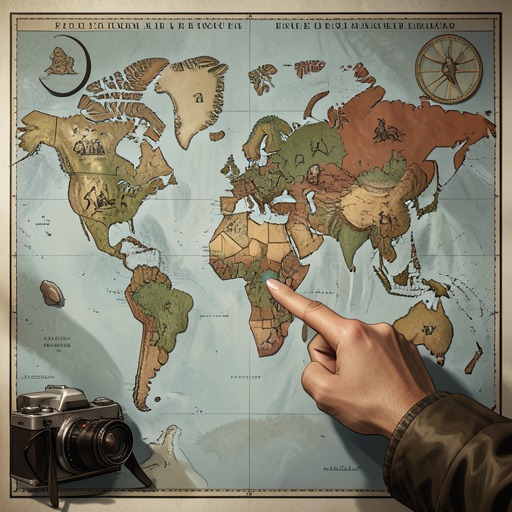
Dongfang - Xibei two opposite poles
OrientalismThe East–West binary is a historically made division that presents the Orient and the Occident as distinct, opposing realities. In Edward Said’s analysis, its decisive function is political: it turns difference into weakness and makes Western interpretation, reconstruction, and rule appear natural. The binary is not simply an inaccurate picture that can be corrected by supplying better facts. It is a durable framework of knowledge and power, reproduced across scholarship, literature, administration, and public argument, whose categories shape how people understand themselves and others. Said’s critique therefore neither defends a pure, timeless Orient nor treats the two sides as fixed essences. It asks how the opposition was built, what material inequalities made it persuasive, and how it continues to organize identity and political conflict.
The making of a dividing line
Said describes the boundary between East and West as an imaginative and geographic division that Westerners have repeatedly projected onto the world and experienced as real. It gathered together assumptions about the Orient’s inferiority and the West’s strength, alongside claims about the Orient’s characteristic nature. The division was thus more than a contrast between places: it was a way to sort societies into opposed positions and to interpret their histories through that sorting. The supposed attributes of the Orient—its eccentricity, backwardness, passivity, and need for Western attention—were not independent observations assembled without consequence. They formed part of an account in which the West appeared active and authoritative, while the East was made into an object to be known and acted upon.
This system did not depend on a single kind of author or institution. Orientalism, as Said presents it, included academic specialists and their scholarship, but also travelers, commercial enterprises, governments, military expeditions, natural historians, publishers, novel readers, and pilgrims. Across these settings, ideas about Oriental character, sensuality, and despotism circulated as familiar truths. During the nineteenth century, the word Oriental could call up a ready-made body of information that seemed as settled and neutral as a date or geographical location. The binary gained strength not merely because particular writers repeated it, but because a broad cultural apparatus made its classifications easy to recognize, reuse, and treat as knowledge.
Knowledge, power, and unequal representation
For Said, cultures and histories cannot be understood apart from the configurations of power through which they are studied and represented. The Orient was not only described as Oriental; it could be made to submit to that description. This is why the East–West division cannot be explained away as an imaginative mistake or a collection of myths. Its representations were enabled by historical inequalities that gave Western observers greater authority to name the Orient and greater power to act there. The knowledge produced under those conditions could then help make domination seem reasonable: the supposedly backward society was represented as requiring the interpretation, reconstruction, or administration of the stronger one.
Said’s example of Gustave Flaubert and Kuchuk Hanem shows how this structure operated at the scale of an encounter. Flaubert, a foreign and comparatively wealthy man, represented an Egyptian woman to his readers as typically Oriental; she did not speak for herself in his account or represent her own emotions and history. Said treats this not as an isolated literary episode, but as a revealing instance of a wider imbalance: one party acquires the power to describe, while the other is made the described object. The example makes the binary’s politics legible in intimate representation as well as in formal scholarship. The question is not simply whether a portrayal is sympathetic or accurate, but who has the authority to construct its subject and whose account is absent.
The same asymmetry appears in the scale and direction of movement between East and West. Said contrasts the numerous Western armies, consular officials, merchants, and scientific and archaeological expeditions traveling east with the much smaller movement in the other direction. Travelers from the Islamic East to Europe between 1800 and 1900 were few by comparison; those who did travel often went to learn from a culture regarded as advanced. Said also notes an estimate of roughly 60,000 books about the Near Orient written between 1800 and 1950, with no remotely comparable number of Oriental books about the West. These contrasts are not incidental statistics: they indicate who possessed the greater capacity to investigate, publish, and define the other, and whose societies were treated as objects of sustained scrutiny.
A stable structure beneath changing claims
Said distinguishes latent Orientalism from manifest Orientalism to explain how the binary could endure even when particular theories changed. Manifest Orientalism consists of stated claims about Oriental society, languages, literature, history, and related subjects. Such claims vary in form, detail, and the personal style of their authors. Latent Orientalism is the more enduring, often unexamined assumption that the Orient remains separate, eccentric, backward, passive, and available for Western attention and reconstruction. Knowledge may change at the manifest level while the deeper division remains substantially intact.
This distinction explains how writers with sharply different intellectual or political positions could nonetheless reproduce a shared framework. Said argues that writers ranging from Ernest Renan to Karl Marx, and from scholarly figures such as Edward William Lane and Silvestre de Sacy to imaginative writers such as Flaubert and Gérard de Nerval, retained the Orient’s separation from the main currents of European progress. Their differences did not necessarily unsettle the underlying premise that the Orient was a special place requiring Western attention, reconstruction, or even redemption. Orientalist discourse consequently had a durability greater than that of any one claim: it was sustained in teachable knowledge, professional institutions, and recurring forms of representation.
The binary also absorbed and reinforced wider intellectual hierarchies. In the nineteenth century, claims of Oriental backwardness and inequality aligned readily with racial classifications and theories that divided societies into advanced and backward peoples. Such classifications carried the opposition into debates about imperial rule: the distinction between advanced powers and supposedly uncivilized regions could be used to argue that annexation or occupation was justified. The division thus did not remain a descriptive convention. It could connect the language of cultural difference to the practical claims of political authority.
Reproduced in policy and public argument
In Said’s account, Orientalist knowledge shaped how European powers understood their claims over the Near East. British and French officials could disagree over policy while sharing the premise that the Orient was a geographical, cultural, political, and historical entity whose destiny they were entitled to determine. Its value was framed in European terms, and European scholarship and administration could be credited with having made it what it was. The binary therefore joined a way of seeing to a way of governing: an inherited image of the Orient offered a framework through which intervention and partition could be discussed as rational responses to the region’s supposed nature.
Said’s distinction between the Orient and Occident is not a claim that history contains two sealed, self-sufficient civilizations. He argues that identities are made through continuing interpretation, in which a community defines itself partly by constructing an opposing other. These identities remain historical and political processes, contested by individuals and institutions; they are not natural facts. Their stakes reach well beyond academic language, touching immigration law, regulation of personal conduct, the definition of orthodoxy, the legitimation of violence or insurrection, education, and foreign policy. The creation of an official enemy or an excluded group is one way that a society gives political force to the boundary between itself and others.
The opposition remained potent in later arguments that described civilizations as fundamentally separate and internally uniform. Said challenges Samuel Huntington’s claim that the end of Cold War bipolarity had given way to a clash among civilizations, including Western, Confucian, and Islamic civilizations conceived as largely self-contained units. Against this account, he emphasizes that cultures are hybrid and heterogeneous, and that their histories are interrelated through conquest, immigration, travel, and the mingling of peoples. The United States, in particular, cannot be understood as a single, uncontaminated civilization: it is a complex historical palimpsest marked by different cultures, conquests, exterminations, and political achievements. To force such histories into separate breeds or essences repeats the act of representation through which the Orient and the West are made to appear as stable kinds.
Critique without a counter-stereotype
Said rejects both the naturalness of the binary and the tempting reversal that would make the Orient wholly innocent and the West wholly culpable. His juxtaposition of Napoleon’s massive Description de l’Égypte with Abd al-Rahman al-Jabarti’s three-volume account of the French invasion makes the inequality of representation visible: the imperial project’s extensive account dwarfs the testimony of a writer describing the invasion from the side of the invaded. Yet Said does not treat these works as inert documents of an eternal conflict between East and West. Together they belong to a historical experience shaped by unequal power, and understanding that experience requires more than falling back on a simple civilizational opposition.
He similarly insists that criticizing Orientalism does not mean claiming access to a true, untouched Orient. He states that he has no such Orient to defend and does not present Islam or the Arab world as a single, stable essence. The critical task instead is to connect the struggle over territory with the struggle over social and historical meaning: both are made in human history, and representations participate in the distribution of power. For the same reason, Said regards the binary as misleading and undesirable when it is treated as a complete description of reality. Its value as an object of study lies in the history of interpretations and competing interests it records, not in its claim to divide humanity into natural, self-contained blocs.
This approach also clarifies the problem of who gets to speak. Said recognizes the pressure created when people have been denied the opportunity to represent their own experience, and he points to twentieth-century liberation movements as evidence that the subaltern can speak. But he does not understand such speech as a reason to preserve the notion of two monolithic rivals. Readers who received his book as a straightforward defense of a unified Arab or Islamic identity, he argues, risk reinstating the fixed divide his analysis questions. The East–West binary remains consequential precisely because it can be contested, reinterpreted, and renewed: resisting its power requires attending to those changing contests, rather than mistaking a historically produced boundary for the permanent shape of the world.