Shared humanity across enemy lines
OsloShared humanity across enemy lines is the play’s central ethical premise and the human basis of its political process. It begins with recognition across an armed divide, becomes a rule for how negotiators live together, and culminates in the claim that listening can change people who have entered the room as enemies. The play presents this not as the disappearance of conflict but as a way to make further conversation possible.
Recognition Across the Divide
In a scene set amid violence, Mona Juul recalls crouching behind an overturned car with Terje Rød-Larsen. They see two boys facing one another, one in uniform and one in jeans, both holding weapons. The visible differences between them remain, but Mona describes their faces as exactly the same: each carries fear and a desperate wish not to be there, confronting the other boy. The recognition does not depend on the boys sharing a side or a uniform. It comes through the likeness of their exposed human predicament.
Mona marks that sight as the beginning of something for her and Terje. The scene gives the play’s larger political idea an intimate point of origin: before there is a process, there is a moment in which opponents cease to appear wholly alien to one another. The boys are not shown resolving their conflict, and the play does not suggest that seeing their resemblance makes the danger vanish. Instead, the image establishes why recognition matters: it makes the other person’s fear legible, even while the confrontation remains real.
A Rule for Living Together
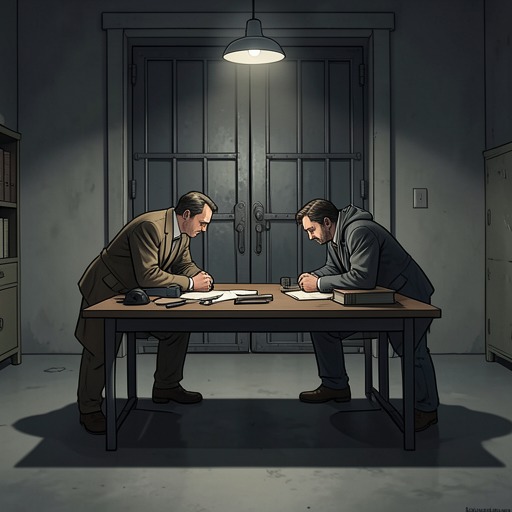
Terje Rød-Larsen turns this principle into a practical arrangement for the negotiators. He distinguishes the closed room, where participants may converse and disagree, from the space outside it, where they are to share meals, talk about their families, and light the fire. The distinction allows political disagreement to remain explicit; the rule does not require the negotiators to pretend that they agree. It asks them to sustain another kind of encounter alongside the argument.
He insists that sharing personal life is necessary to seeing one another as people. In this formulation, ordinary time together is not decorative hospitality added to negotiations. It is part of the method: people who have to contend with one another’s positions also meet one another beyond those positions. The closed door marks the place of dispute, while the shared meals and conversations create a contrasting space in which participants can be encountered through family and daily life. The rule makes mutual recognition a repeated practice rather than a single moment of insight.
Listening as Political Change
The playwright’s account of the historical Oslo meetings gives this principle its political scale. He describes members of the Israeli Government and the Palestine Liberation Organization choosing, amid continuing bloodshed and hatred, to sit across from their enemies and see them as human beings. Each side listens to the other, and that listening permanently changes both. The emphasis falls on a reciprocal act: neither side is presented as the sole listener or sole source of change.
That account also clarifies the play’s distinction between recognition and agreement. Listening matters because it alters the people engaged in the encounter, not because the evidence says that it instantly removes their opposed beliefs or settles every dispute. The play’s theatrical premise is focused on this choice to treat an enemy as human. Its force lies in the contrast between the surrounding hostility and the personal and political courage required to enter a conversation across it.
From Encounter to Possibility
Near the end, Terje Rød-Larsen names the result as a process and a model that can be used again to bring implacable enemies together and find a way forward. His closing appeal asks the audience to look back at how far the participants have come through blood, fear, and hatred, and then toward what may still be possible. The language makes progress neither automatic nor complete: the distance already traveled is evidence for continuing, not proof that the remaining distance has disappeared.
The movement from the boys’ shared fear to the negotiators’ shared life and finally to a reusable process gives the concept its structure. Recognition begins as a perception; the living rule gives it repeated form; listening makes it politically consequential. The play’s hope rests on the possibility of continuing that sequence. Shared humanity does not reconcile enemies by itself, but it permits them to meet, hear one another, and attempt a future that neither could reach alone.