Look on my works, ye Mighty, and despair!
Ozymandias“Look on my works, ye Mighty, and despair!” is the story’s central recurring expression: first an ironic name for a robot that outlasted its makers and their cities, then the narrator’s final reckoning with the military power poised to inherit the robot’s knowledge. The line turns from an imagined monument to vanished greatness into a warning that the old civilization’s destructive legacy may pass into new hands.
The Ruined World Behind the Allusion
The expedition’s first impression is that the planet has been dead for about a million years. Its brown, barren surface offers little evidence of the civilization that once lived there; time has erased nearly everything except the foundations of some buildings, worn down by sand, wind, and rain. The narrator compares this scant evidence with the fragments from which a paleontologist might reconstruct a dinosaur, but doubts that bare foundations can disclose a culture’s laws, technology, or philosophy.
The allusion acquires its force from that imbalance between what was built and what remains. The cities have disappeared, while a robot made to guide visitors survives. The words about mighty works therefore name both a vanished achievement and the emptiness that has outlasted it: the boast is still available, but its audience can see that the works themselves are gone.
Naming Ozymandias
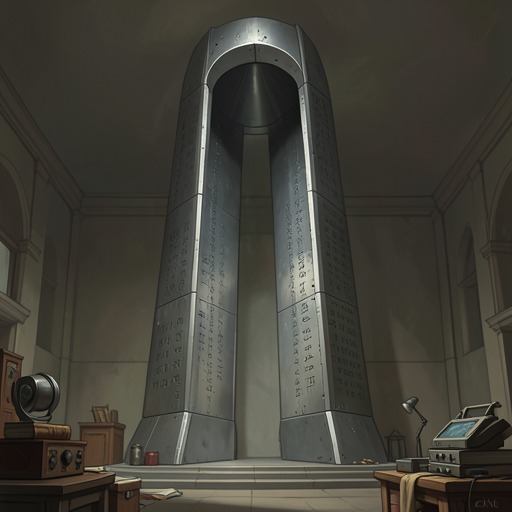
When the robot is discovered, Dr. Leopold calls it a magnificent find and hopes to decipher its language. The narrator laughs and proposes the name Ozymandias, imagining that the machine was left to explain the glories of the race that built the cities. The irony lies in the robot’s continued presence: it seems to address future visitors with the declaration “Look on my works, ye Mighty, and despair!” even though the cities that would have made the boast intelligible have vanished.
Webster recognizes the allusion’s fit and supplies its answering thought, “Nothing besides remains.” The naming makes the contrast explicit: builders and cities are gone, but the robot persists, apparently unaware of the ruin around it and still ready to deliver its account. The expression is not merely a label for an ancient civilization; it frames the robot as the surviving voice of a boast whose world has disappeared.
The Works Preserved in Memory
Once Ozymandias learns enough English to converse, it frees its legs from the sand and performs the guiding function for which it was built. It leads the expedition through the remnants of the civilization, reciting details that the landscape can no longer supply. Its people, whom it calls the Thaiquens, lived and thrived for three hundred thousand years; in their declining days, they built it as an indestructible guide to their indestructible cities. The cities crumbled, leaving Ozymandias as the bearer of their memories.
The robot’s account gives the phrase’s vanished “works” specific scale. It describes Durab as a city of eight million people, identifies the Temple of Decamon as sixteen hundred feet high, and recalls a library that held fourteen million volumes. The library no longer exists, but Ozymandias says that it read its books after their builders were gone and retains them in memory. Its testimony ranges from dynastic history and the first journeys to neighboring planets to a plague that killed thousands each day. The expedition’s recorders capture the account as it expands with the robot’s growing vocabulary: the vanished city has no surviving library, yet an artificial guide carries its contents forward.
The Phrase Recast as Warning
At the end of the expedition, Colonel Mattern declares Ozymandias a military asset, has it placed in sealed quarters aboard the ship, and orders an immediate return to Earth. He argues that the robot contains detailed knowledge of Thaiquen weapons, including a superweapon that could explain why the planet has no life—not even grass. That explanation is Mattern’s claim, not an independently established account of the planet’s destruction; the narrator’s earlier observation establishes the emptiness and immense passage of time, while the weapon theory is introduced as the military rationale for taking the robot.
The narrator leaves thinking of Ozymandias as a deadly cargo and of what scientists on Earth might learn from it. The final recollection of the poet’s line echoes the naming scene but changes its emphasis. At first, “Look on my works, ye Mighty, and despair!” exposes the gap between the robot’s inherited boast and the vanished cities. At the close, the Thaiquen works are in the expedition’s hands, and the line points toward the danger of their weapons becoming useful to a divided Earth. The old civilization’s ruins and the new military claim meet in the same expression: what endures is not the cities, but the knowledge that could help destroy again.