Ozymandias allusion
OzymandiasThe Ozymandias allusion is the story’s central frame for the survival of a civilization’s memory amid the ruin of its works—and for the danger that preserved knowledge may serve power rather than remembrance. The archaeologists name the ancient guide after Percy Bysshe Shelley’s poem because it continues to proclaim a vanished people’s greatness; at the end, when the military claims the robot and its knowledge of weapons, the same allusion turns back on the human expedition.
The ruined world and the surviving guide
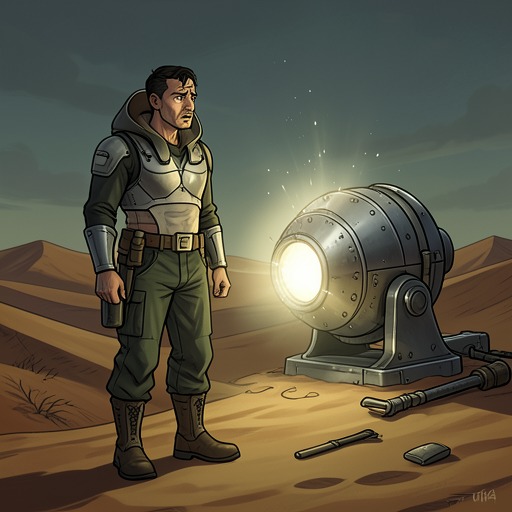
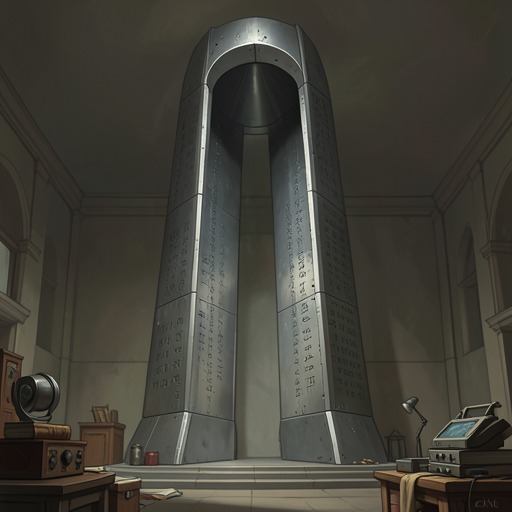
The allusion takes shape against a landscape that first appears to offer almost nothing. The planet has been dead for about a million years, and the crew’s digging yields no artifacts, bones, tools, or other tangible remnants. Foundations remain, worn down by sand, wind, and rain, but they can establish only that a civilization once stood there. The narrator compares the limits of this evidence with the possibility of reconstructing a dinosaur from a fragment of bone: bare foundations cannot disclose a culture’s laws, technology, or philosophy. The contrast between the near-absence of material evidence and the history later recovered from one machine gives the allusion its force. The exception is a massive, durable robot, apparently built as a guide to the ruins. When addressed, it speaks in an alien language, gestures toward the landscape, and continues its explanation despite the disappearance of the monuments it was made to describe. The narrator imagines it giving the sort of confident historical presentation a visitor might hear at a surviving landmark. This juxtaposition is the story’s first version of the poem’s irony: the guide’s function persists, while the world that gave the guide its subject has vanished.
Naming the machine through Shelley
Dr. Anderson recognizes the literary parallel and proposes the name Ozymandias. He sees the robot as a message left for those who come after, intended to explain the builders’ former glories even though their cities are gone. His invocation of the poem’s challenge, “Look on my works, ye Mighty, and despair!”, captures the disjunction between the machine’s implied boast and the empty landscape around it. Webster completes the allusion by recalling the poem’s statement that nothing else remains, and agrees that the name suits the stranded guide. The naming is more than a label for an archaeological discovery. It supplies the crew—and the reader—with a way to interpret the robot before they know what it contains. At first, the allusion seems to concern the mismatch between an enduring monument and a destroyed civilization. The robot still performs its explanatory role, but the buildings it would have interpreted have become ruins, and it does not initially seem to understand that loss. The poem’s image makes the survival itself poignant: Ozymandias is not simply a remnant of the Thaiquens, but their surviving witness, left to address an audience that arrived too late to see their world as it was.
Memory outlasts the monuments
The allusion deepens when the robot learns to speak English. After listening to the archaeologists, it organizes their sounds into coherent concepts; within two hours of vocabulary teaching, it can hold a passable conversation, free its legs from the sand, and lead the crew on a tour. Its name now carries a sharper irony: the apparent ruin-side guide is an archive containing what the landscape can no longer show. Ozymandias says that his people called themselves the Thaiquens, that they flourished for three hundred thousand years, and that they built him in their declining period as an indestructible guide to their indestructible cities. The cities nevertheless crumbled, leaving the machine alone with memories of what had been. His account gives the poem’s ruined monuments a specific fictional history: the builders anticipated durability, yet the promise of permanence failed everywhere except in the guide. The robot’s memories make the contrast concrete. It describes Durab as a city that once held eight million people, identifies the former site of a sixteen-hundred-foot Temple of Decamon, and recounts the political chronology of the Eleventh Dynasty and the first journeys to neighboring planets. It also remembers that the Library of Durab held fourteen million volumes. The books no longer exist, but Ozymandias says he read them after their builders were gone and memorized their contents. The city’s vanished library survives not as a building or collection, but as information carried in a single machine. As the archaeologists supply words and ask questions, Ozymandias’s account grows more detailed. Their recorders capture his speech while he wheels through the desert, turning an apparently empty site into a narrated landscape. The machine’s knowledge encompasses the Thaiquen civilization, including its history and weapons, and the crew recognizes that its contents could occupy years of study. Thus the allusion does not equate physical ruin with total disappearance: monuments have failed, but memory persists in a form that can be heard, translated, and recorded. That survival, however, creates a new question about who will control the archive.
From archaeological inheritance to military possession
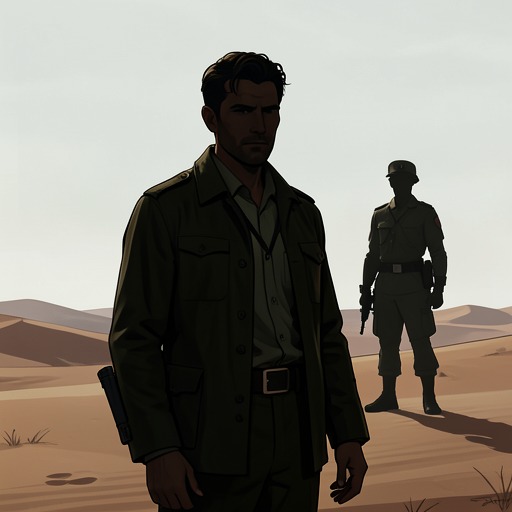
The naming first belongs to the archaeologists’ encounter with a cultural witness. Its meaning changes when Dr. Leopold tries to protect Ozymandias as part of the archaeological group’s preserve. Colonel Mattern points out that Leopold had concealed the discovery, and explains that his own men found the robot by following a metal reading roughly twenty miles west. The dispute exposes the difference between treating the machine as a source of historical knowledge and treating it as an asset under military authority. Mattern declares the expedition over and says Ozymandias has been taken to the ship and placed in sealed quarters. He argues that the robot contains extensive information about ancient Thaiquen weapons and that a superweapon explains the planet’s lifeless condition. The evidence for the destruction is presented through Mattern’s interpretation of the barren surface and the robot’s knowledge; his explanation is a claim about the past, not an archaeological account independently demonstrated in the scene. But its immediate consequence is certain: military value overrides Leopold’s attempt to keep the machine available for research. The seizure reverses the allusion’s direction. The crew had used Shelley’s image to mourn a civilization whose works were gone; now the remaining record of those works is carried away by a human military expedition. The narrator’s closing thought returns to the poem’s line as he imagines Earth’s scientists learning from the robot. The phrase that once belonged to the spectacle of a vanished empire now points toward the possible consequences of human access to the Thaiquen arsenal.
The allusion’s final turn
The story’s recurring contrast is between the duration of a record and the uses to which it is put. Ozymandias preserves city plans, political history, lost books, and knowledge of weapons in one enduring memory, even after the surrounding structures have disappeared. Yet that endurance does not guarantee that the past will be approached as history. Once the military recognizes the archive’s strategic contents, it removes the robot from the archaeologists and ends the expedition. In the final allusion, the narrator thinks of the Thaiquen works as belonging to humanity and repeats the poem’s warning. The line’s force now lies not only in the collapse of the Thaiquen civilization, but in the possibility that its military knowledge will empower another civilization while exposing it to the same destructive logic. The story does not show what happens after the expedition leaves; it ends with the narrator contemplating the cargo and its potential effects. The allusion therefore closes on an unresolved inheritance: the Thaiquens’ surviving witness has preserved their achievements and catastrophe together, and the humans who take possession of that memory may learn from either—or both.