Planet Four
OzymandiasPlanet Four is an unnamed, desolate world where a civilization’s physical traces have almost entirely disappeared, even as the surviving robot Ozymandias preserves an account of its history. Its distance from Earth and the scale of its former cities contrast with the thin evidence left in the sand; its eventual importance lies in the way that contrast makes one surviving witness both an archaeological revelation and a military prize.
Identification and Physical Conditions
The expedition knows the world as Planet Four in a system around a yellow-white F5 IV Procyonoid sun, catalogued as Revised HD 170861. It has no settled name: a commission is considering names drawn from ancient Terran mythologies, but the expedition uses the practical designation. The planet is roughly Earthlike in size, with a diameter of 6,100 miles and a gravity index of .93. Its mean temperature is 45 degrees Fahrenheit, varying by about ten degrees over the day.
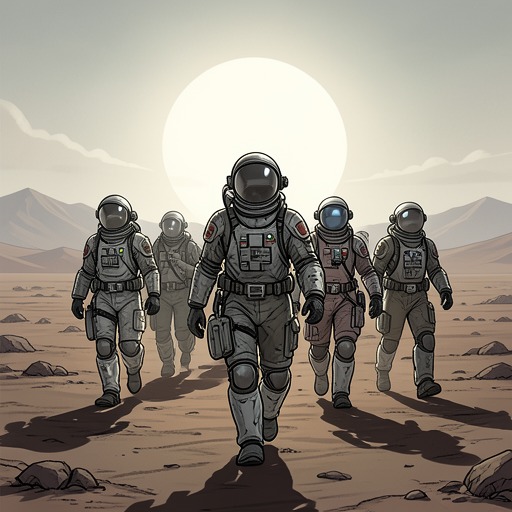
The atmosphere is thin and hostile, consisting mostly of carbon dioxide with traces of helium and nitrogen and only a very small amount of oxygen. The crew rehearses its breathing-mask drills before leaving the ship. At perihelion the planet lies 185 million miles from its fairly hot star, and its eccentric orbit carries it farther away at the other extreme. The setting therefore offers no easy access to the past: even before the archaeological failure becomes apparent, the team must work in breathing masks on a dry, inhospitable surface.
A World After Extinction
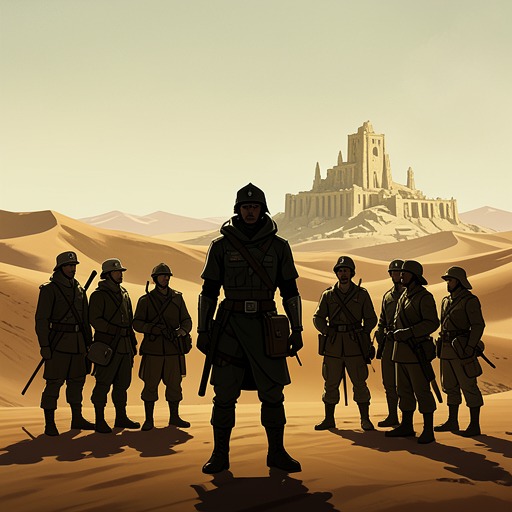
As the expedition descends through orbit, the planet’s sere brown surface suggests a dead world, and that first impression proves accurate. The narrator places the extinction roughly a million years in the past: Earth has made a million circuits of Sol since the last living being here drew breath. The landscape is compared to Mars, but with a crucial difference: this world once supported intelligent life and a flourishing civilization, while Mars has left no comparable sign.
The expedition’s first searches make that difference difficult to recover. The archaeologists find no ordinary artifacts—not a skull, tooth, spoon, knife, or baby-rattle. Some building foundations remain, worn down to stumps by a million years of sand, wind, and rain. They offer evidence that a civilization existed, but little basis for reconstructing its laws, technology, or philosophy. A further excavation half a mile away yields no tangible remnant. The ruins are not a city waiting to be uncovered so much as the last, impoverished outline of one.
The expedition has only a week for this work. The team is searching a group of worlds already passed over hastily by surveyors looking for present life; those surveyors had moved on after finding none, even though some planets had once been inhabited. Planet Four’s extreme age and nearly total erasure sharpen the risk that Earth’s archaeologists may never return to study it. The surviving foundations can establish a vanished past, but not restore it.
The Expedition and Its Competing Purposes
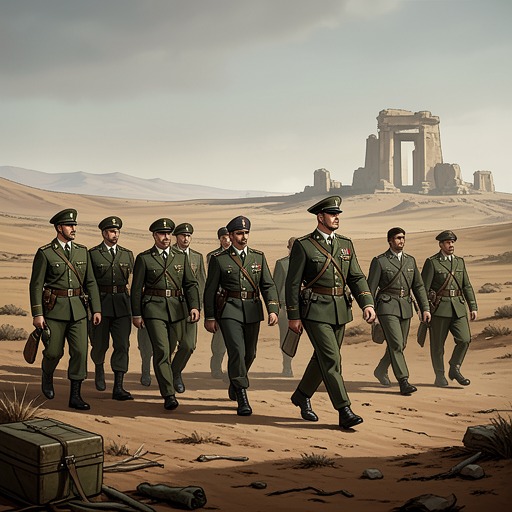
Planet Four’s archaeological investigation takes place within an expedition designed to serve two different aims. Dr. Leopold leads the nonmilitary archaeologists, charged with researching dead civilizations; Colonel Mattern and his men seek fissionable material, alien weapons, lithium, tritium, and other resources with military value. The General Staff of the Armed Forces of the United States of America supplies 70 percent of the budget and expects practical results. Archaeology has been included partly because public opinion has frowned on purely military expeditions, and the expedition charter gives the scientific team limited rights.
That division of authority shapes work on the planet from the start. Mattern urges departure because he considers the dead world useless, while Leopold invokes the charter’s limiting clause to secure time for research. The archaeologists unload cameras, picks, shovels, and brushes, and use three small halftracks to reach the ruins. Mattern’s men help get the vehicles out of the ship, but their assistance is reluctant and minimal. The archaeological team begins knowing it has one week and little chance of winning an extension unless it finds something that changes Mattern’s assessment.
The larger political setting is also present in the expedition’s priorities. Earth is divided, tension is rising, and the Other Hemisphere may resume its own movement into space after a century of quiescence. The military team fears that anything useful must be found before its rival. Planet Four is thus explored not only as a record of a past civilization but as territory in a renewed search for strategic advantage.
Ozymandias and the Recovered Past
The near-absence of artifacts makes the discovery of Ozymandias a decisive reversal. Dr. Leopold finds the object buried up to its knees in sand behind his halftrack. It resembles a robot, more than seven feet tall and vaguely humanoid, with arms, legs, and a head bearing receptor plates in the positions of human eyes, ears, and mouth. Its massive, squarish body has sloping shoulders; its dark metal skin is pitted and corroded by exposure over immense stretches of time.
Once the robot has learned to communicate, the archaeologists discover that it can function as a guide to the civilization that built it. Ozymandias listened to their speech, organized its sounds into sense, and assimilated new vocabulary. After two hours of instruction it can hold a passable conversation, frees its legs from the sand, and leads the team through the former city. The foundations that had seemed nearly mute are now joined by a witness capable of supplying what the landscape cannot.
Ozymandias identifies its people as the Thaiquens, who lived and flourished for 300,000 years. In their declining era they made the robot as an indestructible guide to their indestructible cities. Those cities have crumbled; the robot alone remains, carrying memories of the civilization. It describes Durab as a city that once held eight million people, identifies the site of the Temple of Decamon and the Street of the Winds, and recounts the Eleventh Dynasty and the Thaiquens’ first journeys to neighboring planets. It also remembers the Library of Durab, which held fourteen million volumes. The books themselves no longer exist, but Ozymandias says it read them and retains their contents. Its recollections turn a barren archaeological site into an immense, if mediated, historical record.
The Ruins as a Military Prize
Ozymandias’s historical testimony gives Planet Four a new strategic significance. Mattern announces that the robot is of military use, has been moved to the ship, and is held in sealed quarters under top-level security. Invoking emergency authority, he declares the expedition over and orders an immediate return to Earth with Ozymandias. Leopold’s discovery is acknowledged, but Mattern claims the robot for the military.
Mattern’s stated reasoning draws on the contrast between a world that has lost every sign of life and the knowledge preserved in the machine. He argues that a million years of ordinary time could not have left the planet bare even of grass, and attributes that condition to a Thaiquen superweapon. He says Ozymandias knows the details of that weapon and others, and that the information could make America impregnable. This is Mattern’s explanation of the planet’s lifelessness and the basis of his claim; the ruins themselves offer little physical evidence with which the archaeologists could independently reconstruct either the weapon or the catastrophe.
The location’s meaning consequently shifts from archaeological promise to contested custody. The expedition was fundamentally organized to find weapons and strategic materials for use against the Other Hemisphere, despite the presence of a small archaeological contingent. Once Ozymandias appears to contain military knowledge, the military’s budgetary and institutional authority outweighs the scientists’ purpose. Planet Four’s silence had seemed to make it useless; the surviving memory hidden in that silence makes it valuable, and helps bring the expedition to an abrupt end.